

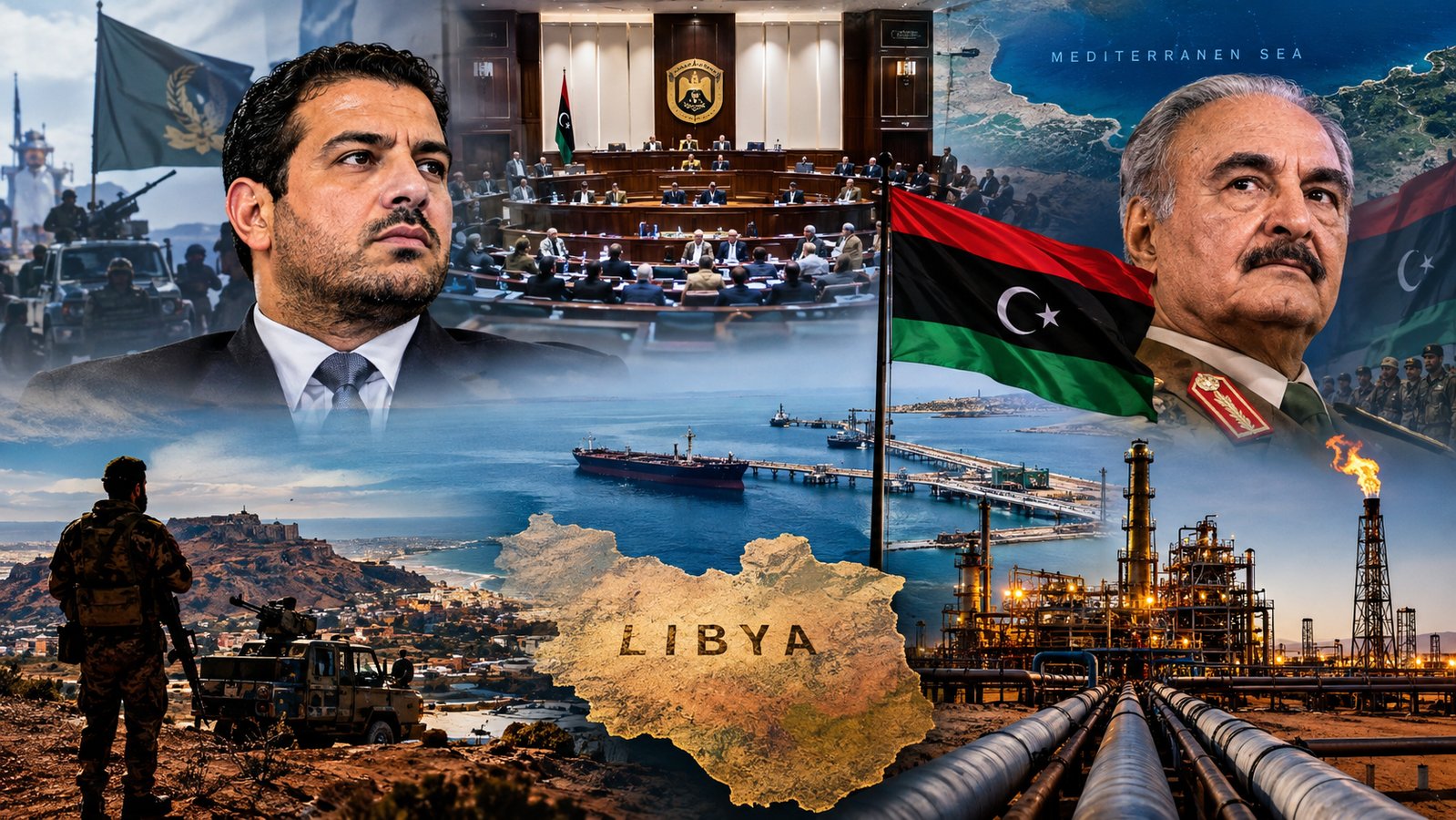
Libya’s central problem is no longer simply that the country has two political centres. It is that the institutions meant to make Libya a state are themselves becoming instruments in a struggle over power, money and succession.
That distinction matters.
For more than a decade, Libya has been described through the familiar language of division: Tripoli against Benghazi, east against west, rival governments, competing armed groups and stalled elections. But that description increasingly feels incomplete.
The more revealing question is not which government is legitimate. It is who has the practical ability to command institutions, deploy armed force, influence oil revenues and determine who gets access to Libya’s enormous economic potential.
That is why the latest confrontation inside the House of Representatives matters. It is why allegations involving Saddam Haftar deserve scrutiny beyond the immediate security concerns. And it is why the expansion of oil production, including the planned increase around the Waha and North Jalo fields, should not be viewed simply as an encouraging economic development.
Libya’s oil is becoming more valuable precisely as its political settlement remains unresolved.
The country therefore faces a paradox. The more attractive Libya becomes to international energy investors, the greater the prize for whoever can influence the institutions that control that wealth.
Parliament becomes the battlefield
On Oct. 5, Libya’s House of Representatives in Benghazi approved a proposal establishing a 12-month term for the parliament’s presidency, with 98 lawmakers voting in favour from 102 present.
The session was chaired by Second Deputy Speaker Misbah Douma in the absence of Speaker Aguila Saleh. The lawmakers said a new parliamentary leadership should be elected within seven days.
Saleh rejected the session, saying it was unofficial and that its decisions had no legal effect.
On the surface, this looks like another procedural dispute inside Libya’s long-divided political system.
It is more consequential than that.
Parliament is not merely a debating chamber in a country where the boundaries between political legitimacy, public spending and control of state institutions remain contested. Whoever controls the legislature can influence appointments, laws, budgets and the legal framework within which the country’s wealth is distributed.
The dispute over the parliamentary presidency is therefore also a dispute over who gets to define legitimacy.
That is the pattern Libya has repeatedly followed since the fall of Muammar Gaddafi.
Institutions are rarely destroyed outright. Instead, competing actors seek to occupy them, reinterpret their authority or create parallel structures around them.
The result is a state that can appear intact from the outside while being divided internally.
The Haftar question
This is where the Haftar family enters the story.
Khalifa Haftar has built one of the most powerful military and political networks in eastern Libya. His forces control territory containing some of the country’s most important oil infrastructure, while his family has increasingly become part of discussions about Libya’s political future.
The emergence of Saddam Haftar has added a new dimension.
Saddam, the son of Khalifa Haftar and a senior figure within the eastern military structure, has been discussed in connection with a proposed U.S.-backed power-sharing formula that could place him in a senior national political role while Abdulhamid Dbeibah remains prime minister.
The reported proposal has not been formally announced as a final agreement, and its details have been subject to competing accounts. But the very fact that such an arrangement has been seriously discussed reveals something important about the nature of Libya’s political problem.
International diplomacy is increasingly trying to reconcile the people who hold power with the institutions that are supposed to exercise power.
That is not the same thing as building democratic institutions.
The drone allegations change the equation
The controversy surrounding Saddam Haftar is particularly significant because of allegations linking him to drone attacks on energy infrastructure in western Libya.
Reports have connected the attacks to fuel and electricity facilities around Zawiya. Reuters reported in August that an attack on the South Zawiya electricity substation knocked more than 700 megawatts of capacity offline, while separate drone attacks targeted fuel storage tanks at the Zawiya oil complex.
The allegations involving Saddam Haftar remain allegations and should not be treated as established fact without due process and independently verified evidence.
But politically, the damage can occur before a courtroom settles the question.
That is because the alleged attacks strike at the heart of the argument behind the international push for unity.
If a future national settlement depends on integrating rival military and political networks, allegations that senior members of one faction were involved in attacks on critical infrastructure create an obvious credibility problem.
A power-sharing arrangement requires trust between people who have spent years treating each other as rivals.
It becomes much harder when the same actors are accused of using force against the infrastructure that keeps the country functioning.
Oil makes everything harder
Libya’s oil story is remarkable.
At the beginning of 2024, the country held about 48 billion barrels of proven crude oil reserves, the largest proven reserves in Africa and roughly 41% of the continent’s total.
That makes Libya different from many other fragile states.
Its crisis is not fundamentally a story about a country without resources.
It is about a country with extraordinary resources and weak mechanisms for deciding how those resources should be governed.
That distinction explains why oil repeatedly becomes part of the political struggle.
The National Oil Corporation remains one of the few institutions with a national mandate, but its operations are vulnerable to political conflict, armed attacks and disputes over funding.
The paradox is obvious.
Libya needs oil revenues to rebuild the state.
But the value of those revenues makes control of the state more politically valuable.
This is why a production increase cannot automatically be interpreted as evidence of stabilisation.
Production is rising
There is, nevertheless, a significant economic opportunity emerging.
The Waha concessions, operated by Waha Oil Company and involving Libya’s National Oil Corporation, TotalEnergies and ConocoPhillips, are set for further investment.
TotalEnergies said in January that Waha was producing around 370,000 barrels of oil equivalent per day and that the development of North Gialo was expected to add 100,000 barrels of oil equivalent per day.
On Oct. 6, National Oil Corporation Chairman Masoud Suleiman said the corporation expected a 100,000 barrel increase involving Waha and North Jalo in partnership with TotalEnergies and ConocoPhillips.
That matters beyond the balance sheet.
Every additional barrel strengthens Libya’s economic importance to Europe and international energy companies.
It also increases the strategic importance of whoever can guarantee access to fields, pipelines, export terminals and financial institutions.
This is where Libya’s political crisis becomes an African geopolitical question.
Who owns the oil?
Technically, Libya’s oil belongs to the Libyan state.
Politically, the answer is much less straightforward.
The real issue is not ownership in the legal sense. It is control.
Who controls the territory around production facilities?
Who controls security?
Who controls the institutions that approve spending?
Who controls the Central Bank?
Who controls the National Oil Corporation?
Who controls the armed forces protecting the infrastructure?
And who ultimately decides how oil revenues are converted into salaries, contracts, public projects and political influence?
Those questions are more important than asking which faction has the strongest claim to the presidency.
A president without control over the armed forces, financial institutions and oil infrastructure would possess constitutional authority but limited practical power.
Conversely, an actor who controls territory, weapons and access to economic resources can wield enormous influence without holding the country’s highest elected office.
That is the structural problem Libya has failed to solve.
America wants a shortcut
Washington’s renewed engagement reflects the recognition that Libya’s political fragmentation has become economically and strategically costly.
The U.S. initiative associated with Massad Boulos has reportedly sought to use the prospect of greater energy investment as an incentive for rival Libyan factions to cooperate. Reports have also described discussions around a power-sharing formula involving Dbeibah and Saddam Haftar.
There is logic to this approach.
Libya needs investment.
International companies need security and political predictability.
Europe needs stable energy supplies and greater cooperation on migration.
Libyan elites need a political arrangement that can unlock state resources without another war.
On paper, the incentives appear aligned.
But Libya’s history suggests that elite bargains can produce stability without producing a functioning state.
That distinction is crucial.
A settlement that merely divides positions among powerful families, military figures and political factions could freeze today’s power structure rather than replace it.
Unity is not the same as integration
This is perhaps the most important point.
Libya can unify its governments without truly unifying its state.
Two rival administrations could become one administration while armed networks retain separate chains of command.
A single cabinet could sit in Tripoli while powerful regional actors maintain autonomous security structures.
A national budget could be approved while competing political networks continue fighting over who controls appointments and spending.
That would be political consolidation, not necessarily state consolidation.
The UN-backed 4+4 process is therefore significant because it focuses not only on political arrangements but also on elections and institutional unification. The agreement signed in August aims to move Libya toward presidential and parliamentary elections and a unified executive authority.
The test will be whether the process produces institutions that can survive the people who currently dominate them.
The real Haftar dilemma
The Haftar family is now facing a problem that goes beyond one individual.
For years, the strength of the eastern camp came partly from its ability to present a coherent power structure around Khalifa Haftar.
Succession changes that calculation.
Saddam Haftar’s growing prominence has made him an important political figure, but it also raises questions about whether the next phase of Libya’s struggle will involve competition within the Haftar camp itself.
Reports have pointed to differences between Saddam and his brothers, adding another layer of uncertainty to an already complicated political landscape.
If Libya’s future becomes a competition among political families rather than a competition among institutions, the country risks reproducing the same problem under a different generation.
That would be a profound failure of the international diplomatic effort.
Libya’s real ownership problem
The title question therefore has a deliberately uncomfortable answer.
Nobody completely owns Libya.
But many actors own pieces of the system.
Political leaders possess legitimacy.
Military commanders possess force.
Oil institutions possess economic power.
Banks possess financial leverage.
Foreign governments possess diplomatic and security influence.
International energy companies possess capital and technology.
Local armed groups possess territorial influence.
And ordinary Libyans possess the sovereignty that every one of these actors claims to represent.
The danger is that the state becomes the arena in which these forms of power are exchanged rather than the institution that controls them.
That is why Libya’s next political settlement should not be judged simply by whether rival leaders shake hands.
It should be judged by whether the country develops one chain of military command, one functioning financial system, one accountable executive authority, one credible electoral framework and one transparent mechanism for managing oil wealth.
Anything less risks turning unity into a transaction among elites.
Africa should be watching
For Who Owns Africa, Libya is not simply another North African political crisis.
It is a case study in how natural resources can become both the foundation of state power and the reason state power becomes contested.
Libya sits at a strategic intersection between Africa and Europe, between the Mediterranean and the Sahel, and between enormous hydrocarbon wealth and fragile political institutions.
Its future will influence migration routes, regional security, energy investment and the balance of power across North Africa.
The question facing Libya is therefore bigger than whether Khalifa Haftar, Saddam Haftar, Dbeibah or another political figure eventually occupies the top office.
The real question is whether the office itself will finally become more powerful than the networks surrounding it.
That is the measure of a state.
If Libya’s oil production rises while its institutions remain fragmented, the country may become richer without becoming stronger.
If its politicians agree to share power without agreeing to share the state, the country may become quieter without becoming unified.
And if international powers focus on finding personalities who can keep the system stable rather than institutions capable of governing it, Libya could simply enter another chapter of the same crisis.
The opportunity is enormous.
So is the danger.
Libya does not need another arrangement that decides who gets which chair. It needs institutions strong enough to make the chairs matter less than the state they serve.
That is the real test of Libya’s unity gamble.
And ultimately, that is the answer to the question of who really owns the state.

More from Politics
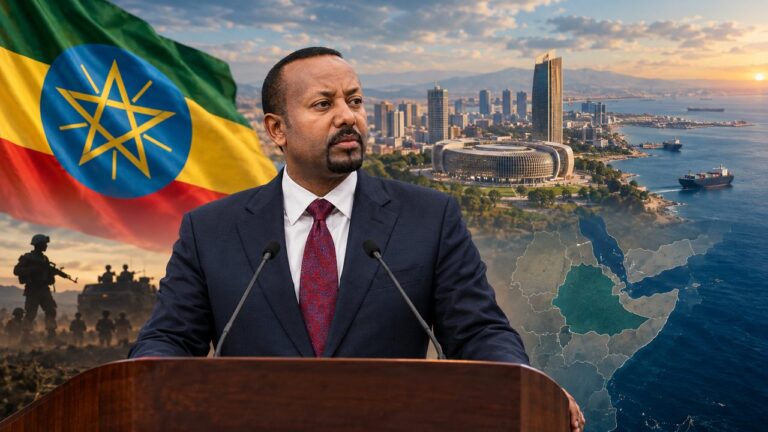
Abiy Ahmed begins new term as Ethiopia faces security and regional challenges
Ethiopia’s new political chapter begins with a stronger mandate, but unresolved conflicts and regional rivalries could define Abiy Ahmed’s second term.

Wicknell Chivayo: What his rise reveals about Zimbabwe’s business and political elite
The rise of Wicknell Chivayo reveals how wealth, state contracts, philanthropy and political access are reshaping Zimbabwe’s modern power structure.
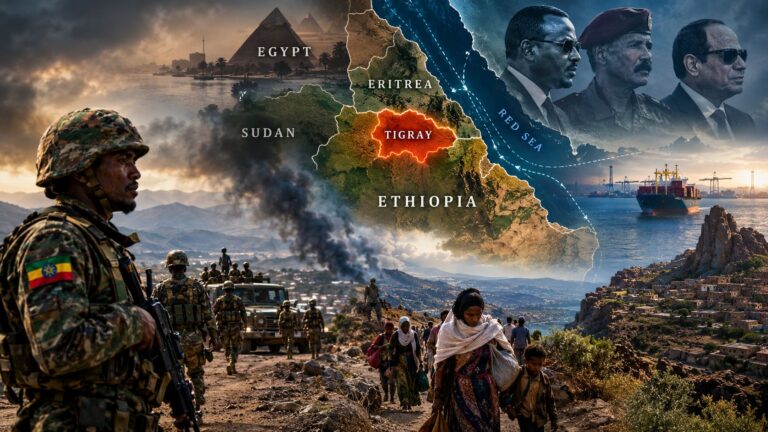
Ethiopia is sliding back into war: Who is really behind the new Tigray conflict?
Ethiopia's renewed Tigray war is exposing a dangerous struggle over power, borders, sea access and influence across the Horn of Africa.