

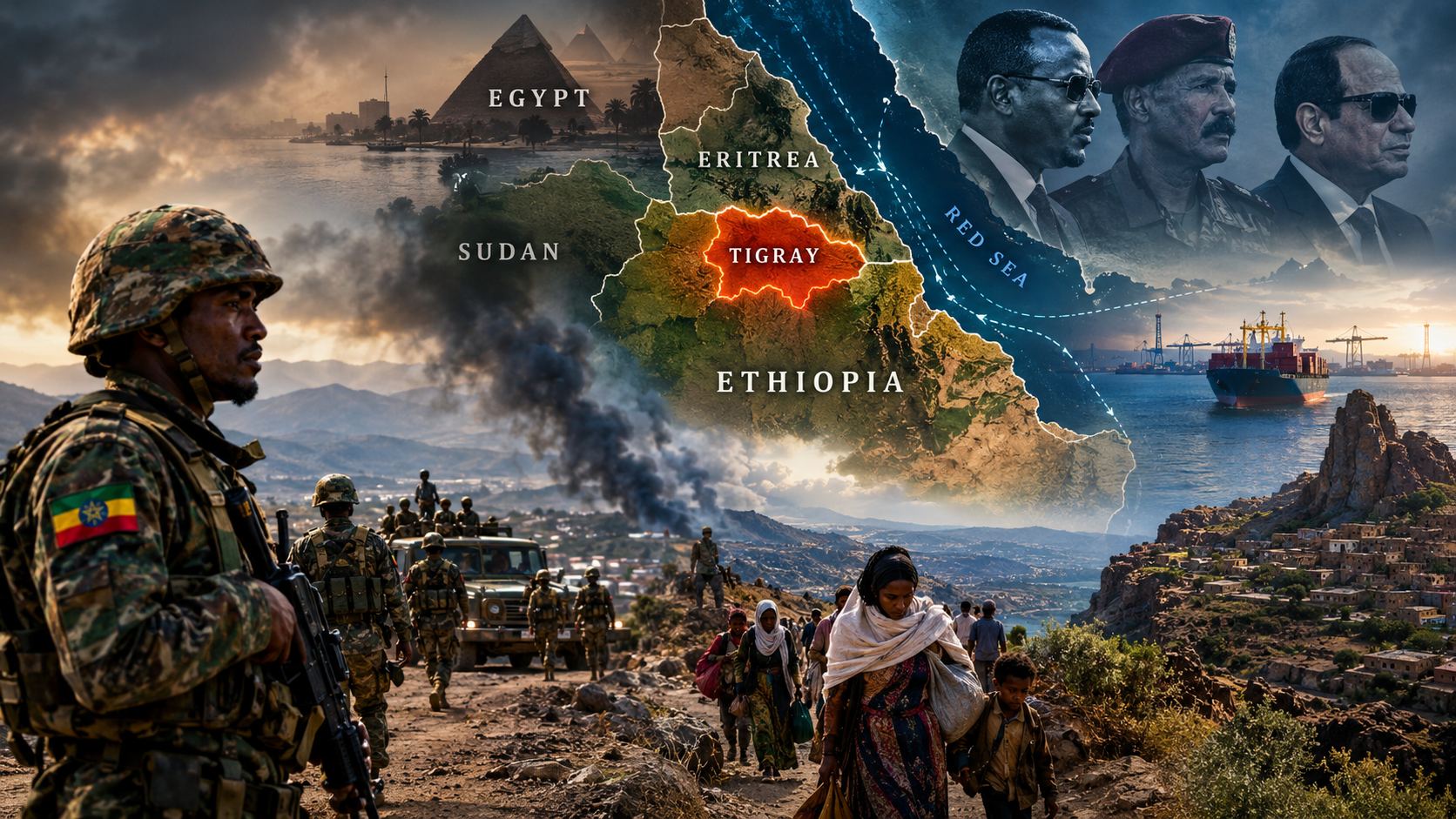
Ethiopia is not simply returning to the war it thought it had left behind. The renewed fighting in Tigray is exposing something more unsettling: the peace that ended the previous conflict never resolved the political and strategic disputes that made the war possible in the first place.
Federal forces have retaken Mekelle after Tigrayan forces withdrew from the regional capital, but the fighting has continued elsewhere. Airstrikes and artillery have been reported in northern Tigray, with humanitarian sources reporting at least 17 deaths in attacks around Mekelle, Adwa and Sheraro. The renewed violence, which began on September 23, is the most serious escalation since the devastating 2020 to 2022 Tigray war.
That is the immediate story.
The deeper story is about power.
It is about who controls Ethiopia, who controls its borders, who can influence its armed groups, who has leverage over the Red Sea and who gets to shape the political future of one of Africa’s most strategically important states.
And that is why the question of who is behind the new Tigray conflict cannot be answered simply by pointing at the Tigray People’s Liberation Front, Eritrea, Egypt or Sudan.
There is no single puppeteer.
There is instead a dangerous system of competing interests in which domestic grievances and regional rivalries are reinforcing each other.
The peace was never complete
The Pretoria agreement of November 2022 stopped the large-scale fighting between Ethiopia’s federal government and the TPLF. It was an extraordinary achievement after two years of destruction, displacement and humanitarian suffering.
But ending battlefield violence is not the same as resolving the political argument that produced it.
Important questions remained unsettled, including disputed territories, the return of displaced people, disarmament and the political relationship between Tigray and Addis Ababa. Analysts at Chatham House have argued that the failure to build effectively on the Pretoria agreement, combined with a continuing zero-sum approach by the principal sides, left the peace extremely vulnerable.
This is where Ethiopia’s present crisis becomes more complicated than a simple government-versus-rebels narrative.
The TPLF remains a powerful political organisation with a deep historical relationship with Tigray. Prime Minister Abiy Ahmed’s government, meanwhile, has been attempting to consolidate federal authority after years of political fragmentation and armed resistance.
Neither side fully trusts the other.
That mistrust is now being converted back into military power.
The danger is that once guns become the language of political negotiation, every unresolved issue becomes a security issue.
Mekelle is a symbol, not the end
The government-aligned forces’ return to Mekelle may look like a decisive military victory.
It is not necessarily one.
The TPLF has already used withdrawal from Mekelle as a strategy before. During the earlier war, Tigrayan forces lost and later regained the city. This time, the TPLF said its latest withdrawal was intended to prevent further destruction and that its administration would operate elsewhere.
That distinction matters.
Capturing a capital can create an image of control without creating political control.
A government can occupy a city while failing to eliminate the political movement that controls the loyalties of large sections of the population.
This is one of the central lessons of Ethiopia’s previous war.
Military victories can be temporary when the underlying political conflict survives.
The immediate question, therefore, should not be whether Addis Ababa controls Mekelle.
It should be whether Addis Ababa can prevent another cycle in which territorial advances are followed by guerrilla warfare, displacement and internationalisation.
Eritrea changes everything
The most dangerous difference between today’s conflict and the previous war is the deterioration in Ethiopia’s relationship with Eritrea.
During the 2020 to 2022 conflict, Eritrean forces fought alongside Ethiopian federal forces against the TPLF.
Today, Ethiopia accuses Eritrea of supporting forces opposed to the federal government.
Eritrea rejects those accusations.
But the relationship has deteriorated so dramatically that Ethiopia ordered the closure of its embassy in Asmara and expelled 10 Eritrean diplomats. Eritrea then announced that it was severing diplomatic relations with Ethiopia.
That is not a minor diplomatic dispute.
It is a strategic rupture between two countries that have already fought a devastating border war.
And beneath the diplomatic language lies a much bigger issue: the Red Sea.
The sea-access question
Ethiopia is landlocked.
That fact has increasingly shaped the country’s foreign policy.
Prime Minister Abiy Ahmed has repeatedly argued that reliable access to the Red Sea is important for Ethiopia’s economic and strategic future. Ethiopia has said that it wants access through peaceful arrangements.
Eritrea, however, views Ethiopia’s ambitions with deep suspicion, particularly because Eritrea possesses the ports and coastline that Ethiopia lacks.
The memory of the 1998 to 2000 Ethiopia-Eritrea border war has not disappeared.
For Eritrea, an increasingly powerful Ethiopia seeking maritime access can look less like an economic necessity and more like a potential strategic threat.
For Ethiopia, remaining dependent on neighbouring states for access to international maritime trade is a structural vulnerability.
This is why the Tigray conflict cannot be separated from the Red Sea.
The battlefield may be in northern Ethiopia, but some of the strategic calculations extend all the way to the coast.
Is Eritrea behind the Tigray offensive?
This is where caution becomes essential.
Ethiopian officials have accused Eritrea of supporting the armed opposition. Eritrean officials have denied the allegations and have accused Ethiopia of creating a pretext for confrontation.
There is currently no credible basis for reducing the entire conflict to an Eritrean operation.
But Eritrea has clear strategic reasons to oppose an Ethiopia that becomes more militarily powerful, more assertive and more interested in maritime access.
That does not automatically mean Asmara controls the TPLF.
It means that the interests of Eritrea and Ethiopia have become increasingly incompatible.
The distinction is important.
Regional conflicts are often sustained not because one foreign power controls every armed group, but because different actors discover that supporting, tolerating or exploiting instability can serve their interests.
That is a much harder problem to solve.
Egypt’s shadow over the conflict
Then there is Egypt.
Ethiopia and Egypt have been locked in a long-running dispute over the Grand Ethiopian Renaissance Dam, or GERD, on the Blue Nile.
For Ethiopia, the dam represents development, electricity generation and national sovereignty.
For Egypt, the Nile is an existential resource.
That fundamental difference has turned the dam into one of Africa’s most important geopolitical disputes.
Ethiopia now accuses Egypt of supporting forces opposed to its government. Egypt denies the allegation.
Yet Cairo has an obvious strategic interest in preventing Ethiopia from becoming overwhelmingly dominant in the Horn of Africa.
Egypt’s concerns are not limited to Tigray.
They involve the Nile, Sudan, the Red Sea and the broader balance of power in northeastern Africa.
The renewed Ethiopian conflict therefore gives the Nile dispute another strategic dimension.
It is not necessarily evidence that Egypt created the war.
It is evidence that the war takes place inside an already existing network of Egyptian-Ethiopian rivalry.
Sudan is the third pressure point
Sudan makes the situation even more combustible.
Sudan has been fighting its own devastating civil war since 2023, with the Sudanese Armed Forces and Rapid Support Forces competing for control.
The Ethiopian and Sudanese conflicts are increasingly difficult to treat as separate crises.
Ethiopia has accused Sudanese actors of supporting forces opposed to Addis Ababa. Sudan has made its own accusations against Ethiopia.
Researchers at Chatham House have highlighted the growing interconnection between the two conflicts, including allegations and counter-allegations about support for armed groups operating across borders.
This creates a classic regional security dilemma.
Each government sees armed groups across its border as a threat.
Each government then looks for partners or buffers.
Those actions make neighbouring governments more suspicious.
Suspicion produces additional military preparations.
And those preparations make conflict more likely.
The result is a cycle in which nobody needs to formally declare a regional war for a regional war to begin developing.
The new conflict has more players
Another important difference is that the TPLF is no longer simply confronting the federal government in isolation.
It is part of a broader opposition alliance.
Fighting has also reached or affected areas beyond Tigray, including Afar, while political and military tensions are rising around Ethiopia’s other borders.
That creates a fundamentally different strategic environment.
Ethiopia’s federal government is not only trying to defeat one regional political organisation.
It is trying to prevent a coalition of armed and political forces from turning regional grievances into a national challenge.
That is an enormous undertaking.
And Ethiopia is too large, too strategically important and too interconnected with its neighbours for the consequences to remain domestic.
The Horn is becoming one battlefield
Look at a map of the Horn of Africa and the logic becomes clearer.
Ethiopia sits between Sudan, Eritrea, Djibouti, Somalia and Kenya.
To the north is the Red Sea.
To the west is war-torn Sudan.
To the northeast is Eritrea.
To the east are Somalia and the Gulf of Aden.
Below that sits Kenya, an important regional economic and diplomatic power.
The conflicts overlap.
The Red Sea crisis overlaps with the Horn of Africa.
Sudan’s war overlaps with Ethiopia’s security concerns.
The Nile dispute overlaps with Egypt’s regional strategy.
Ethiopia’s search for sea access overlaps with Eritrea and Somalia.
The Gulf states have interests in ports, logistics, food security and regional influence.
This is why the phrase “Tigray conflict” can sometimes be misleading.
The fighting is taking place in Tigray, but the strategic consequences stretch far beyond it.
Who benefits from instability?
This is perhaps the most uncomfortable question.
Conflict creates winners as well as victims.
Governments can use insecurity to strengthen national-security arguments.
Military establishments gain political importance.
Armed groups gain bargaining power.
Foreign powers gain opportunities to deepen alliances.
States gain leverage over rivals.
Businesses connected to security, logistics and strategic infrastructure can gain importance.
But there is another side to this equation.
Ordinary Ethiopians lose.
Farmers lose access to land.
Businesses lose customers.
Young people lose years of education.
Families are displaced.
Transport networks are disrupted.
Investment decisions are postponed.
And the state spends money on war that could otherwise be used for electricity, roads, health care and jobs.
This is the paradox of geopolitical competition in Africa.
Outside powers may view a country through the lens of strategic access, alliances and resources.
Citizens experience the consequences through food prices, insecurity and lost livelihoods.
The economic cost is easy to underestimate
The economic consequences of another prolonged Ethiopian war would extend well beyond Tigray.
Ethiopia is one of Africa’s largest economies and one of the continent’s most important population centres.
A prolonged conflict would put pressure on government finances, disrupt trade routes and discourage private investment.
It could also complicate Ethiopia’s efforts to attract international capital and strengthen its manufacturing and infrastructure ambitions.
Air transport is particularly sensitive to instability.
The suspension of flights to Mekelle, Axum and Shire during the recent escalation illustrates how quickly conflict can isolate communities and disrupt economic activity.
The broader concern is confidence.
Investors do not only ask whether a factory is physically located near a battlefield.
They ask whether political instability could affect currency markets, supply chains, regulations, taxation, transport and access to labour.
A country can therefore suffer economically long before the fighting reaches its commercial centre.
The human cost should remain central
Strategic analysis can make war sound like a chessboard.
It is not.
The previous Tigray conflict killed hundreds of thousands of people according to various estimates, while millions were displaced and the region’s health and economic systems were severely damaged.
The renewed fighting is already producing casualties and displacement.
Humanitarian sources reported at least 17 people killed in recent airstrikes around Adwa and Sheraro, although Reuters said it could not independently verify the reports or determine who launched the strikes.
That uncertainty is itself part of the problem.
When communications are disrupted and access is restricted, misinformation can spread faster than verified information.
Every side has an incentive to present the battlefield in a way that strengthens its political position.
The public then receives competing versions of reality.
That makes independent journalism more important, not less.
What happens next?
There are three broad possibilities.
The first is a contained conflict.
Federal forces maintain control of Mekelle while fighting remains limited to parts of Tigray and neighbouring areas. Political negotiations eventually resume.
The second is a prolonged insurgency.
The TPLF and allied groups avoid conventional battles, withdraw from vulnerable urban areas and use rural terrain to continue resistance.
That could produce a long, expensive conflict without a clear victor.
The third is the most dangerous.
Eritrea becomes directly involved.
Sudan’s conflict becomes more closely connected to the Ethiopian battlefield.
Egypt becomes more deeply involved in the regional security equation.
The Red Sea becomes another theatre of confrontation.
At that point, the Tigray war would no longer really be a Tigray war.
It would be a Horn of Africa crisis.
Africa cannot afford another regional war
The African Union has a particular responsibility here because Africa has already seen what happens when domestic conflicts become internationalised.
Sudan is still suffering from war.
Somalia continues to confront insecurity.
The Sahel remains unstable.
The Great Lakes region faces its own unresolved tensions.
Another major war in Ethiopia would create a strategic shock across eastern Africa.
The fact that Egypt, Eritrea, Somalia and Sudan issued a joint declaration calling for political and peaceful solutions as Ethiopia’s fighting intensified is therefore significant. It shows that regional governments recognise the danger, even while their own interests and rivalries remain part of the problem.
The real test will be whether diplomatic statements can become practical restraint.
The real question is not who started it
The temptation in every conflict is to search for one villain.
Who started the war?
Who is funding the rebels?
Who is supplying the weapons?
Who is pulling the strings?
Those are important questions, but they can also obscure the bigger reality.
Ethiopia’s renewed crisis is being produced by several forces at once.
There is unresolved Tigrayan political grievance.
There is Addis Ababa’s determination to strengthen federal authority.
There is Eritrea’s fear of an increasingly assertive Ethiopia.
There is Egypt’s concern over the Nile and Ethiopia’s growing regional power.
There is Sudan’s collapsing security environment.
There is the strategic importance of the Red Sea.
There is Ethiopia’s desire for reliable maritime access.
And there are external powers watching a strategically important region where ports, trade routes, security partnerships and political influence intersect.
The conflict therefore has no single owner.
It has many stakeholders.
And that may be precisely what makes it so dangerous.
Ethiopia’s choice
For Prime Minister Abiy Ahmed, the immediate military objective may be to restore federal control and prevent the opposition alliance from expanding.
But military control alone will not solve Ethiopia’s political crisis.
If the government wins territory but fails to address the grievances that sustain armed opposition, the country risks entering another cycle of rebellion.
For the TPLF, the calculation is equally difficult.
Military resistance may preserve its leverage, but another prolonged war could devastate Tigray and destroy whatever political space remains for negotiation.
For Eritrea, escalation could weaken Ethiopia but also create an unpredictable conflict on its own doorstep.
For Egypt and Sudan, supporting or tolerating pressure on Ethiopia could serve short-term strategic objectives while creating long-term instability.
Every actor therefore faces the same dilemma.
They may gain from weakening a rival.
But they may ultimately lose from the instability that follows.
Ethiopia’s war is Africa’s warning
The most profound lesson from the return of fighting in Tigray is not that Ethiopia has failed to maintain peace.
It is that peace without political settlement is fragile.
The Pretoria agreement stopped the guns.
It did not eliminate the strategic competition surrounding Ethiopia.
That competition has now returned with a wider cast of characters.
The international community should therefore resist treating the latest fighting as another isolated Ethiopian crisis.
The danger lies precisely in its connections.
Tigray is connected to Eritrea.
Eritrea is connected to the Red Sea.
Egypt is connected to the Nile.
Sudan is connected to Ethiopia’s western border.
Somalia is connected to Ethiopia’s maritime ambitions.
And all of them are connected to the increasingly contested geopolitics of the Horn of Africa.
The question confronting Africa is no longer simply whether Ethiopia can prevent another Tigray war.
It is whether the region can prevent Ethiopia’s war from becoming everybody’s war.
That is the real story unfolding now.
And if diplomacy fails, history may remember the fall of Mekelle not as the end of a conflict, but as the moment when a much larger regional struggle began to take shape.

More from Politics

Wicknell Chivayo: What his rise reveals about Zimbabwe’s business and political elite
The rise of Wicknell Chivayo reveals how wealth, state contracts, philanthropy and political access are reshaping Zimbabwe’s modern power structure.
Africa takes on the world map: UN backs a new picture of the continent
A Togo-led campaign to correct distorted world maps gives Africa a symbolic victory over geography, perception and colonial-era narratives.
Niger’s attempted mutiny raises questions over who profits from Sahel instability
Failed uprising highlights the intersection of military rule, foreign influence, strategic minerals and regional security in one of Africa's most volatile regions.