

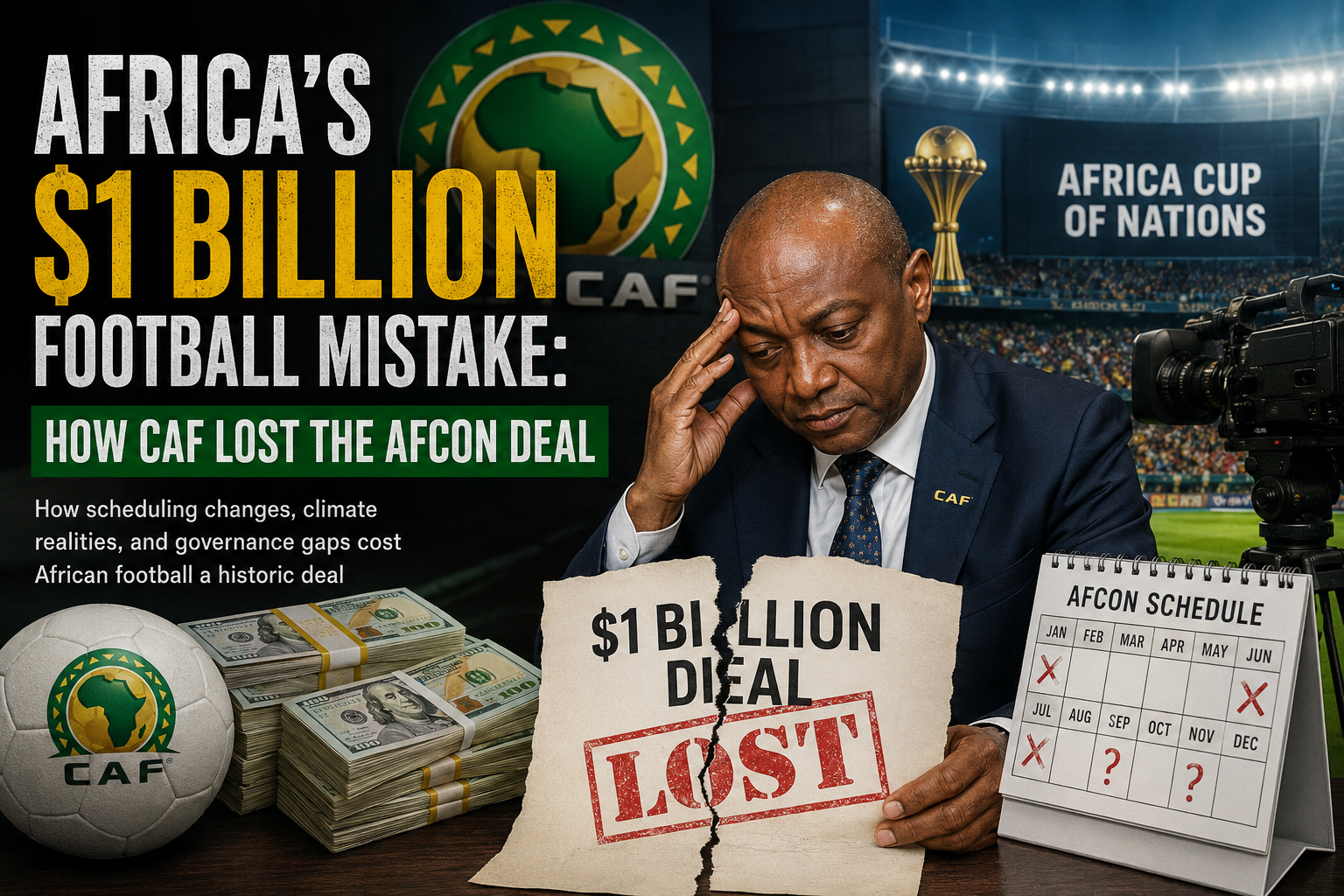
Africa’s football governing body, the Confederation of African Football (CAF), is facing renewed scrutiny after a decision to change the frequency of the Africa Cup of Nations (AFCON) disrupted a potential commercial deal worth more than $1 billion.
The deal was reportedly being negotiated as an eight-year package covering broadcasting and commercial rights.
But CAF’s decision to move AFCON from a two-year cycle to a four-year cycle after the 2028 tournament changed the value of the proposed package.
The setback has raised fresh questions about CAF’s commercial strategy, governance and ability to maximise the value of Africa’s biggest football tournament.
A $1 billion opportunity disrupted
The issue goes beyond when AFCON is played. It is also about how often the tournament takes place.
For decades, AFCON has been held every two years. That regular schedule has helped broadcasters and sponsors plan their investments around one of Africa’s biggest sporting events.
CAF’s decision to move to a four-year cycle from 2028 was aimed partly at reducing clashes with the international football calendar and European club competitions.
But the move also means fewer AFCON tournaments will be available to commercial partners during an eight-year rights period.
That change reportedly disrupted a deal that had been close to completion and was valued at more than $1 billion.
CAF President Patrice Motsepe had previously said the organisation was close to securing an eight-year broadcast agreement worth $1 billion covering major CAF competitions.
The change to the AFCON cycle altered the commercial proposition and forced CAF to reconsider how future rights would be packaged.
Why AFCON scheduling matters
AFCON scheduling has always been difficult.
Many of Africa’s best players play for European clubs. When the tournament is held during the European football season, those clubs must release their players for international duty.
That can leave clubs without key players during important domestic and European matches.
CAF has tried to reduce the problem by moving AFCON towards the European off-season.
But that solution has its own challenges.
Weather conditions vary sharply across Africa. Heavy rains can disrupt matches and transport in some regions, while extreme heat can create problems in others.
The international football calendar also leaves limited room for major tournaments.
The 2025 AFCON showed how complicated the situation can become.
The tournament was eventually held from December 2025 to January 2026 after its original mid-year window clashed with the expanded FIFA Club World Cup.
The battle with European clubs
The scheduling problem is closely linked to the growing influence of European club football.
A large share of Africa’s leading players are based in Europe, where clubs invest heavily in their squads and depend on their best players throughout the season.
When AFCON is held during the European season, clubs can lose important players for several weeks.
The issue has created tensions between national teams and clubs.
CAF’s four-year AFCON cycle is partly intended to create a more manageable international calendar.
But reducing the frequency of AFCON also creates a commercial problem because the tournament is one of CAF’s most valuable revenue-generating assets.
Why the money matters
AFCON is not just a football tournament. It is a major source of income for African football.
Reuters reported in December 2025 that AFCON accounts for about 80% of CAF’s revenue.
That makes the tournament central to CAF’s financial model.
Broadcasting rights, sponsorships and commercial partnerships generate money that supports CAF and its member associations.
A reduction in the number of AFCON tournaments could therefore have consequences across African football.
National associations, particularly smaller ones, often depend on continental funding to support competitions, youth programmes and development projects.
Infrastructure remains a challenge
The calendar is only part of the problem.
Hosting AFCON requires modern stadiums, training grounds, reliable transport, hotels, security and communications infrastructure.
Not every potential host country has all of these facilities in place.
Climate can also complicate preparations.
Africa’s regions have very different weather patterns, making it difficult to identify a single tournament window that works equally well everywhere.
Morocco’s hosting of AFCON 2025 showed what is possible when a host has strong infrastructure.
The tournament was staged across six cities and nine stadiums, with 52 matches played over 29 days.
The challenge for CAF is to ensure that future hosts can meet similar standards.
Questions over CAF’s strategy
The commercial setback has also put CAF’s decision-making under the spotlight.
Motsepe, who became CAF president in 2021, has pushed for reforms aimed at improving the organisation’s finances and commercial performance.
But the AFCON change shows how difficult it can be to balance sporting priorities with commercial interests.
For broadcasters and sponsors, predictability is critical.
Companies negotiating multi-year rights agreements need to know when tournaments will take place, how often they will be held and what competitions are included.
Major changes can force them to reassess the value of their investments.
Who could lose?
The consequences could extend beyond CAF.
National football associations could receive less money if commercial revenues decline. Smaller associations could be particularly vulnerable because they have fewer alternative sources of income.
Broadcasters and sponsors could also become more cautious about investing in African football.
Players and fans could feel the effects indirectly if reduced revenues lead to less money for development, facilities and tournament operations.
CAF, however, says the new competition structure can create a more sustainable football calendar.
The organisation plans to introduce an African Nations League from 2029, which it says will help compensate for the reduced frequency of AFCON.
Africa’s bigger football problem
The AFCON dispute exposes a much larger challenge.
Africa produces some of the world’s best footballers, yet much of the financial value generated by that talent is captured outside the continent.
European clubs benefit from African players, while many African leagues struggle to attract major broadcasting and sponsorship deals.
AFCON is different.
It has a global audience and a strong identity. That gives CAF an opportunity to build one of the world’s most valuable international football properties.
But doing so requires more than talented players.
It requires a stable calendar, reliable infrastructure, strong governance and a commercial strategy that can withstand changes in the football market.
What CAF needs to do
CAF’s immediate challenge is to restore confidence among broadcasters, sponsors and investors.
The organisation needs to provide a clear long-term competition calendar and avoid major changes that could undermine commercial agreements.
It also needs to develop new revenue streams to compensate for holding AFCON less frequently.
The planned African Nations League could play a role, but its commercial success will depend on whether CAF can make the competition attractive to broadcasters, sponsors, players and fans.
Infrastructure investment will also remain important.
Public-private partnerships could help host countries improve stadiums, transport and other facilities needed for major tournaments.
The lesson for African football
The $1 billion setback offers a simple lesson: sporting decisions and commercial decisions cannot be separated.
Changing the frequency of AFCON may help solve some problems with the international calendar, but it also changes the value of the tournament to broadcasters and sponsors.
CAF must therefore find a balance between the needs of players and clubs, the realities of hosting tournaments and the commercial demands of the global football industry.
A turning point
The reported loss of a potential $1 billion commercial opportunity is a major setback for CAF.
But it could also become a turning point.
Moving AFCON to a four-year cycle gives CAF an opportunity to rethink how African football is packaged and sold globally.
The organisation now needs to prove that fewer AFCON tournaments can be offset by stronger commercial partnerships and new competitions.
For African football, the challenge is no longer simply producing world-class players.
It is building a football business capable of capturing more of the value that those players and competitions generate.
The $1 billion opportunity may have been lost, but the bigger question is whether CAF can ensure the next one is not.

More from Sports

How Yan Diomandé became the most expensive African soccer player in history
From dirt pitches in Abidjan to a record-breaking move to Real Madrid, the 19-year-old Ivorian winger has risen through football with remarkable speed, talent and resilience.

Senegal appoint Patrick Vieira as head coach with AFCON qualifiers looming
Dakar-born Vieira takes charge after World Cup disappointment, with Senegal targeting AFCON qualification and renewed continental success.
Africa has 54 votes. Why the continent is becoming FIFA’s kingmaker
Africa's growing voting power is reshaping the balance between football, money and global politics.