
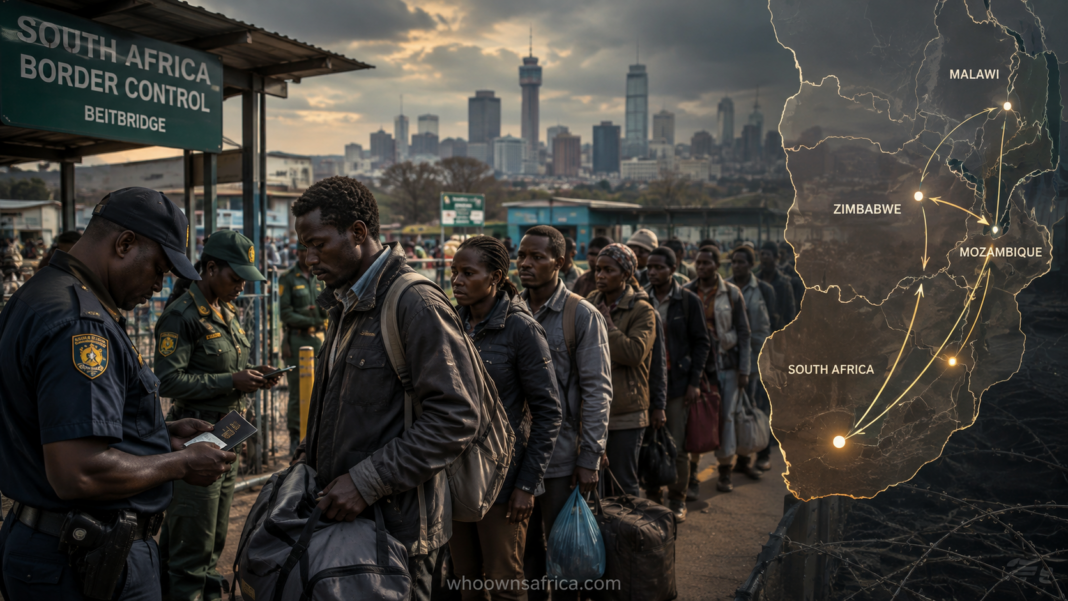

South Africa’s intensifying crackdown on migrants is driving deportations, increasing fear among foreign nationals and raising concerns across Southern Africa about the political, economic and humanitarian consequences.
More than 178,000 migrants have recently left or been deported, according to official figures and regional estimates. Rights groups describe the campaign as one of the most aggressive enforcement periods in years.
The crackdown comes as South Africa faces high unemployment, economic stagnation and growing anti-immigrant sentiment. Political pressure is also increasing ahead of key electoral cycles.
The impact extends beyond South Africa. Neighbouring countries in the Southern African Development Community (SADC) are dealing with returning migrants, strained public services and growing diplomatic concerns.
At the centre of the debate is a broader question: Who benefits from South Africa’s migrant crackdown?
Migration Becomes a Political Issue
Migration has become a major issue in South African politics. Political parties across the spectrum are increasingly calling for tougher action against undocumented migrants.
Analysts say the shift reflects public frustration over unemployment, inequality and crime.
South Africa’s unemployment rate remains above 30%, among the highest in the world. Migrants are often portrayed as competing with South Africans for jobs and public services, despite limited evidence supporting that claim.
“Migration has become a convenient political pressure valve,” said a Johannesburg-based policy researcher. “It allows leaders to redirect public anger without addressing deeper structural problems.”
Political rhetoric has also linked migrants to crime and economic decline. Such claims resonate with communities facing rising living costs and limited employment opportunities.
The narrative has contributed to periodic outbreaks of xenophobic violence, with foreign-owned businesses among the frequent targets.
Government officials say the enforcement campaign is focused on upholding immigration laws. Critics, however, argue that the scale and intensity of the operations point to a wider political dimension.
The Economic Debate
The economic impact of migration remains contested.
Government officials and political leaders often argue that migrants place additional pressure on public services. But economists say the reality is more complicated.
Many migrants work in informal sectors such as construction, agriculture and small-scale retail. These are areas where labour shortages can exist.
Other migrants run businesses that contribute to local economies and create jobs.
Economists argue that migrants can fill gaps in the labour market rather than simply replace South African workers. Some work in sectors where local workers may be less willing to take available jobs.
“The idea that migrants are the primary cause of unemployment is not supported by data,” said an economist based in Cape Town. “The real issues are slow economic growth, skills mismatches and structural inequality.”
Public services remain under pressure in some urban areas. Healthcare facilities and schools are dealing with increased demand, which officials partly attribute to migration.
That pressure has fuelled resentment in communities where resources are already limited.
Inside the Deportation System
South Africa has expanded its deportation operations in recent years. Authorities have increased border enforcement, workplace inspections and detention operations.
Migrants without proper documentation can be detained in holding centres before being processed for deportation.
Rights groups have raised concerns about conditions in some facilities. They cite overcrowding, limited access to legal representation and delays in processing cases.
The government says the operations are lawful and necessary to protect national security and maintain order.
Advocacy organisations argue that enforcement measures can disproportionately affect vulnerable migrants.
“There is a growing system that operates with limited transparency,” said a regional human rights observer. “The scale of deportations suggests a coordinated effort that goes beyond routine enforcement.”
Reports have also highlighted the role of informal networks, including local vigilante groups. In some cases, these groups assist or pressure authorities during raids.
This has made it harder to distinguish between official enforcement and community-driven action.
Humanitarian Cost
The crackdown is also having a human cost.
Families are being separated, children are missing school and some migrant communities are struggling to access healthcare.
In Johannesburg and Durban, some migrants say they are avoiding public spaces and government services because they fear arrest.
This has contributed to lower attendance at schools and reduced use of routine healthcare services. Humanitarian groups warn that the long-term effects could be serious if the crackdown continues at its current pace.
“Migration is not just a legal issue, it is a human issue,” said a representative from a regional aid group. “When people are pushed out abruptly, it creates ripple effects that extend far beyond borders.”
Women and children are particularly vulnerable to exploitation and may have limited access to support services.
Pressure on Neighbouring Countries
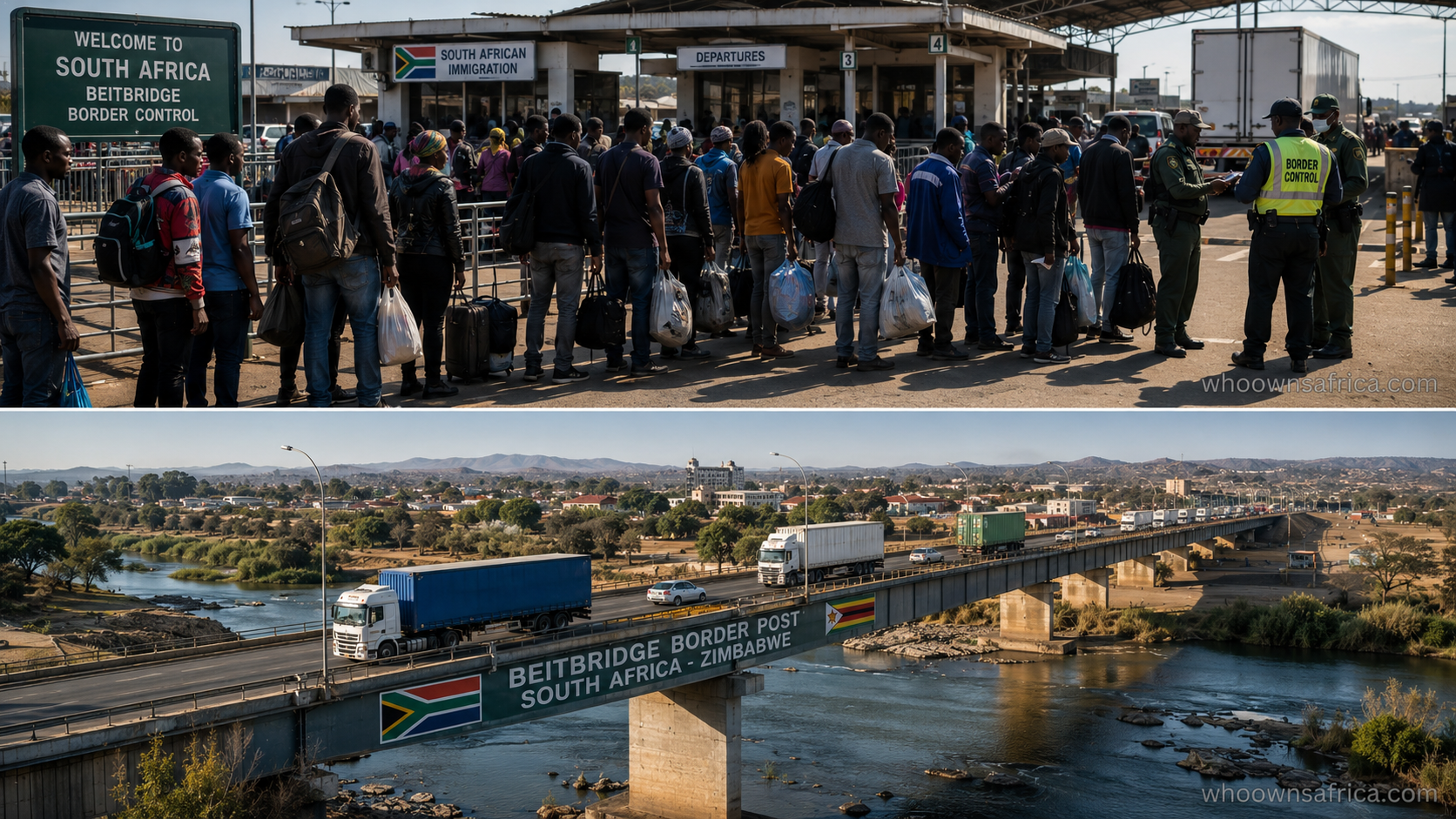
South Africa’s migration policies are also affecting neighbouring countries.
Zimbabwe, Mozambique and Malawi are receiving returning migrants, many of whom had left their home countries because of economic hardship.
The return of large numbers of people is putting additional pressure on already fragile economies. Governments face the challenge of providing services while creating jobs for returnees.
Diplomatic tensions have also emerged. Some governments have expressed concern about how their citizens are being treated in South Africa.
Calls for greater regional cooperation and coordinated migration policies are growing.
SADC has emphasised the importance of cooperation, but progress has been slow. Different national interests and economic conditions have made it difficult to develop a unified regional approach.
Migration across Southern Africa has historically been driven by economic differences. South Africa has remained a major destination because of its relatively stronger economy.
The current crackdown could change these migration patterns for years to come.
Migration and Crime
Crime remains one of the most sensitive issues in South Africa’s migration debate.
Some political leaders and community groups argue that undocumented migrants contribute to crime. These claims have helped build public support for tougher enforcement.
Research findings, however, are mixed. While some localised problems exist, there is no clear evidence that migration is responsible for overall increases in crime rates.
Experts warn that linking migration too closely with crime can reinforce harmful stereotypes and distract from other causes of insecurity.
“Crime in South Africa is a complex issue with many drivers,” said a security analyst. “Focusing solely on migrants oversimplifies the problem and risks ignoring more effective solutions.”
Despite this, high-profile incidents and political messaging continue to shape public opinion.
Informal Power Networks
The migration debate is not shaped by government policy alone.
Community groups, local business associations and criminal organisations can also influence how enforcement takes place.
In some areas, organised groups have taken it upon themselves to identify and report undocumented migrants. Such actions can sometimes escalate into violence.
There are also allegations that some networks profit from the migration system by facilitating illegal crossings or exploiting detained migrants.
These claims point to hidden economies surrounding migration and highlight concerns about transparency and accountability.
Analysts say stronger oversight of enforcement systems is needed to address these risks.
A Region at a Crossroads
South Africa’s migration crisis reflects wider challenges across Southern Africa, including economic inequality, weak institutions and population movement.
As deportations increase and tensions rise, pressure is growing for governments to find longer-term solutions.
Experts say enforcement needs to be balanced with humanitarian concerns and regional cooperation.
Possible solutions include creating more legal migration pathways, investing in economic development across the region and strengthening institutions responsible for managing migration.
“There is no simple solution,” said a regional policy expert. “But ignoring the root causes will only deepen the crisis.”
What Happens Next?
Migration is likely to remain a major issue in South Africa’s political and economic debate.
With public pressure mounting, policymakers face difficult choices over how to enforce immigration laws while managing the economic and humanitarian consequences.
The current trajectory points to continued enforcement and tougher political rhetoric. But the long-term sustainability of that approach remains uncertain.
For migrants, the immediate reality is one of uncertainty and risk.
For neighbouring countries, the consequences could be even broader as returning migrants place additional pressure on economies and public services.
The central question is whether regional cooperation and policy reform can prevail over division and short-term political gains.
The answer could shape not only the future of migration in Southern Africa but also the region’s wider prospects for stability and economic development.

