

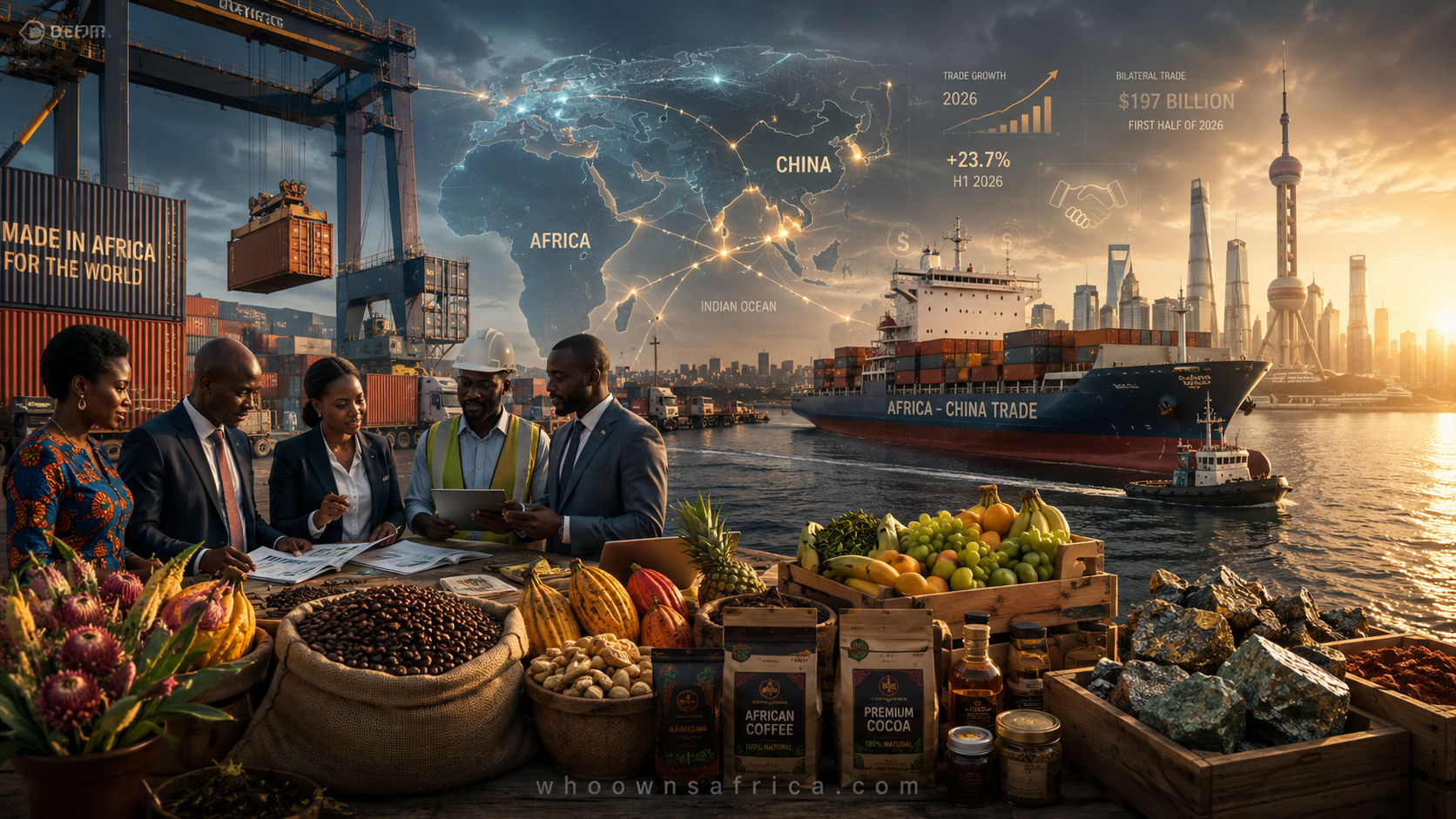
China’s zero tariff policy is opening its vast consumer market to 53 African countries. The move could boost African exports, but turning market access into economic power will depend on production, infrastructure and value addition.
China Africa trade is entering a new phase.
From May 1, 2026, 53 African countries with diplomatic relations with China became eligible for zero tariff treatment across all tariff lines under Beijing’s expanded preferential trade policy.
The move gives African exporters wider access to one of the world’s largest consumer markets. It could create new opportunities for agriculture, manufacturing and processed goods.
The timing is significant.
China Africa trade reached about 1.41 trillion yuan, equivalent to roughly $196.6 billion, in the first half of 2026, according to China’s Foreign Ministry.
That represents a record first half for bilateral trade.
But behind the headline figure is a persistent imbalance. China exports considerably more to Africa than it imports from the continent, while many African economies continue to depend heavily on raw materials and commodities.
The key question is whether China’s zero tariff Africa policy can help change that pattern.
What China’s zero tariff policy means for Africa
The latest policy extends zero tariff treatment to 53 African countries that maintain diplomatic relations with Beijing.
Eswatini is excluded because it maintains diplomatic relations with Taiwan.
China had already introduced zero tariff treatment for 33 African least developed countries in December 2024.
The latest expansion brings another 20 African economies into the arrangement, including several of the continent’s largest markets.
For the newly included countries, the preferential treatment is currently scheduled to run from May 1, 2026 to April 30, 2028.
For exporters, the immediate benefit is clear. Products entering China can avoid import duties, potentially reducing costs and improving competitiveness.
But zero tariffs do not guarantee success.
African exporters must still meet Chinese customs requirements, food safety regulations, product standards and certification rules.
They must also overcome high transport costs and logistical challenges before their goods even reach the Chinese market.
China Africa trade reaches record levels
The tariff changes come as bilateral trade continues to expand.
China Africa trade reached approximately $295.6 billion in 2024, according to Chinese government data.
Chinese exports to Africa were about $178.8 billion, while imports from Africa stood at approximately $116.8 billion.
That left China with a trade surplus of about $62 billion.
The relationship continued to grow in 2026.
Chinese government data showed bilateral trade reached 646.56 billion yuan in the first quarter of 2026, an increase of 23.7% from the same period a year earlier.
By the end of June, trade had reached 1.41 trillion yuan.
The numbers show how important China has become to African economies.
China is a major source of machinery, electronics, vehicles, industrial equipment and consumer products.
Africa, meanwhile, supplies China with oil, minerals, agricultural products and other commodities.
Which African exports could benefit?
Agriculture is likely to be one of the biggest immediate beneficiaries of the new policy.
China has a huge consumer market and growing demand for food and premium agricultural products.
African countries already produce many goods that could find wider markets in China.
These include coffee, tea, cocoa, fruit, nuts, wine, spices and horticultural products.
Kenya, Ethiopia, South Africa, Ghana and Côte d’Ivoire are among the African economies with established agricultural export industries.
The opportunity, however, goes beyond exporting larger quantities.
African businesses can potentially earn more by processing and branding their products before they reach China.
That means exporting roasted coffee instead of only green beans, processed cocoa instead of raw cocoa beans, and packaged foods instead of bulk agricultural commodities.
The bigger opportunity is value addition
For decades, Africa’s trade relationship with China has followed a familiar pattern.
African countries export commodities and natural resources while importing manufactured goods, machinery, electronics and consumer products.
That relationship has generated significant economic activity.
But it has also raised concerns about how much value African economies retain from their exports.
When raw materials are processed elsewhere, much of the manufacturing income and employment is created outside the producing country.
The zero tariff policy creates an opportunity to change part of that model.
African governments and businesses can use greater access to China to expand food processing, mineral refining, textile manufacturing, leather production and other industries.
The objective should be simple: export more value, not just more volume.
Can Africa reduce its trade deficit with China?
The trade imbalance remains one of the biggest challenges in China Africa trade.
In 2024, China exported approximately $178.8 billion in goods to Africa while importing about $116.8 billion.
The gap shows that increased market access alone will not create a balanced trading relationship.
African countries need competitive products that Chinese consumers and businesses actually want.
They also need sufficient production capacity to supply the market consistently.
China is a highly competitive market.
African exporters must compete with producers from Asia, Europe, Latin America and other regions.
That makes quality, price, reliability and branding increasingly important.
Agriculture could lead the next export wave
Agriculture could become a major driver of African exports to China.
The continent has substantial agricultural potential, while China has enormous food demand.
African producers could expand exports of coffee, tea, cocoa, fruit, nuts, wine, meat and processed foods.
The greatest opportunity may be in products that combine African raw materials with local processing.
That could generate more revenue while creating jobs in manufacturing, packaging, transport and logistics.
But African farmers and companies need support to compete.
Reliable electricity, roads, ports, cold storage, financing and quality control systems will be essential.
Without those improvements, tariff reductions may have only a limited impact.
Infrastructure could determine who wins
One of Africa’s biggest export challenges is infrastructure.
A product can enter China without a tariff and still be uncompetitive if it is too expensive to transport from a farm or factory to the port.
Poor roads, congested ports, unreliable electricity and limited storage facilities increase the cost of doing business.
The problem is particularly serious for fresh agricultural products.
Delays can cause spoilage and turn a potentially profitable export into a loss.
This makes infrastructure investment central to the future of China Africa trade.
African governments need to improve transport networks, energy systems, ports, logistics facilities and digital infrastructure.
Businesses also need better access to affordable finance.
The minerals opportunity
Minerals add another important dimension to China Africa trade.
Africa has significant deposits of copper, cobalt, lithium, manganese and graphite.
Many of these minerals are critical to renewable energy, batteries, electronics and modern manufacturing.
China is a major player in global mineral processing and manufacturing.
That creates opportunities for African countries to attract investment and build industries around their natural resources.
But there is also a risk.
If Africa continues exporting minerals in raw or minimally processed form, much of the final economic value will still be created elsewhere.
The long term objective should therefore be processing and manufacturing.
African countries need investment in refining, energy, technology and skills to capture more value from their mineral wealth.
What the policy means for Kenya
Kenya is among the African economies that could benefit from wider access to China.
The country already exports products such as tea, coffee, flowers and horticultural goods.
But increasing exports will require more than simply producing larger volumes.
Kenyan companies need to understand Chinese consumer preferences and build products specifically for that market.
Processing and branding could be particularly important.
A Kenyan company that exports packaged coffee, for example, can potentially capture more value than one selling only unprocessed beans.
The same approach can be applied to tea, fruit, spices and other agricultural products.
For Kenya, the Chinese market could also provide an opportunity to diversify beyond traditional export destinations.
A new opportunity for African businesses
The success of China’s zero tariff policy will depend on whether ordinary African businesses can use it.
Large commodity exporters are likely to benefit first.
But small and medium sized enterprises could eventually have an even greater impact on employment and local economic development.
Many smaller businesses lack financing, market information and the technical capacity required to enter distant markets.
Governments, banks and trade promotion agencies can help close that gap.
They can provide information about Chinese demand, certification requirements, financing and distribution channels.
African businesses will also need to invest in branding and digital marketing.
China should increasingly be viewed not only as a source of imports but as a major destination for African products.
What happens next for China Africa trade?
The expansion of zero tariff access marks an important moment in the economic relationship between China and Africa.
For 53 African countries, tariffs are no longer the same barrier they once were.
But market access is only the beginning.
African countries still need to improve infrastructure, production capacity, financing, quality standards and industrial capabilities.
The real opportunity is not simply to export more to China.
It is to export better products and capture more value.
Africa has the resources, labour and entrepreneurial talent to build globally competitive industries.
The challenge is creating the conditions that allow those businesses to scale.
For decades, the central question in Africa’s relationship with China has been what Africa can buy from China and what China can build in Africa.
The zero tariff policy introduces another question.
What can Africa build and sell to China?
That question could define the next chapter of China Africa trade.
If African economies use the opportunity to expand processing, manufacturing, branding and high value exports, the policy could help reshape Africa’s position in global trade.
If exports remain dominated by unprocessed commodities, the benefits could be far more limited.
China has opened a wider door to its market.
The next move belongs to Africa.

More from Business

Kenya wants to build Africa’s electric-car future: Inside the $3 billion EV bet
Kenya’s electric vehicle ambition is becoming an industrial strategy, testing whether Africa can move beyond importing technology to building it.

From Lagos to Lamu: How Dangote is building Africa’s first truly continental oil empire
From Lagos to Lamu, Dangote is turning refining, capital markets and regional trade into a new argument about African ownership.

Who owns Quickmart? Inside Kenya’s KSh15 billion supermarket IPO
Quickmart’s public listing exposes how Kenyan retail, private equity and everyday consumer power are quietly reshaping who owns the country’s economy.