

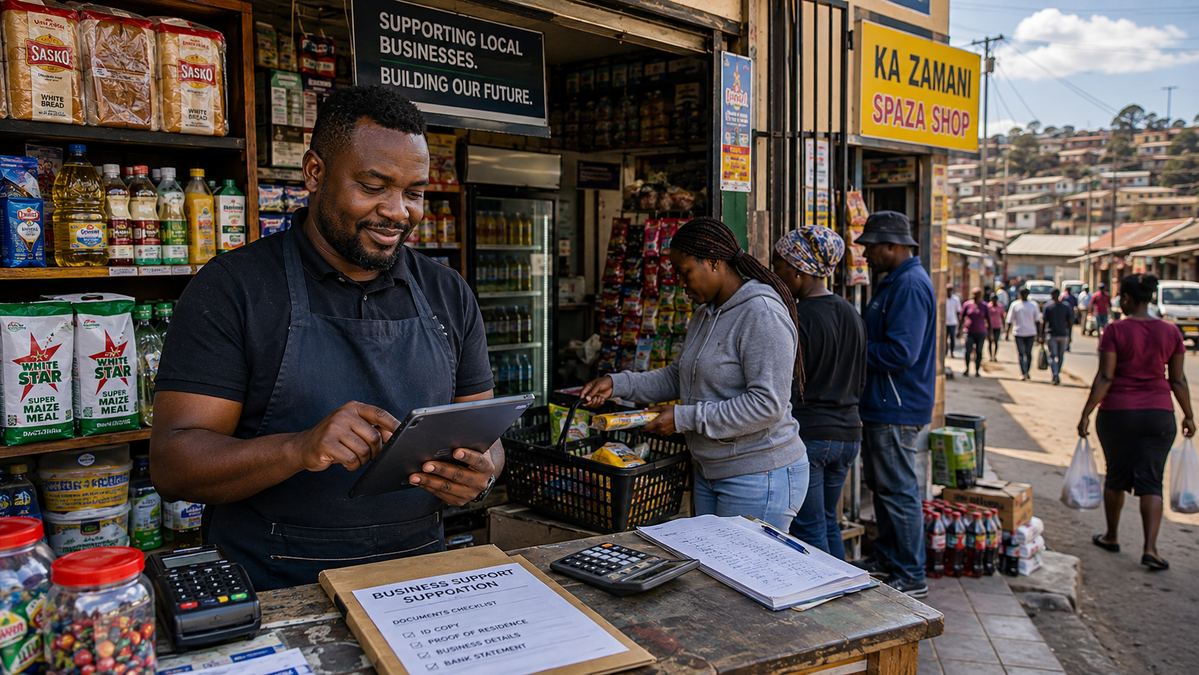
South Africa’s R500 million Spaza Shop Support Fund is intended to do more than keep small shops stocked. It is part of a broader government effort to strengthen township businesses, increase local ownership and bring informal retailers into the formal economy. But as funding reaches more businesses, scrutiny is growing over who qualifies, how applications are verified and whether the programme can deliver lasting economic benefits.
The fund was launched in April 2025 by the Department of Small Business Development and the Department of Trade, Industry and Competition. It is administered through the Small Enterprise Development and Finance Agency, known as SEDFA, and the National Empowerment Fund, or NEF.
For government, the logic is straightforward. Spaza shops are deeply embedded in township and rural communities, providing essential goods while creating income and employment for thousands of entrepreneurs. Giving qualifying businesses access to finance, stock, equipment and business development support could help them compete more effectively with larger retailers.
But turning that ambition into reality is proving complicated. Licensing requirements, ownership verification and administrative delays have slowed the process, while allegations involving foreign nationals have placed the programme under parliamentary scrutiny.
Why spaza shops matter
The spaza shop is one of the most important businesses in South Africa’s township economy. These small retailers are often located within walking distance of residential communities and provide everyday products such as bread, milk, maize meal, cooking oil, snacks and household goods.
For many customers, convenience is the biggest advantage. A neighbourhood shop can remain open late and provide goods without the need for residents to travel to a shopping centre. For entrepreneurs, however, operating such a business can be difficult.
Small retailers typically have less purchasing power than large supermarket chains. They may pay more for stock, have limited access to credit and operate without sophisticated inventory or financial management systems. These disadvantages can make it difficult to build enough capital to expand.
The Spaza Shop Support Fund is therefore designed to address some of those structural weaknesses. The programme combines financial assistance with measures intended to improve business management, compliance, technology and access to markets.
The ultimate objective is to help more township retailers move from survival businesses to sustainable enterprises.
How much money has been approved?
The R500 million headline figure has attracted significant attention, but the money is not being distributed as one large cash allocation.
The programme provides different forms of financial and non-financial assistance depending on the needs and circumstances of qualifying businesses. Support can include stock, equipment, infrastructure improvements, technology and business development services.
By May 2026, government had approved R179.6 million for 2,369 businesses. SEDFA had approved 1,316 applications worth R79.6 million, while NEF had approved 1,053 enterprises worth R99.9 million.
The figures show that the programme has moved beyond the announcement stage, but they also highlight the scale of the challenge. A significant portion of the R500 million allocation still needs to move through the approval and disbursement process.
By July 31, SEDFA had approved 1,386 applications worth R83.9 million and had disbursed R57 million to 930 spaza shop owners. The difference between approvals and actual payments is important because an approved application does not necessarily mean that the money has already reached the business.
That makes implementation one of the most important measures of the programme’s success.
Licensing is holding businesses back
One of the biggest obstacles has been licensing.
Many township businesses have operated informally for years. Their owners may have established customer bases and functioning shops, but they may not have all the municipal permits and licences required under the formal funding process.
This creates a difficult situation. The government wants informal businesses to become formal, but some entrepreneurs lack the resources and administrative capacity needed to navigate the process.
Government reported that licensing and compliance remained major challenges for applicants. By July, about 38% of applicants still did not have valid business licences or temporary permits, according to information presented to Parliament.
The issue is more than paperwork.
Without the necessary documentation, a business can struggle to access government finance, formal banking services and other opportunities. Yet obtaining those documents can itself be expensive, time-consuming or complicated.
Government has been working with municipalities to improve the licensing process and help qualifying businesses meet the necessary requirements.
If those efforts succeed, they could have an impact beyond the current fund. Thousands of township businesses could emerge with stronger records and a clearer path into the formal economy.
Who actually owns the shops?
Ownership is arguably the most sensitive issue surrounding the programme.
The fund is specifically aimed at qualifying South African-owned spaza shops. That means government has a responsibility to verify not only who applied for the money, but also who actually owns and operates the business.
SEDFA has said its verification process compares information including the applicant, business licence holder and actual operator. Officials have identified applications where those details did not match.
Some applications reportedly involved businesses that could not be found at the stated addresses, while others contained discrepancies involving ownership or the identity of the person operating the shop.
According to officials, applications with these problems were stopped before funding was disbursed.
That distinction is important. An application being flagged does not automatically mean that government money was improperly paid.
It does, however, demonstrate why verification has become central to the programme.
Parliament steps in
The issue has now moved firmly into the political spotlight.
In August 2026, Parliament’s Portfolio Committee on Small Business Development questioned SEDFA over allegations contained in a Public Protector investigation concerning possible disbursement of money from the R500 million fund to foreign nationals.
The committee also sought an update on the extent to which qualifying South African-owned spaza shops had received support.
The allegations are serious because the programme’s eligibility rules are built around South African ownership. At the same time, they need to be distinguished from established findings about individual applications.
Officials have told Parliament that verification controls were used to identify applications with ownership discrepancies and that such applications were prevented from receiving funding.
The parliamentary process is therefore important not only because of the allegations, but because it gives lawmakers an opportunity to examine whether the controls are strong enough and whether the programme is reaching the businesses it was designed to support.
The wider issue of fronting
The controversy also touches on a much broader problem in South Africa’s economic transformation policies: fronting.
Fronting involves presenting ownership or control arrangements in a way that allows a business to qualify for opportunities reserved for specific groups, while the actual economic control may rest elsewhere.
This makes verification particularly important for programmes based on ownership.
But there is also a delicate balance to maintain. Strong verification is necessary to protect public funds, yet excessive bureaucracy can prevent genuine entrepreneurs from receiving support.
A small shop owner should not be forced through a process so complicated that the cost of applying becomes greater than the potential benefit.
The government’s challenge is therefore to create a system that is both rigorous and accessible.
What does the support mean for shop owners?
For a small retailer, support does not necessarily have to arrive as unrestricted cash to make a difference.
A shop with empty shelves may benefit significantly from a stock injection. Another may need refrigeration equipment, shelving or a point-of-sale system. A more established business might benefit from working capital or financing that allows it to increase inventory.
This approach could make the programme more productive than a simple cash-transfer model.
The real value comes when the support helps a business increase sales, improve its margins and build a track record that allows it to access private finance later.
That is the point at which government funding begins to create a multiplier effect.
Instead of repeatedly depending on public support, a stronger business can generate its own growth.
Technology could change township retail
Technology is another area where the fund could have a lasting impact.
Digital point-of-sale systems can help shop owners understand their sales and inventory. Better records can make it easier to identify fast-moving products, control losses and plan purchases.
Financial records can also make a small business more credible when approaching banks and other lenders.
For decades, many informal businesses have struggled partly because their financial performance was difficult to document. A shop may have strong daily sales but lack the records needed to demonstrate that performance to a formal financial institution.
Helping retailers become more digitally organised could therefore be one of the fund’s most important long-term benefits.
Women and young entrepreneurs
The question of who benefits extends beyond nationality and ownership.
The programme also places emphasis on women, young entrepreneurs and people with disabilities.
Government reported that 43% of approved enterprises were women-owned and 18% were youth-owned in its May update.
Those figures matter because access to finance remains a major obstacle for many small businesses, particularly those without significant assets or established banking relationships.
If the programme succeeds in helping more women and young entrepreneurs build sustainable businesses, its impact could extend beyond retail.
It could create new household income, additional employment and a larger pool of entrepreneurs capable of expanding into other sectors.
The real test comes later
The number of applications approved is an important measure of government performance, but it should not become the final measure of success.
Five years from now, the more important questions will be whether funded businesses are still operating, whether they have increased their revenues and whether they have created additional jobs.
Government should also be able to demonstrate how many supported businesses have become more formal, adopted digital systems, gained access to private finance or expanded their operations.
Those outcomes would provide a much clearer picture of whether R500 million has changed the structure of township retail.
A programme can distribute money successfully and still fail to transform an economy.
The objective should be to create businesses that can survive after the government support has ended.
A bigger battle for township ownership
The Spaza Shop Support Fund is taking place against a much larger debate about who owns and controls economic activity in South Africa’s townships.
Foreign-owned businesses have become important participants in township retail, while South African policymakers want to increase opportunities for local entrepreneurs.
The issue is complicated by the fact that businesses ultimately compete on price, quality, convenience and supply efficiency.
Funding can help, but it cannot solve every competitive problem.
A shop owner still needs reliable suppliers, affordable stock, electricity, secure premises and customers with sufficient purchasing power. Without those conditions, even a well-funded business can struggle.
That means the spaza fund should be viewed as one part of a wider strategy for developing the township economy.
Who will really benefit?
The answer will depend on what happens next.
Government says its verification systems have prevented applications with ownership discrepancies from receiving funding. Parliament is continuing to examine the programme, while more legitimate businesses are being brought into the funding process.
The programme now faces two fundamental tests.
The first is integrity. Public money must reach the businesses that meet the rules, and the government must be able to explain clearly how decisions are made.
The second is economic impact. Businesses receiving support must become stronger, more competitive and more sustainable.
For South Africa, the stakes go beyond R500 million.
Spaza shops are a visible part of everyday economic life in townships and rural communities. If government support can help thousands of them build stronger businesses, create jobs and participate more effectively in formal supply chains, the programme could become an important model for grassroots economic development.
But if funding becomes trapped by bureaucracy, weak verification or poor implementation, the opportunity will be much smaller.
For Who Owns Africa, the central question is therefore bigger than who receives the money.
It is about who owns the businesses, who controls the supply chains, who creates the jobs and, ultimately, who captures the wealth generated by South Africa’s township economy.
That is the real test of the R500 million Spaza Shop Support Fund.

More from Business

Kenya wants to build Africa’s electric-car future: Inside the $3 billion EV bet
Kenya’s electric vehicle ambition is becoming an industrial strategy, testing whether Africa can move beyond importing technology to building it.

From Lagos to Lamu: How Dangote is building Africa’s first truly continental oil empire
From Lagos to Lamu, Dangote is turning refining, capital markets and regional trade into a new argument about African ownership.

Who owns Quickmart? Inside Kenya’s KSh15 billion supermarket IPO
Quickmart’s public listing exposes how Kenyan retail, private equity and everyday consumer power are quietly reshaping who owns the country’s economy.