

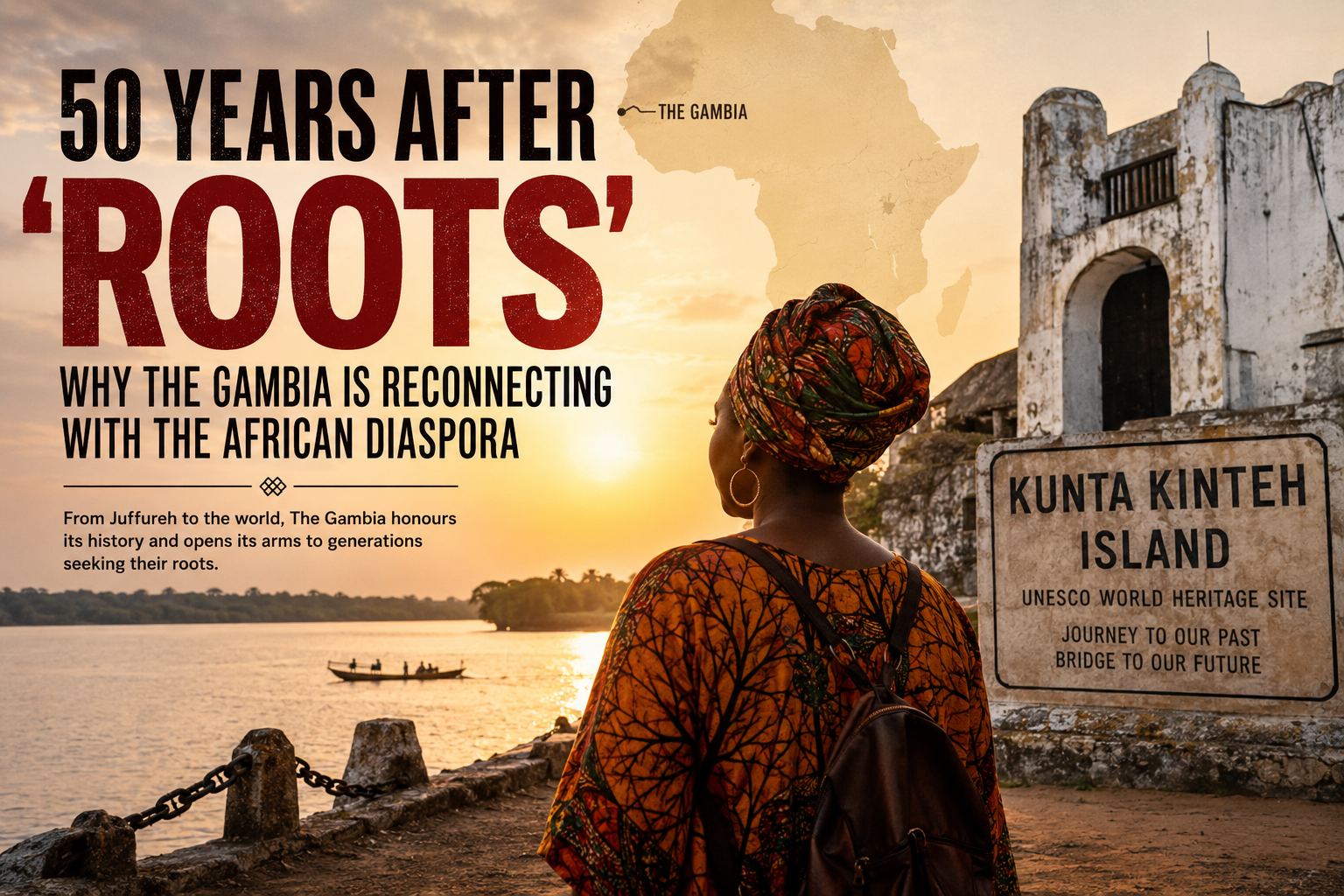
Fifty years after Alex Haley published Roots: The Saga of an American Family, the story of one African American family’s search for its origins continues to shape how millions of people understand their connection to Africa. For The Gambia, the legacy is especially powerful. The small West African nation became internationally associated with Haley’s search for his ancestor, Kunta Kinte, and today it is using that history to deepen its relationship with people of African descent around the world.
Published in 1976, Roots followed Haley’s family history from slavery in the United States back to an African ancestor whom he identified as Kunta Kinte, a young Mandinka man from the village of Juffureh in what is now The Gambia. The book became a cultural phenomenon and was followed by a television miniseries in 1977.
Its impact extended well beyond literature.
For many African Americans, Roots offered a powerful language for thinking about ancestry at a time when the history of enslaved Africans was often fragmented, undocumented or deliberately obscured.
For The Gambia, the effect was equally profound. A country that had been largely unknown to many Americans suddenly became part of one of the most important stories in African American popular culture.
From Juffureh to the world
The connection between Haley and The Gambia centres on Juffureh and Kunta Kinteh Island, sites along the River Gambia that have become symbols of the transatlantic slave trade and the African diaspora.
Haley’s research led him to The Gambia in the late 1960s, where he encountered oral traditions linking his family to Kunta Kinte. His account helped establish Juffureh as a destination for African Americans searching for a tangible connection to their African past.
Historical scholars have questioned aspects of the genealogy presented in Roots, including the reliability of some oral testimony Haley used. Those debates have not erased the wider significance of the story. The River Gambia was genuinely part of the Atlantic slave trade, and the surviving sites along the river document centuries of European and African interaction, including the forced movement of Africans across the Atlantic.
That distinction matters.
The power of Roots is not simply that every detail of Haley’s genealogy can be independently verified. Its enduring influence lies in the way it transformed an individual family search into a universal question: where did the ancestors of millions of people taken from Africa come from?
A pilgrimage to the past
For visitors of African descent, travelling to The Gambia can therefore carry a meaning that goes beyond conventional tourism.
Juffureh, Albreda and Kunta Kinteh Island form part of a landscape of memory. UNESCO recognises Kunta Kinteh Island and related sites as a World Heritage property because they provide testimony to the long history of African-European encounters and the slave trade.
The island, formerly known as James Island, sits in the River Gambia. Its surviving ruins are reminders of the commercial system that helped connect West Africa to European markets and the Atlantic world.
The surrounding sites include Fort Bullen, the Six-Gun Battery, historic buildings in Albreda and Juffureh, and other locations linked to the region’s colonial and slave-trade history.
For members of the diaspora, the journey can be deeply personal.
A visit can mean standing beside the river from which generations of enslaved Africans were taken, hearing local histories and seeing landscapes that were previously known only through family stories, books or films.
That emotional dimension has helped make The Gambia one of West Africa’s most recognisable destinations for roots and heritage tourism.
The diaspora connection
The Gambia has spent decades building institutions and events around this connection.
UNESCO notes that the Gambian government established the International Roots Homecoming Festival in 1996. The event was designed to attract visitors from the African diaspora and has included pilgrimages to Kunta Kinteh Island and the Juffureh area.
The country’s heritage strategy has continued to evolve.
In his 2025 State of the Nation address, President Adama Barrow said his government had revived the Roots Homecoming and Futampaf festivities while expanding efforts to develop cultural tourism, river cruising and other heritage attractions. The government also said it had completed a national assessment of major tourism sites and identified key locations for investment.
That approach reflects a wider shift in Africa.
Across the continent, governments are increasingly looking at the diaspora not only as a community with historical ties to Africa, but also as a potential partner in tourism, investment, culture and development.
For The Gambia, that opportunity is unusually concentrated around one story.
Beyond tourism
The challenge is to ensure that the Roots legacy becomes more than a tourism slogan.
Heritage tourism can create jobs and generate income for communities, but it also raises questions about who controls the story, who benefits economically and how painful history is presented.
The communities around Juffureh and the River Gambia are not simply backdrops for an American story. They have their own histories, traditions and memories.
That makes local participation essential.
The World Heritage designation also highlights another challenge. UNESCO has warned that the historic ruins are vulnerable and require continuing maintenance and conservation. Resources for managing the sites remain limited, with funding coming largely from entrance fees and other available resources.
Preserving the physical landscape is therefore part of preserving the diaspora connection.
If the ruins disappear, future generations may lose some of the most visible evidence of the historical routes that connected West Africa to the Americas.
A new generation returns
The meaning of Roots is also changing.
When Haley published his book in 1976, genealogy was largely a specialist pursuit. Today, DNA testing, digital archives and online family-history databases have made ancestral research accessible to millions.
A younger generation of African Americans and members of the wider African diaspora can investigate family histories in ways Haley could scarcely have imagined.
For The Gambia, that creates an opportunity to move the conversation beyond slavery.
The country can present its history before the Atlantic slave trade, its Mandinka and other cultural traditions, its Islamic heritage, its colonial experience and its modern identity.
The diaspora relationship can then become a two-way exchange rather than a journey defined solely by loss.
That distinction is important for Africa’s broader engagement with its diaspora.
The story does not have to end at the point where Africans were captured and transported across the Atlantic. It can continue through culture, business, education, music, family history and investment.
The meaning of home
There is a reason the word “roots” has remained so powerful.
For people whose ancestors were forcibly removed from Africa, the idea of returning can carry a significance that is difficult to measure in economic terms.
The Gambia has understood this for decades.
The country’s small size and its concentration of historic sites along the River Gambia make it possible for visitors to encounter places that have become globally recognised symbols of the African diaspora experience.
Academic research has documented how the publication of Roots helped bring The Gambia and Juffureh to international attention and contributed to a new relationship between Gambian communities and African American visitors.
Half a century later, that relationship remains unfinished.
The next chapter is likely to be less about telling diaspora communities where their roots are and more about asking what can grow from reconnecting with them.
A bridge, not just a memory
For The Gambia, the 50th anniversary of Roots offers an opportunity to revisit a story that changed the country’s place in the global imagination.
The country can honour Haley’s contribution while also acknowledging the historical questions surrounding his research. It can protect the sites associated with the slave trade while ensuring that local communities benefit from heritage tourism. And it can invite the diaspora to see The Gambia not simply as the place where an ancestor was taken, but as a living country with a future of its own.
That may ultimately be the most important legacy of Roots.
The book began with a search for one man’s family history. Fifty years later, its influence has become part of a much larger conversation about identity, memory and belonging.
For The Gambia, the task now is to turn that memory into a lasting relationship.
For the African diaspora, the invitation is more profound than a visit.
It is an opportunity to return, learn, reconnect and ask what it means to build a future from a history that was once deliberately broken.
For Who Owns Africa, the story of Roots is therefore not simply about looking back 50 years. It is about understanding how Africa and its diaspora can reconnect around history, culture and a shared sense of ownership of the future.

More from Magazine

Who owns South Africa’s fuel infrastructure?
South Africa’s fuel shock exposes the hidden ownership, infrastructure and corporate power shaping prices paid by consumers and industry.

How Aliko Dangote is turning Africa’s biggest refinery into a $47 billion public company
Nigeria's SEC has cleared a $1.6 billion share sale for Dangote's refinery, setting up Africa's largest-ever stock market listing.

Inside Ethiopia’s $12.5 billion bet to build Africa’s next aviation hub
Ethiopia’s massive Bishoftu airport aims to transform Ethiopian Airlines into Africa’s dominant aviation hub while attracting global investment and technology.