

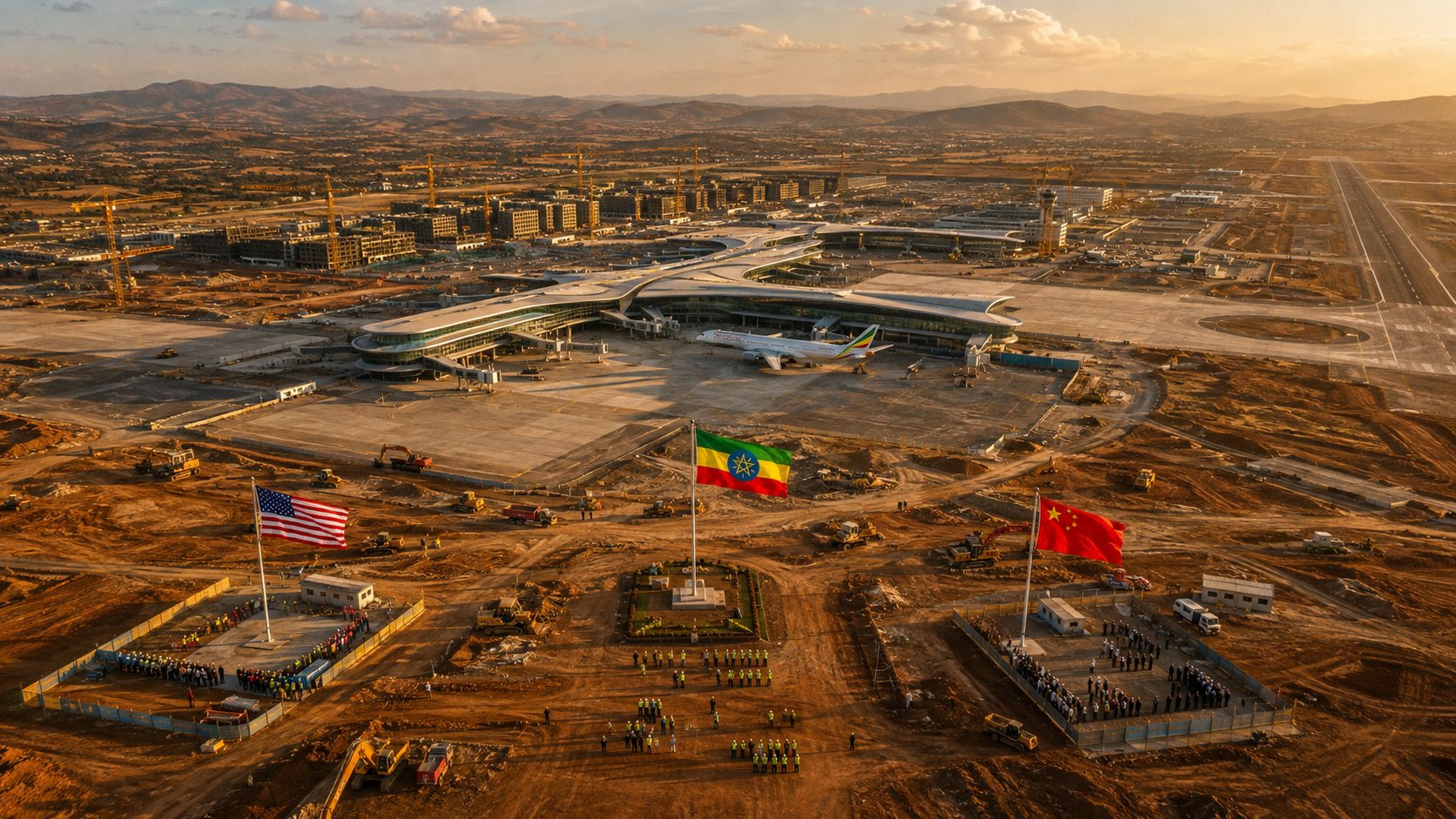
On the outskirts of Ethiopia’s capital, a vast airport project is becoming something much bigger than a construction contract. Bishoftu International Airport, a planned $12.5 billion aviation hub, is emerging as a test of how China and the United States will compete for influence in Africa’s infrastructure economy.
Construction of the four-runway airport began in January, with Ethiopian Airlines aiming to complete the first phase by 2030. When fully developed, the airport is expected to handle up to 110 million passengers a year, making it one of the largest aviation projects ever attempted on the continent.
For Ethiopia, the project is principally about capacity, connectivity and the future of its national airline. For Washington and Beijing, however, Bishoftu represents an opportunity to secure a place in a strategically important African market at a time when competition over infrastructure, technology and investment is intensifying.
The contest is not a simple choice between a Chinese airport and an American airport. Ethiopia has opened the procurement process to a wide range of international companies. But Chinese construction groups have established a particularly strong presence among the companies shortlisted for the major works packages, while the United States is now openly pushing for its companies to participate.
That makes Bishoftu an unusually revealing case study in the new competition for African infrastructure.
A project built for Ethiopian Airlines
The airport is being developed by Ethiopian Airlines Group, Africa’s largest carrier, as the centrepiece of its long-term expansion strategy.
The existing Bole International Airport in Addis Ababa has become increasingly important to Ethiopian Airlines as the carrier has expanded its network across Africa, Asia, Europe, the Middle East and North America.
Bishoftu is designed to take that growth to another level.
The airport will be located about 45 kilometres southeast of Addis Ababa and will eventually have four runways. Its first phase is expected to accommodate 60 million passengers annually, while the wider master plan envisages capacity rising to 110 million passengers. The project is also designed to handle millions of tonnes of cargo and provide parking for hundreds of aircraft.
Ethiopian Airlines has said the project will become its new global hub and a major gateway for African aviation.
The scale explains the $12.5 billion price tag. The cost has risen from earlier estimates of about $10 billion as the plans have expanded. The investment covers not only terminal and runway construction but also utilities, transport links, aviation systems and other infrastructure needed to operate a major airport city.
For Ethiopia, there is a strategic calculation behind the investment.
A bigger hub would give Ethiopian Airlines more room to grow its passenger and cargo operations, while strengthening Addis Ababa’s position as one of Africa’s principal aviation crossroads.
That matters because aviation hubs are not simply places where aircraft land.
They are economic platforms connecting hotels, logistics companies, cargo operators, financial institutions, technology providers, retailers, manufacturers and tourism businesses.
Whoever participates in building such a hub can gain commercial opportunities that extend well beyond the initial construction contract.
China already has a head start
China’s position in Bishoftu is significant.
Ethiopian Airlines has shortlisted several Chinese companies and joint ventures for the airport’s major engineering, procurement, construction and financing packages.
Among the companies are China Communications Construction Company, China Construction Eighth Engineering Division, China Road and Bridge Corporation, China Civil Engineering Construction Corporation, Beijing Construction Engineering Group and Beijing Urban Construction Group.
The companies are competing across packages covering the main airport facilities, support facilities, airfield infrastructure and offsite links.
That does not mean China has won the airport contract. The companies remain bidders in a procurement process involving firms from Europe, Asia and the Middle East.
But the breadth of Chinese participation is notable.
It reflects a broader pattern across Africa, where Chinese engineering and construction companies have built roads, railways, ports, power stations, industrial parks and other major infrastructure over the past two decades.
China’s competitive advantage has often been its ability to combine large-scale construction capacity with financing, equipment and long-term commercial relationships.
Bishoftu therefore fits a familiar model, although this project is more globally contested than many earlier Chinese-backed infrastructure ventures in Africa.
The airport procurement is also structured around EPC-F contracts, meaning bidders are expected to combine engineering, procurement and construction with financing arrangements. That makes the competition about more than who can pour concrete fastest. Financing capability, risk allocation, technology and access to international lenders can all influence the final outcome.
Washington enters the contest
The United States has now made clear that it does not want to watch from the sidelines.
Mark Mitchell, a U.S. deputy assistant secretary of commerce for the Middle East and Africa, said Washington was closely engaged in efforts to secure U.S. participation in the Bishoftu project.
He did not specify which American companies might take roles, but pointed to potential opportunities that could involve aviation technology and further purchases of U.S.-made aircraft.
The intervention comes after a broader U.S. commercial push around the project.
The U.S. Department of Commerce has encouraged American companies involved in airport infrastructure, engineering, aviation systems, cargo logistics, energy, security and smart-terminal technology to explore opportunities linked to Bishoftu.
Washington has also promoted matchmaking between U.S. businesses and potential international partners for the project.
This is important because the U.S. does not necessarily need to win the main construction contract to gain a foothold.
American companies could participate in specialised systems, airport technology, aircraft supply, engines, financial services, security, communications and other high-value components.
That approach would give Washington a different route into the project from the traditional infrastructure model dominated by large construction contractors.
Boeing gives America another advantage
The airport competition is unfolding alongside an important commercial relationship between Ethiopian Airlines and the United States.
In April, Ethiopian Airlines agreed to buy six additional Boeing 787-9 Dreamliners, adding to 20 aircraft already ordered. The new aircraft are scheduled for delivery from 2028.
The airline is therefore already a major customer for American aerospace companies.
U.S. officials see opportunities to build on that relationship.
Mitchell said greater U.S. participation in Bishoftu could potentially contribute to more Boeing aircraft powered by GE Aerospace engines, linking the airport project to the wider American aviation supply chain.
This creates a different kind of U.S. proposition.
China may offer construction expertise and large engineering groups. The United States can offer aviation technology, aircraft, engines, financial services and digital systems.
For Ethiopia, having both sides interested could strengthen its bargaining position.
The money matters as much as the concrete
The most important contest may ultimately be financial.
The project is too large to be financed simply through Ethiopian Airlines’ balance sheet.
Under the financing structure, Ethiopian Airlines plans to contribute a portion of the capital while international lenders and development finance institutions provide much of the remaining funding. The African Development Bank has committed $500 million and is leading efforts to mobilise billions of dollars in additional financing.
U.S. financial institutions have expressed interest, according to Ethiopian Airlines chief executive Mesfin Tasew.
That creates another layer to the geopolitical competition.
Infrastructure influence is not determined solely by which company builds a terminal. It can also be shaped by who provides loans, insurance, guarantees, technology and financial expertise.
The U.S. Department of Commerce has previously highlighted potential opportunities involving the U.S. International Development Finance Corporation and Export-Import Bank of the United States.
At the same time, Ethiopia is working with institutions such as the African Development Bank, which gives the project a distinctly African financial dimension.
That is important.
Bishoftu is not simply a stage on which Washington and Beijing are competing. African institutions are also seeking to shape how the project is financed and how its economic benefits are distributed.
Ethiopia holds the leverage
For Ethiopia, the geopolitical competition offers an opportunity.
The government and Ethiopian Airlines do not have to choose one foreign power for everything.
They can seek Chinese participation in areas where Chinese companies are competitive, while pursuing American technology and finance in other parts of the project. European, Turkish, Middle Eastern and Asian companies are also in the running.
The official shortlist demonstrates that Ethiopia has kept the procurement field broad. Companies from several countries are competing for the different packages.
That gives Ethiopian Airlines room to negotiate on price, technology, financing and delivery.
It also reduces the risk of putting the entire project in the hands of a single foreign partner.
But the balancing act will require careful management.
Large infrastructure projects can create long-term dependencies. A company that builds critical systems may remain involved for years through maintenance, upgrades, software and equipment replacement.
Financing can also create lasting relationships.
The decisions made during construction could therefore shape Ethiopia’s aviation ecosystem long after the first passenger walks through the new terminal.
A new African infrastructure battleground
The Bishoftu contest comes as Africa becomes increasingly important in the global competition for markets and influence.
China has spent years developing deep commercial relationships across the continent. The United States is now trying to expand its economic engagement, with a stronger emphasis on private-sector investment, technology, trade and strategic supply chains.
Other powers are also active.
Europe remains a major source of infrastructure expertise and financing. Gulf states are expanding their investments in African logistics and aviation. Turkey has become a significant construction and commercial partner in many African countries.
India, Japan, South Korea and others are also competing for opportunities.
Africa’s infrastructure gap makes the continent particularly attractive.
Governments need airports, ports, railways, energy systems, digital networks and industrial infrastructure. The companies capable of delivering these projects can establish relationships with governments and businesses that last decades.
Bishoftu therefore carries significance beyond Ethiopia.
If successful, it could become a model for how African governments use international competition to secure major infrastructure while retaining greater control over strategic decisions.
The question of who owns the future
The title of the competition can be misleading.
The question is not necessarily whether China or the United States will “own” Bishoftu.
Ethiopian Airlines will operate the airport, and Ethiopia will remain the sovereign owner of the national infrastructure.
The more consequential question is who will build the systems, finance the expansion, supply the technology and maintain the infrastructure.
Those decisions determine where money flows and which companies develop long-term relationships with Africa’s next generation of economic hubs.
That is why Bishoftu matters to Who Owns Africa.
The airport is a physical symbol of Ethiopia’s ambitions, but it is also a window into a changing global economy.
For decades, African infrastructure was often discussed in terms of shortages: too few airports, too little power, weak transport networks and inadequate logistics.
The new conversation is different.
Africa is increasingly becoming a market where global powers compete for large, strategic projects.
The runway ahead
The immediate question is which companies will eventually secure the major Bishoftu contracts.
The answer is not yet settled.
Chinese firms have a strong presence among the shortlisted bidders, but European, Asian and Middle Eastern companies remain competitive. The United States is seeking participation, although Washington has not yet identified a specific American contractor that will take a leading role in the construction packages.
That distinction matters.
The U.S. is competing for influence, but it has not yet won the construction race.
China, meanwhile, has an established position in the procurement process but still has to win contracts.
For Ethiopia, that may be the most valuable feature of the contest.
The more credible bidders and financiers that remain at the table, the greater the possibility that Addis Ababa can secure better terms while avoiding excessive dependence on any one foreign power.
Bishoftu is ultimately Ethiopia’s project.
But as the airport rises from the ground, the choices made around it will reveal something larger about Africa’s place in the world economy.
China has arrived with construction giants and years of infrastructure experience.
The United States is arriving with aircraft, technology, finance and a determination to regain commercial ground.
And Ethiopia, sitting between those competing propositions, has something both powers want: a strategic gateway into one of Africa’s most important aviation markets.
The race for Bishoftu is therefore not only about who builds Africa’s next mega-airport.
It is about who gets to help shape the networks that will connect Africa to the world for decades to come.

More from News

Does health insurance in Africa really matter?
Across the continent, insurance schemes promise protection from medical bills, yet most people still pay from their own pockets.
Japan sends 2,500 tonnes of rice to Burundi as food security takes centre stage
Japan’s rice donation to Burundi highlights growing food security pressures while deepening Tokyo’s development partnership with the East African nation.

Who was King Oyo Nyimba? Uganda bids farewell to Tooro’s long-serving monarch
Uganda mourns King Oyo Nyimba, who became monarch at three and spent nearly three decades as a symbol of Tooro identity.