

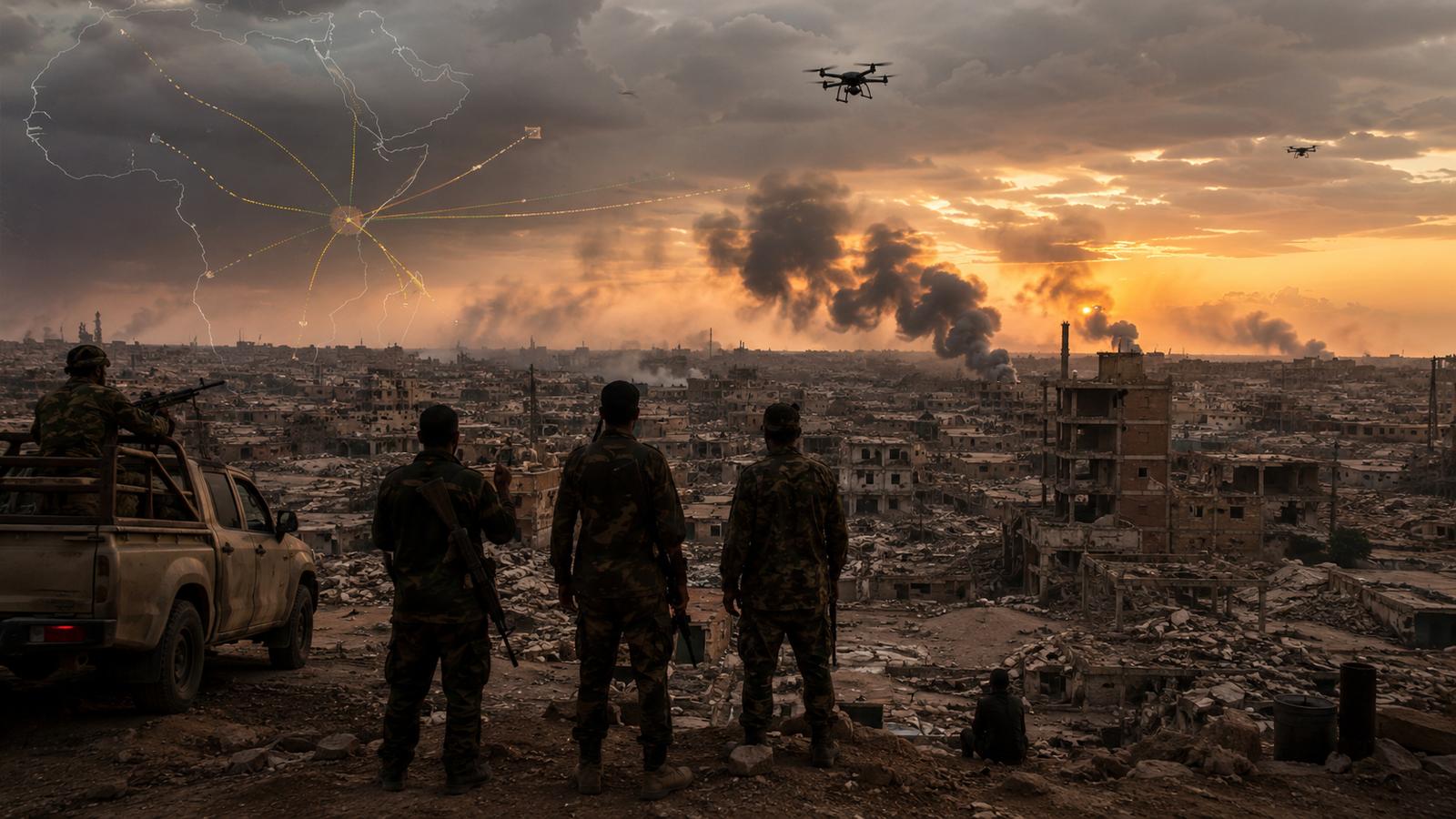
Sudan’s devastating war is no longer being fought only by Sudanese forces. A new United Nations investigation says foreign weapons, drones, military expertise, fighters and logistical networks are helping sustain the conflict, raising fresh questions about who is really influencing the country’s battlefield and political future.
The findings by the Independent International Fact-Finding Mission for Sudan offer one of the clearest recent pictures of how external networks are feeding the conflict. The mission says networks involving the United Arab Emirates, Chad, Libya and Somalia supplied the Rapid Support Forces, or RSF, with weapons, equipment, logistics, training and foreign personnel. It also identified the involvement of Colombian contractors who allegedly helped operate and maintain advanced weapons systems, including drones.
The investigation comes as Sudan enters another dangerous phase of a war that began in April 2023 after a power struggle between the Sudanese Armed Forces and the RSF collapsed into open fighting. What began as a confrontation between two powerful military camps has developed into a regional conflict with supply routes, foreign contractors, sophisticated aircraft and drones extending far beyond Sudan’s borders.
For civilians, the internationalisation of the war has had a devastating consequence. Weapons that once required proximity to the battlefield can now strike targets hundreds of kilometres away. The UN mission said more than 1,000 people were killed in drone strikes during the first five months of 2026, while attacks have damaged hospitals, schools, markets, electricity infrastructure and displacement sites.
The UAE question
At the centre of the international debate is the United Arab Emirates.
For years, Sudanese officials, researchers and rights groups have accused Abu Dhabi of supporting the RSF, allegations the UAE has repeatedly rejected. The latest UN investigation does not simply reduce the issue to a single government-to-government weapons transfer. Instead, it describes a network involving individuals and entities connected to several countries that allegedly provided the RSF with military resources and personnel.
The distinction matters. Modern conflicts increasingly depend on intermediaries, private companies, aviation networks, recruitment agencies and informal logistics channels. A weapon does not necessarily travel directly from a government warehouse to a battlefield. It can pass through commercial entities, airports, neighbouring countries and private contractors before reaching a fighting force.
The UAE has denied militarily backing the RSF and told Reuters that it remains committed to dialogue with the UN fact-finding mission. Chad also rejected allegations concerning its involvement, saying it was neutral in the Sudan conflict and working to secure its borders. Somalia said it did not permit its territory, airspace or ports to be used for military purposes by the warring parties, while acknowledging gaps in information-sharing between the federal government and regional authorities.
Those denials are important because the allegations carry significant diplomatic consequences. If external supply networks continue to operate with little disruption, international pressure on Sudan’s neighbours and foreign partners is likely to increase.
Libya as a regional gateway
Libya has emerged as another critical piece of the puzzle.
The country’s divided political and military landscape has created an environment in which armed groups, foreign contractors and commercial operators can move across large stretches of territory with limited central oversight. UN reporting has previously identified eastern Libya as a transit and logistical area for foreign fighters moving toward Sudan.
A UN Security Council document reported that Colombian fighters travelled through Libya with support from forces associated with Khalifa Haftar, using Kufrah as a stopover before moving toward the RSF in Sudan. The document described Libya as more than a transit point, saying it also functioned as an operational, logistical and tactical base.
Reuters reporting has separately documented aircraft linked to a U.S. military contractor’s business network operating routes between Chad, Libya and Somalia and areas controlled by the RSF. The investigation found Boeing aircraft connected to companies controlled by Steven Shaulis operating along supply routes used by the paramilitary force, although Reuters reported that it found no evidence Shaulis or his companies had been sanctioned or formally accused of wrongdoing by authorities.
The aviation trail illustrates the complexity of Sudan’s war economy. Aircraft, airports, fuel, maintenance crews and pilots can become as strategically important as ammunition. The ability to move people and equipment across borders can determine whether a military force can maintain a siege or launch operations deep inside enemy territory.
Colombia’s mercenary pipeline
Perhaps the most striking element of the UN investigation is the scale of Colombian involvement.
The mission said up to 2,000 Colombian contractors had helped operate and maintain drone systems and other advanced weapons used by the RSF. Some were reportedly present during military operations around El Fasher in Darfur, a city captured by the RSF in October 2025 after a lengthy siege.
The recruitment network is not entirely new. In April 2026, the UN Security Council sanctions committee identified Colombian nationals accused of recruiting former Colombian military personnel for deployment with the RSF. UN records said between 350 and 380 Colombian fighters, mostly retired soldiers, had been recruited through private security firms, with personnel serving as infantrymen, artillerymen, drone pilots, vehicle operators and instructors.
This development highlights how Sudan has become a market for specialised military skills. Colombia has a large pool of former military personnel with experience from decades of armed conflict and counterinsurgency operations. For an organisation such as the RSF, recruiting experienced foreign personnel can provide capabilities that are difficult to generate quickly within its own ranks.
It also complicates accountability. Fighters recruited through private security structures may operate far from the countries where they were born, while payment, recruitment and transportation can involve several jurisdictions.
Drones change the battlefield
The most consequential change may be technological.
The UN mission says both Sudan’s army and the RSF have expanded their ability to conduct long-range attacks through foreign-supplied drones and loitering munitions. Investigators said these systems have allowed both sides to strike targets far beyond immediate front lines.
That shift has transformed the geography of the war. Front lines are no longer the only places where civilians face danger. Markets, hospitals, fuel depots and power infrastructure can become military targets or collateral damage from attacks launched from considerable distances.
The mission cited repeated RSF drone attacks on electricity and fuel facilities around El Obeid between May and July 2026. The strikes disrupted water supplies, healthcare, transport and other essential services in a city already under severe pressure. Investigators also said army strikes killed at least 70 people at Ad-Da’ein Teaching Hospital in East Darfur.
The allegations point to a broader problem: technology can accelerate a war even when the number of soldiers on the ground does not dramatically increase. Drones allow relatively small teams to project force across vast distances, while foreign technicians can provide the expertise needed to operate increasingly sophisticated systems.
Who is really influencing Sudan?
The answer is not one country.
Sudan’s conflict has developed into a competition involving domestic commanders, neighbouring states, Gulf interests, private military networks, arms suppliers, commercial aviation operators and foreign fighters. Different actors may have different objectives, from regional influence and security interests to commercial opportunities and access to Sudan’s resources.
The RSF has built relationships across regional supply routes, while Sudan’s military has also received external political and military support. Reuters has previously reported that the Sudanese Armed Forces have had backing from regional powers including Egypt, Turkey, Saudi Arabia and Qatar, while Iran has been linked to drone support for the army.
That makes the conflict harder to resolve through a purely Sudanese settlement. A ceasefire between the army and RSF could remain fragile if foreign weapons, money and personnel continue moving into the country.
The UN fact-finding mission has urged the Security Council to strengthen enforcement of the arms embargo on Darfur and extend the embargo across Sudan.
The recommendation goes to the heart of the problem. If outside supply networks are helping both sides sustain their military campaigns, then diplomacy aimed only at Sudan’s commanders may not be enough.
The wider African stakes
Sudan’s war is also becoming a test of regional security.
Its borders connect the conflict to Chad, Libya, South Sudan, the Central African Republic and Egypt, while routes through the Red Sea and Gulf region create wider strategic implications. Every additional foreign fighter, aircraft or weapons shipment increases the risk that Sudan’s conflict will spill further into neighbouring countries.
The danger is especially acute in border communities where state authority is weak and armed groups can exploit long-established smuggling routes. Once military infrastructure and supply networks become embedded across several countries, dismantling them becomes considerably harder.
The conflict has already displaced more than 14 million people, according to the latest UN findings cited by Reuters. The humanitarian cost is enormous, but the strategic cost may last even longer if Sudan becomes permanently divided into competing zones of influence.
A war sustained from outside
Sudan’s battlefield is increasingly international, even though its victims remain overwhelmingly Sudanese.
The new UN investigation provides further evidence that foreign involvement is not simply a background feature of the conflict. It is becoming part of the machinery that keeps the war going.
The allegations against the UAE, Chad, Libya, Somalia and foreign contractors require careful scrutiny, and the countries named have rejected or challenged key accusations. But the larger picture is difficult to ignore. Weapons cross borders. Contractors cross continents. Aircraft connect distant military hubs. Drones extend the reach of commanders. Private networks help move fighters and equipment.
For Sudan’s civilians, the distinction between a domestic war and an internationalised conflict offers little comfort.
The central question now is whether international diplomacy can target the networks that make the fighting possible, rather than focusing only on the generals who order it.
Until those networks are disrupted, Sudan’s war risks becoming something more entrenched than a struggle for power between two commanders. It risks becoming a regional system of conflict sustained by foreign interests, private military expertise and an increasingly sophisticated weapons economy.

More from News
South Africa’s anti-migrant backlash puts SADC unity to the test
Ramaphosa urges Southern African leaders to cooperate on migration as protests and migrant departures expose regional tensions.
China and US face off over Ethiopia’s $12.5 billion mega-airport
Bishoftu airport is emerging as a strategic battleground where Chinese builders and American companies seek influence.
Egypt–Ethiopia Nile tensions escalate over plans for three more dams
Egypt is warning Ethiopia against expanding its Nile dam programme as the decades old water dispute threatens to reshape the balance of power across the Nile Basin.