

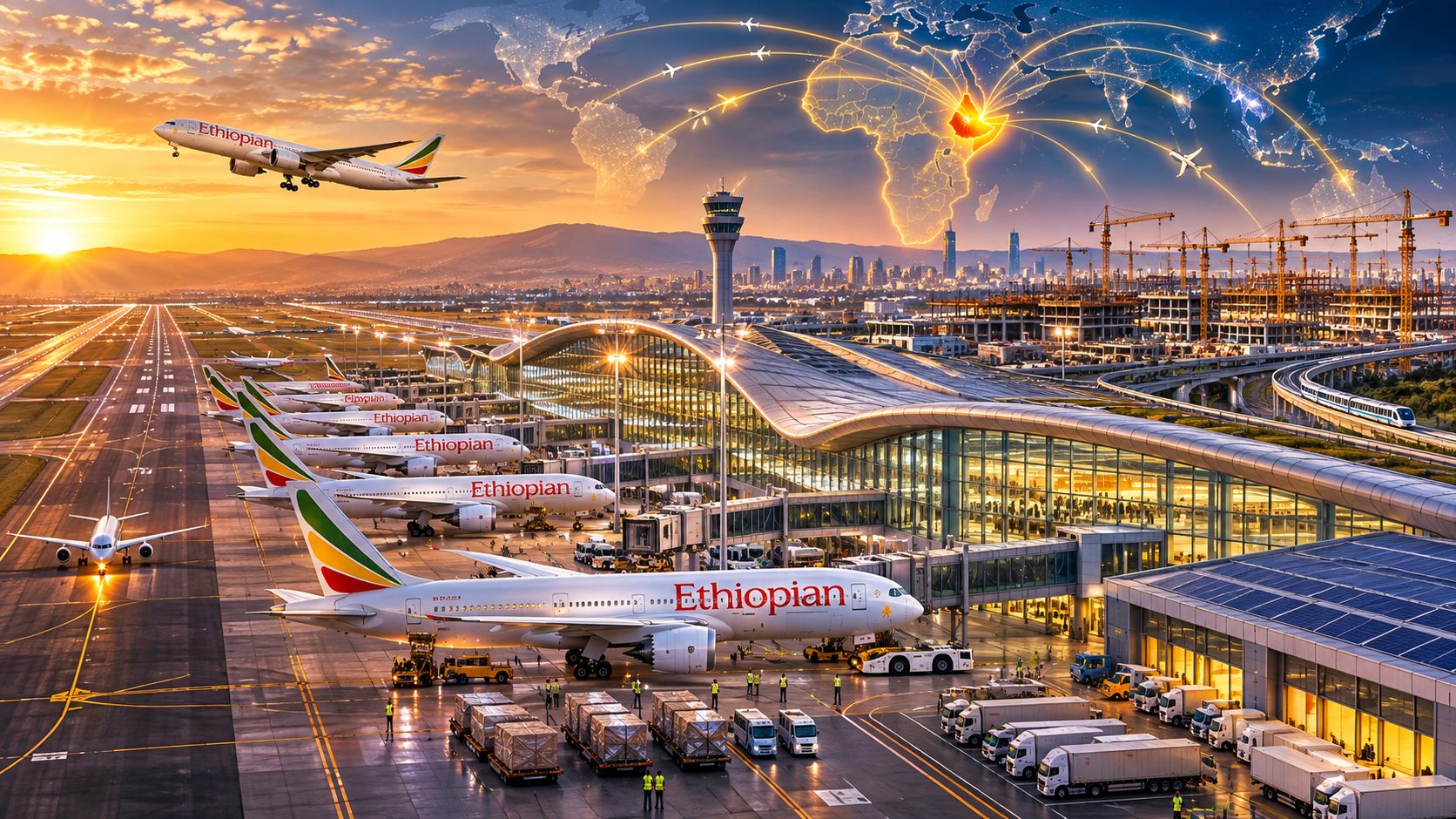
Ethiopia is betting $12.5 billion on an airport that could redefine the geography of African aviation, putting Ethiopian Airlines at the centre of a project designed to handle tens of millions of passengers while drawing construction companies, lenders and technology suppliers from China, the United States, Europe and the Middle East.
The Bishoftu International Airport, about 45 km southeast of Addis Ababa, is no ordinary expansion project. Ethiopian Airlines began construction in January, with the first phase expected to be completed in 2030.
When fully developed, the airport is planned to handle up to 110 million passengers a year and accommodate 270 aircraft. Its four runways are intended to provide the capacity needed for Ethiopian Airlines to expand its already extensive international network and reinforce Ethiopia’s position as one of Africa’s principal aviation gateways.
But the airport is also becoming something larger: a test of how Africa’s infrastructure will be financed, built and controlled in an era of intense competition between global powers.
A hub built for Ethiopian Airlines
The logic behind Bishoftu starts with the success of Ethiopian Airlines.
The state-owned carrier has grown into Africa’s largest airline and one of the continent’s most important international transport companies. Its network connects African cities with Europe, Asia, the Middle East and the Americas, giving Addis Ababa a role as a major transfer point for passengers travelling across the continent.
That growth is creating a problem at Bole International Airport.
Ethiopian officials have warned that the existing Addis Ababa facility is approaching its limits as passenger traffic and airline operations expand. The new airport is intended to provide room for growth rather than simply add another terminal to an already crowded aviation system.
The scale is striking.
The first phase of the project is valued at about $12.5 billion and is designed to accommodate as many as 60 million passengers annually. Full development would eventually take that capacity to 110 million passengers, according to Ethiopian Airlines.
The original project was estimated at about $10 billion. Its cost increased as the plans expanded.
Ethiopian Airlines says it will finance about 30% of the project, with international lenders expected to provide the balance. The airline has already allocated $610 million for earthworks.
That financing structure is important.
Unlike many African infrastructure projects that depend heavily on a single foreign government or development partner, Bishoftu is being assembled through a much broader pool of international capital.
The African Development Bank has pledged $500 million and is helping mobilise an additional $8.7 billion. Lenders from the Middle East, Europe, China and the United States have also expressed interest.
China moves into pole position
The airport has quickly become a contest for construction contracts.
The latest development is particularly significant. Ethiopian Airlines has completed the prequalification stage for four major engineering, procurement, construction and financing packages, with a large number of Chinese companies and joint ventures making the shortlist.
China Communications Construction Company, China Construction Eighth Engineering Division and China Road and Bridge Corporation are among the bidders for the main facilities package.
Other Chinese companies shortlisted across different packages include China Civil Engineering Construction Corporation, Beijing Construction Engineering Group, Beijing Urban Construction Group and China First Highway Engineering Company.
Their presence illustrates the depth of China’s infrastructure footprint in Ethiopia.
For more than a decade, Chinese companies have been involved in major Ethiopian infrastructure projects, from roads and railways to industrial facilities and public buildings. Their ability to mobilise engineering capacity and financing has made them formidable competitors for large African construction projects.
The Bishoftu tender therefore offers another opportunity for Chinese firms to deepen their position in one of Africa’s most strategically important economies.
A Reuters report on Aug. 20 said Chinese construction companies had emerged as key contenders as Ethiopian Airlines moved closer to awarding contracts.
For Beijing, the opportunity extends beyond the airport itself.
A project of this size can generate decades of demand for engineering services, airport systems, maintenance, logistics infrastructure and technology.
Washington wants a seat
The United States is watching closely.
Washington has been seeking a role for American companies in the project as it competes with China and other powers for economic and infrastructure influence across Africa.
Mark Mitchell, the U.S. Commerce Department’s deputy assistant secretary for the Middle East and Africa, said in July that Washington was closely engaged in efforts to secure U.S. participation.
He did not specify the precise contracts American companies could win, but the aviation relationship provides an obvious entry point.
Ethiopian Airlines has long been a major Boeing customer. In April, the airline agreed to buy six additional Boeing 787-9 Dreamliners, bringing its firm orders for the aircraft to 26. The carrier has also been expanding its fleet as it adds destinations and frequencies.
Mitchell pointed to the possibility of more Boeing aircraft powered by engines from GE Aerospace as one avenue for greater U.S. participation.
That makes the airport more than a construction story for Washington.
It is also an export opportunity.
Airport infrastructure requires sophisticated systems covering aviation technology, security, communications, baggage handling, air traffic management, power, construction equipment and aircraft support.
American companies may therefore find opportunities even if U.S. construction groups do not dominate the main civil works packages.
Ethiopia’s bigger ambition
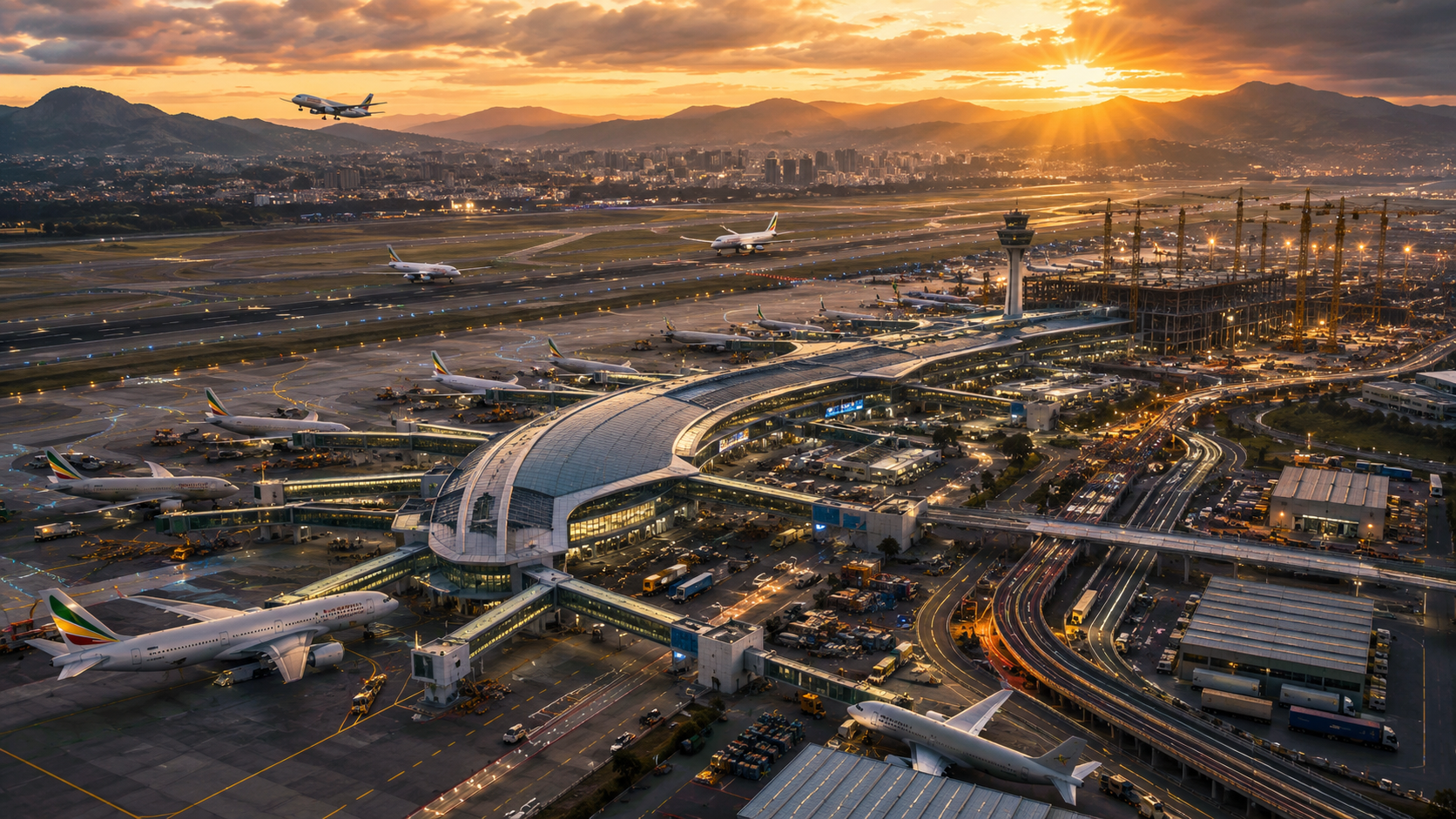
For Ethiopia, the objective is not simply to build a larger airport.
The government and Ethiopian Airlines want to create an aviation and logistics ecosystem capable of supporting trade, tourism, investment and manufacturing.
The airport has been described by officials as a potential “Dubai of Africa”, reflecting ambitions for it to become more than a place where aircraft take off and land.
That vision is consistent with Ethiopia’s broader attempt to use infrastructure to strengthen its position as a regional economic centre.
Bishoftu’s location could help.
The site is close enough to Addis Ababa to serve the capital while providing space for a large greenfield development. The airport is expected to be connected to surrounding transport infrastructure, creating opportunities for logistics companies, hotels, warehouses, cargo operators and other businesses.
The implications could extend beyond Ethiopia.
A large hub operated by Ethiopian Airlines could improve connections between African cities that currently require indirect travel through Europe or the Middle East.
For African businesses, better air connectivity can reduce travel times and improve access to international markets.
For exporters, cargo capacity can be just as important as passenger traffic.
The cargo opportunity
The airport’s strategic value will depend heavily on what happens beyond passenger terminals.
Ethiopian Airlines has developed a significant cargo business, using Addis Ababa as a gateway between Africa and global markets.
A new aviation hub with substantial land and infrastructure could allow that business to expand.
That matters for sectors such as pharmaceuticals, fresh produce, flowers, electronics and other high-value goods that depend on reliable air freight.
It could also support Ethiopia’s ambitions to attract investment into manufacturing and export-oriented industries.
The airport’s success will therefore not be measured only by passenger numbers.
The more important question may be whether Bishoftu becomes a platform for businesses to move goods, people and capital across Africa.
A huge financial challenge
The ambition comes with equally large risks.
At $12.5 billion, the project is one of the most expensive infrastructure developments in Africa. Financing such a project requires confidence that future passenger and cargo revenues will be sufficient to support the debt and operating costs.
The financing structure will therefore be closely watched.
Ethiopian Airlines’ decision to fund 30% gives the carrier a substantial stake in the project’s success, while international lenders will have to assess the long-term commercial viability of the airport.
The African Development Bank’s involvement is significant because it provides institutional backing and is helping mobilise additional financing.
But large infrastructure projects can face delays, cost overruns, currency risks and changes in demand.
The airport will also have to compete with other major aviation hubs on the continent and in the Middle East.
The Africa-wide contest
Bishoftu is emerging as part of a much larger contest over Africa’s infrastructure future.
China remains a major infrastructure player. Gulf states have become increasingly active investors in African ports, airports, logistics and real estate. European companies remain important contractors and technology providers, while the United States is seeking to expand commercial engagement.
For African governments, the competition can create opportunities.
Multiple bidders and financiers can potentially give countries more choices over technology, financing and construction partners.
But the benefits will depend on the terms.
The strategic question for Ethiopia is not simply who builds the airport. It is how much value remains in Ethiopia after construction is completed.
That includes jobs, technology transfer, local suppliers, maintenance capabilities and opportunities for Ethiopian businesses.
Ethiopian Airlines’ next chapter
The airport’s timing coincides with another period of rapid expansion for Ethiopian Airlines.
The airline reported revenue of $9.1 billion for its 2025/26 financial year, a 20% increase from the previous year, according to the Ethiopia News Agency.
That growth provides part of the economic rationale for the airport.
Ethiopian Airlines is expanding its fleet, routes and frequencies at a time when international demand for African air travel is growing.
The carrier’s success has also given Ethiopia something relatively rare on the continent: an aviation company with the scale and network to potentially anchor a mega-hub.
Bishoftu is effectively a bet that the airline can keep growing.
The deadline is 2030
Construction formally began on Jan. 10, with major contractor activity expected to accelerate as the project moves through its procurement process.
The next phase will therefore be closely watched.
The choice of contractors will reveal how Ethiopia balances cost, experience, financing and geopolitical considerations.
The participation of Chinese firms is already clear. European, Middle Eastern, Turkish, Indian and South Korean companies are also represented among the shortlisted bidders.
The United States, meanwhile, is looking for openings through aviation equipment, aircraft, engines, technology and financing.
That makes Bishoftu a useful window into Africa’s changing infrastructure economy.
More than an airport
If Ethiopia succeeds, Bishoftu could become one of the continent’s defining infrastructure projects of the next decade.
Its four runways, enormous passenger capacity and links to Ethiopian Airlines could turn the airport into a major gateway between Africa and the rest of the world.
But the project’s importance will ultimately be determined by what it enables around it.
If new logistics companies emerge, if Ethiopian exporters gain access to new markets, if African passengers gain better connections and if local businesses capture a meaningful share of the economic activity, Bishoftu could become much more than Africa’s biggest airport.
It could become an engine for Ethiopia’s next stage of economic integration.
That is why the competition surrounding the project matters.
The cranes and runways will be visible. The more consequential contest will happen behind them, in the financing agreements, technology contracts, airline orders and long-term commercial relationships that determine who benefits from Africa’s next aviation hub.
For Ethiopia, the challenge is to turn global competition into national advantage.
For the United States and China, the airport is another front in a wider struggle for commercial influence.
And for Africa, Bishoftu could offer a glimpse of what the continent’s infrastructure race will look like when African companies themselves become powerful enough to lead projects of global scale.

More from News

South Africa’s anti-migrant backlash puts SADC unity to the test
Ramaphosa urges Southern African leaders to cooperate on migration as protests and migrant departures expose regional tensions.
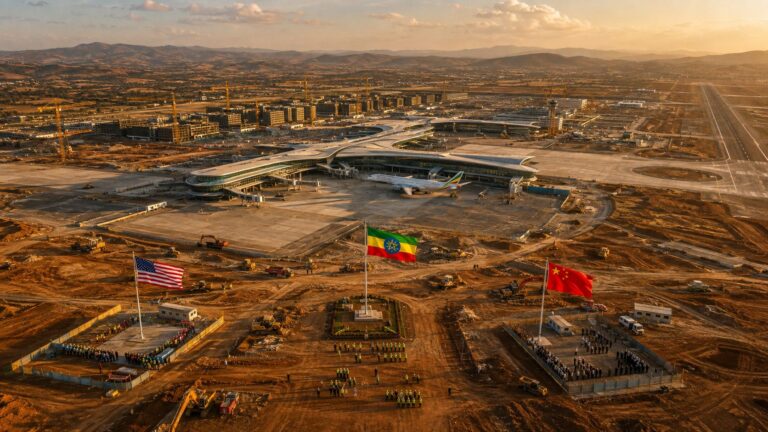
China and US face off over Ethiopia’s $12.5 billion mega-airport
Bishoftu airport is emerging as a strategic battleground where Chinese builders and American companies seek influence.

Egypt–Ethiopia Nile tensions escalate over plans for three more dams
Egypt is warning Ethiopia against expanding its Nile dam programme as the decades old water dispute threatens to reshape the balance of power across the Nile Basin.