

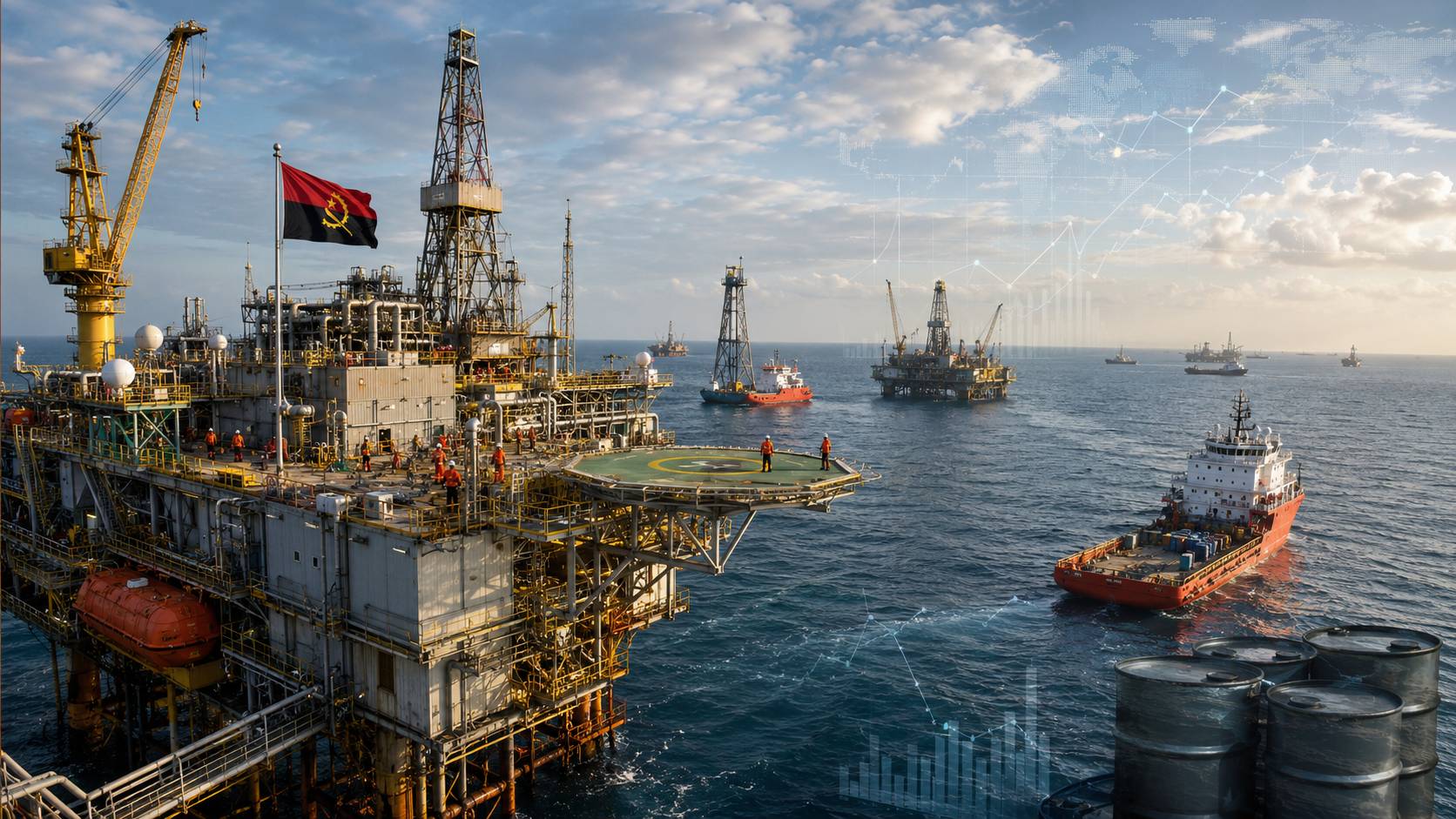
Angola has found more oil offshore, and Chevron is at the centre of the discovery. But the bigger story is not just how much oil may be underground. It is who owns the block, who operates it and who could ultimately benefit from the new offshore wealth.
Chevron announced a significant oil and gas-condensate discovery in Angola’s Block 0, a long-producing offshore concession near Cabinda. The discovery adds fresh interest to one of Angola’s most important oil-producing areas at a time when the country is looking for new investment and trying to slow declines from mature fields.
For Chevron, the discovery strengthens its position in Angola.
For Sonangol, Angola’s state oil company, it could mean another opportunity to increase national oil revenues.
For TotalEnergies and Azule Energy, the find could provide additional value from their interests in the block.
But there is an important detail that can easily get lost in the excitement around a new oil discovery.
Chevron does not own Block 0 outright.
Sonangol actually holds the largest share.
Who owns Angola’s Block 0?
Block 0 is operated by Chevron’s Angolan subsidiary, Cabinda Gulf Oil Company, commonly known as CABGOC.
The ownership structure is:
- Sonangol E&P: 41%
- Chevron/CABGOC: 39.2%
- TotalEnergies: 10%
- Azule Energy: 9.8%
This makes Sonangol the largest individual shareholder in the block, while Chevron remains the operator.
That distinction is important.
The operator manages the day-to-day technical and operational work, but ownership determines the partners’ economic interests in the project.
If the new discovery eventually moves into commercial production, the partners would therefore have different levels of direct exposure to the revenue generated by the field.
Chevron finds new oil
Chevron’s latest discovery was made in the Pinda reservoir in Block 0.
The company said the well encountered a hydrocarbon column of more than 600 metres, including more than 90 metres of high-quality net pay.
Those figures are encouraging, but they do not yet tell investors how much commercially recoverable oil the discovery contains.
That will require further evaluation.
In the oil industry, there is a major difference between finding hydrocarbons and developing a profitable oil field.
Companies must establish the size and quality of the reservoir, estimate recoverable volumes and assess the cost of bringing the resource to market.
Chevron and its partners will now have to answer those questions.
Why the discovery matters
Angola is one of Africa’s major oil producers, but its petroleum industry faces a familiar problem: some of its biggest offshore fields are getting older.
Production from mature assets naturally declines unless companies invest in new wells, enhanced recovery or new discoveries.
That makes the latest Block 0 find significant.
A new discovery inside an established producing area can be particularly valuable because the infrastructure needed to produce and export oil may already be nearby.
Block 0 has been producing for decades.
That means Chevron and its partners do not necessarily have to start from scratch.
If the new resource can be connected to existing infrastructure, development could potentially be faster and less expensive than building an entirely new offshore production system.
Sonangol has the biggest stake
The 41% interest held by Sonangol makes Angola’s national oil company the biggest individual owner in Block 0.
That could become important if the discovery proves commercially viable.
Sonangol’s role gives Angola a direct equity interest in potential production, alongside the wider revenues the government receives from the petroleum sector.
This is one of the key reasons ownership matters.
When an international oil company announces a discovery, the headline often focuses on the company that drilled the well.
But the financial benefits can extend well beyond the operator.
In this case, Sonangol’s 41% stake means the Angolan state is positioned to participate directly in the economic value created by the block.
Chevron remains a major player
Although Chevron’s 39.2% stake is slightly below Sonangol’s, its role as operator gives the company considerable responsibility.
CABGOC manages Block 0 and has been involved in Angola’s offshore oil industry for decades.
The long-term nature of the concession also matters.
Angola extended the Block 0 concession for another 20 years in 2021, taking the concession period through 2050.
For oil companies, long concession periods can make it easier to justify investment in exploration and development because there is more time to recover capital.
For Angola, keeping experienced operators active in mature fields can help maintain production while attracting new investment.
Who will make money from the discovery?
It is still too early to say exactly how much money the new Angola oil discovery could generate.
There is no publicly established commercial reserve figure for the discovery yet, and the partners still need to determine whether development makes economic sense.
However, the ownership structure provides a clear starting point.
If the discovery becomes a producing field, Sonangol would have the largest direct equity interest at 41%.
Chevron would have 39.2%.
TotalEnergies would receive value through its 10% interest, while Azule Energy would participate through its 9.8% share.
But equity ownership is only one part of the picture.
The Angolan government can also benefit through taxes, royalties and other petroleum-related revenues.
At the same time, the companies must account for exploration, drilling and development costs.
That means the eventual profits will depend on more than the number of barrels discovered.
Oil prices, production costs, reservoir performance and Angola’s fiscal terms will all influence the final economics.
Existing infrastructure could be the advantage
One of the strongest features of the Block 0 discovery is its location.
Oil companies spend enormous amounts of money developing offshore fields. New platforms, subsea equipment, pipelines and export facilities can turn a promising discovery into a multibillion-dollar project.
Existing infrastructure can change that calculation.
If Chevron and its partners can connect the new discovery to facilities already operating in Block 0, they could potentially reduce capital requirements and shorten the path to production.
This is becoming increasingly important across Africa.
As international energy companies become more selective about where they invest, discoveries that can use existing infrastructure may become more attractive than expensive frontier projects.
For Angola, that could help extend the life of its mature offshore oil industry.
Angola needs new oil
Oil remains central to Angola’s economy.
The country has spent years trying to attract investment, increase production and develop new energy resources while reducing its dependence on declining mature fields.
The latest discovery fits into that wider strategy.
It shows that exploration in established oil-producing areas can still produce new opportunities.
But discoveries alone will not solve Angola’s production challenges.
The country needs successful development projects that can move from exploration to production and generate revenues for years.
That is where the next stage of Block 0 becomes critical.
A wider African energy story
Angola’s new oil discovery also reflects a broader trend across Africa.
Countries such as Angola, Nigeria and other major hydrocarbon producers are trying to keep international investment flowing into their petroleum industries while global energy markets continue to change.
International oil companies, meanwhile, are increasingly focused on projects that can deliver competitive returns.
That is putting pressure on African producers to make their investment frameworks attractive while ensuring that governments and citizens receive meaningful economic benefits.
Angola has been trying to improve its investment environment, particularly for offshore exploration.
The Block 0 discovery provides another example of why that competition for investment matters.
What happens next?
The immediate focus will be on evaluation.
Chevron and its partners will need to determine the size of the reservoir, the recoverable volumes and the best way to develop the discovery.
They will also need to establish whether existing Block 0 infrastructure can be used.
If the numbers work, the discovery could eventually become another producing asset in Angola’s offshore oil portfolio.
But that process will take time.
A discovery announcement is not the same thing as first oil.
Investors will be watching for further information on appraisal results, resource estimates, development plans and potential production timelines.
Who really owns Angola’s new oil wealth?
The answer is more complicated than simply saying Chevron found it.
Chevron operates Block 0 and holds a 39.2% interest.
But Sonangol owns the largest share at 41%.
TotalEnergies holds 10%, while Azule Energy owns 9.8%.
That structure means the potential wealth from the discovery is shared among several partners, while the Angolan state can also benefit through its broader petroleum revenue system.
The real value of the discovery will only become clear once the resource is fully evaluated and a development plan is approved.
For now, the discovery offers Angola something it needs: another potential source of offshore production from an established oil province.
And for Chevron and its partners, it offers a potentially valuable opportunity to find new barrels without necessarily having to build an entire oil-production system from the ground up.
The oil is still underground. But if Chevron and its partners can turn the discovery into commercial production, the ownership structure shows exactly where the new offshore wealth could flow.

More from Oil & Gas
Who will own Dangote refinery after the IPO?
Nigeria's SEC-approved offer sets the stage for Africa's largest share listing, reshaping ownership at the world's biggest single-train oil refinery.
How Samuel Dossou-Aworet built a $1.43 billion stake in Nigeria’s oil industry
A Benin-born engineer who once ran Gabon's national oil sector has quietly assembled one of Nigeria's largest energy fortunes today.
Libya’s $40 billion oil plan: Who will control its next energy boom?
Libya wants billions in new investment to unlock oil wealth, but security, politics and ownership could determine who benefits.