

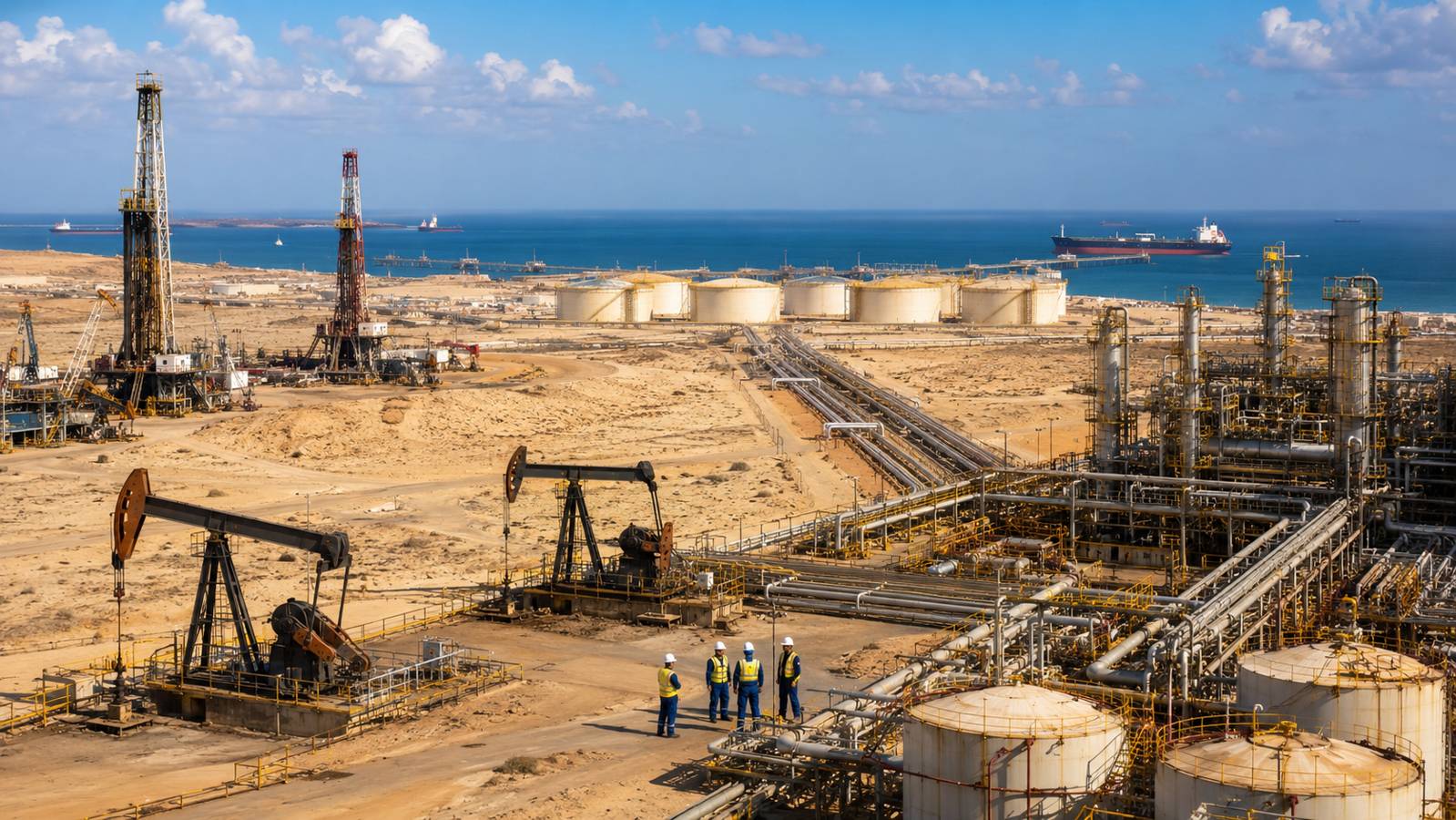
Libya is seeking up to $40 billion in investment to rebuild its oil and gas industry and raise crude production from about 1.4 million barrels per day to 2 million by 2030, a plan that could reshape the country’s energy sector and create a new contest among international oil companies for access to some of Africa’s largest undeveloped hydrocarbon resources.
For Libya, the opportunity is enormous. For investors, however, the calculation is more complicated.
The country holds about 48 billion barrels of proved crude oil reserves, the largest in Africa and roughly 41% of the continent’s total proved reserves at the beginning of 2024. Much of Libya remains relatively underexplored, meaning the country’s known reserves may represent only part of its longer-term petroleum potential.
The question now is not simply whether Libya can attract $40 billion.
It is who will control the investment, who will operate the fields, how foreign companies will recover their costs and profits, and whether Libya can provide the political and security conditions needed to protect the billions of dollars that could flow into the sector.
A return to big oil
The first signs of a new oil race are already visible.
In February, Libya awarded exploration blocks to international companies including Chevron, Eni, QatarEnergy, Repsol and others in its first licensing round in nearly two decades. The awards covered areas of the Sirte and Murzuq basins, as well as offshore acreage in the Mediterranean.
The licensing round was significant because international investors had largely stayed away from major new commitments in Libya following years of conflict, political fragmentation and attacks on energy infrastructure.
Chevron’s return is particularly notable. The U.S. oil major secured an onshore exploration licence in the Sirte Basin, while Eni and QatarEnergy joined forces on a major offshore block. A consortium involving Repsol, Turkey’s TPAO and Hungary’s MOL also secured exploration rights. Nigerian company Aiteo was among the winners, giving an African independent oil producer a place in Libya’s emerging investment story.
Eni, already one of Libya’s most important international energy partners, has further strengthened its position. Its consortium with QatarEnergy was awarded offshore License O1, covering about 29,000 square kilometres in the offshore extension of the Sirte oil and gas province.
These deals provide a glimpse of what the next phase of Libya’s oil industry could look like: European majors, U.S. companies, Middle Eastern energy firms and African independents competing for access to Libyan acreage.
The $40 billion question
The National Oil Corporation, Libya’s state-owned oil company, is now looking well beyond the initial licensing round.
NOC Chairman Masoud Suleman has outlined a plan requiring as much as $40 billion in investment to modernise the industry, develop fields and infrastructure and increase production to around 2 million barrels per day by 2030. The strategy could involve more than 60 undeveloped fields.
The scale is important.
Libya does not need simply to drill more wells. It needs investment across the entire petroleum chain, including exploration, production facilities, pipelines, storage, export terminals, refineries and supporting infrastructure.
Years of conflict and underinvestment have left parts of the industry in need of rehabilitation. Production has also been repeatedly interrupted by political disputes, security incidents, maintenance problems, labour disputes and shortages of funding.
Yet there is evidence that the underlying industry can recover quickly when conditions improve.
In June, the NOC reported crude production of 1.438 million barrels per day, with condensates taking total output to almost 1.49 million barrels per day. It described the crude figure as the highest since 2013.
That makes the 2 million barrel target ambitious, but not entirely disconnected from Libya’s history.
Before the 2011 civil war, crude production had reached about 1.7 million barrels per day.
Who gets the contracts?
This is where the ownership question becomes more important.
Libya’s oil remains under state control through the NOC, but the capital, technology and technical expertise needed to develop new resources are likely to come from international partners.
The structure of those partnerships will determine how much value stays in Libya and how much flows to foreign investors.
The country’s latest licensing round used new production-sharing arrangements designed to make investment more attractive. Three agreements were formally signed in June with consortia led by Eni, Repsol and Chevron, according to industry reporting.
For international companies, the attraction is obvious.
Libya offers large reserves, relatively low-cost conventional oil resources and proximity to European markets. Its light, sweet crude is also generally considered valuable because it can be processed efficiently in refineries.
But investors will demand compensation for taking political and operational risks.
That means contract terms matter.
If Libya offers more favourable terms to attract capital, foreign companies could gain greater economic participation in future production. If the state insists on retaining a larger share, it could protect national revenues but potentially make some projects less attractive.
The balance will be one of the defining questions of Libya’s next oil chapter.
Politics remains the biggest risk
Libya’s biggest problem is not geology.
It is politics.
The country remains divided between rival authorities and competing armed groups, with eastern Libya controlled by forces aligned with military commander Khalifa Haftar and the internationally recognised political establishment based in the west.
The oil industry has repeatedly found itself caught between these competing centres of power.
For investors considering multi-billion-dollar projects with payback periods extending for decades, the possibility of production stoppages or attacks on infrastructure represents a major financial risk.
That risk was highlighted again this month when drone attacks struck the Zawiya oil complex west of Tripoli.
The attacks damaged fuel storage infrastructure, including a tank holding about 4.5 million litres of gasoline. The refinery itself was not seriously damaged, but the incident demonstrated how vulnerable Libya’s energy infrastructure remains.
Zawiya is strategically important. The refinery has a processing capacity of about 120,000 barrels per day and is linked to the Sharara oilfield, one of Libya’s major producing assets.
For an international oil company, such incidents are more than headlines.
They affect insurance costs, personnel security, construction schedules, financing and ultimately the expected return on investment.
The hidden cost of cheap fuel
Another challenge lies inside Libya’s domestic energy system.
The country has historically kept fuel prices extremely low through subsidies. While the policy is intended to allow citizens to benefit from Libya’s oil wealth, it has also encouraged smuggling and placed a heavy burden on public finances.
The International Monetary Fund has estimated that energy subsidies have become a significant fiscal burden while contributing to corruption and fuel smuggling. Its analysis found that gasoline and diesel imports account for a large share of domestic consumption despite Libya’s own petroleum resources.
The NOC has also identified fuel smuggling as a major problem affecting supply and distribution.
This creates a paradox.
Libya is one of Africa’s richest oil countries, yet it still imports large quantities of refined fuel.
A successful $40 billion investment programme therefore cannot focus only on producing crude oil. Libya will also need to improve refining capacity, distribution systems, revenue collection and fuel governance.
Otherwise, higher oil production could simply increase the amount of money moving through a system that already suffers from leakages.
Europe is watching
Libya’s geography gives its oil strategy a wider significance.
The country sits across the Mediterranean from Europe, with established export infrastructure and longstanding energy relationships with European companies.
For Europe, greater Libyan production could provide another source of crude and natural gas at a time when governments and companies remain focused on diversifying energy supplies.
For Libya, Europe offers nearby customers and established commercial relationships.
That creates a strategic advantage for companies already operating in the country.
Eni’s long presence in Libya is a clear example. The Italian company has operated there since 1959 and reported equity hydrocarbon production of about 162,000 barrels of oil equivalent per day in Libya in 2025.
The return of Chevron and the involvement of QatarEnergy, Repsol, MOL, TPAO and Aiteo show that the competitive landscape is widening.
The African opportunity
For Africa, Libya’s investment push also raises a broader question about who owns and develops the continent’s natural resources.
Aiteo’s participation is particularly interesting because it demonstrates that African energy companies can compete for major opportunities outside their traditional markets.
But the larger ownership story remains dominated by multinational companies with access to capital, technology and international markets.
That does not necessarily mean Libya will lose control of its resources.
The NOC remains central to the sector, and the government can use contracts, taxation, local-content requirements and partnerships to determine how much economic value stays inside the country.
The challenge is ensuring those rules are transparent and stable enough for investors while protecting national interests.
A boom with conditions
Libya has something many oil-producing countries would like to have: enormous reserves and substantial room for production growth.
But reserves alone do not create prosperity.
The $40 billion investment ambition will only become an economic transformation if Libya can protect infrastructure, establish predictable contracts, reduce smuggling, improve transparency and maintain a functioning national oil institution.
The country’s recent production gains show what can be achieved. The return of major international companies suggests investors are again willing to take a calculated bet on Libya.
But the recent violence around Zawiya is a reminder that the old risks have not disappeared.
For Who Owns Africa, the central issue is therefore bigger than the headline investment figure.
The real story is about control.
Who controls the licences? Who finances the projects? Who operates the fields? Who gets the production? And, most importantly, how much of Libya’s oil wealth reaches ordinary Libyans?
If the NOC can attract capital while retaining meaningful national control, Libya could turn its enormous reserves into one of Africa’s most significant energy growth stories of the next decade.
If political fragmentation and weak governance continue to dominate, the $40 billion plan could instead become another chapter in the long history of a country rich in oil but unable to fully capture the value of its own resources.
Libya has the oil.
The next question is whether it can build the institutions strong enough to own the boom.

More from Oil & Gas
Who will own Dangote refinery after the IPO?
Nigeria's SEC-approved offer sets the stage for Africa's largest share listing, reshaping ownership at the world's biggest single-train oil refinery.
How Samuel Dossou-Aworet built a $1.43 billion stake in Nigeria’s oil industry
A Benin-born engineer who once ran Gabon's national oil sector has quietly assembled one of Nigeria's largest energy fortunes today.
Angola’s new oil discovery: Who will own and profit from the new offshore wealth?
Chevron’s latest oil discovery in Angola could add new value to a mature offshore block, but who stands to benefit?