
Uganda has opened a narrow door for investors to buy into one of Africa’s most powerful industrial assets, raising a bigger question about who will own the continent’s next generation of energy companies.
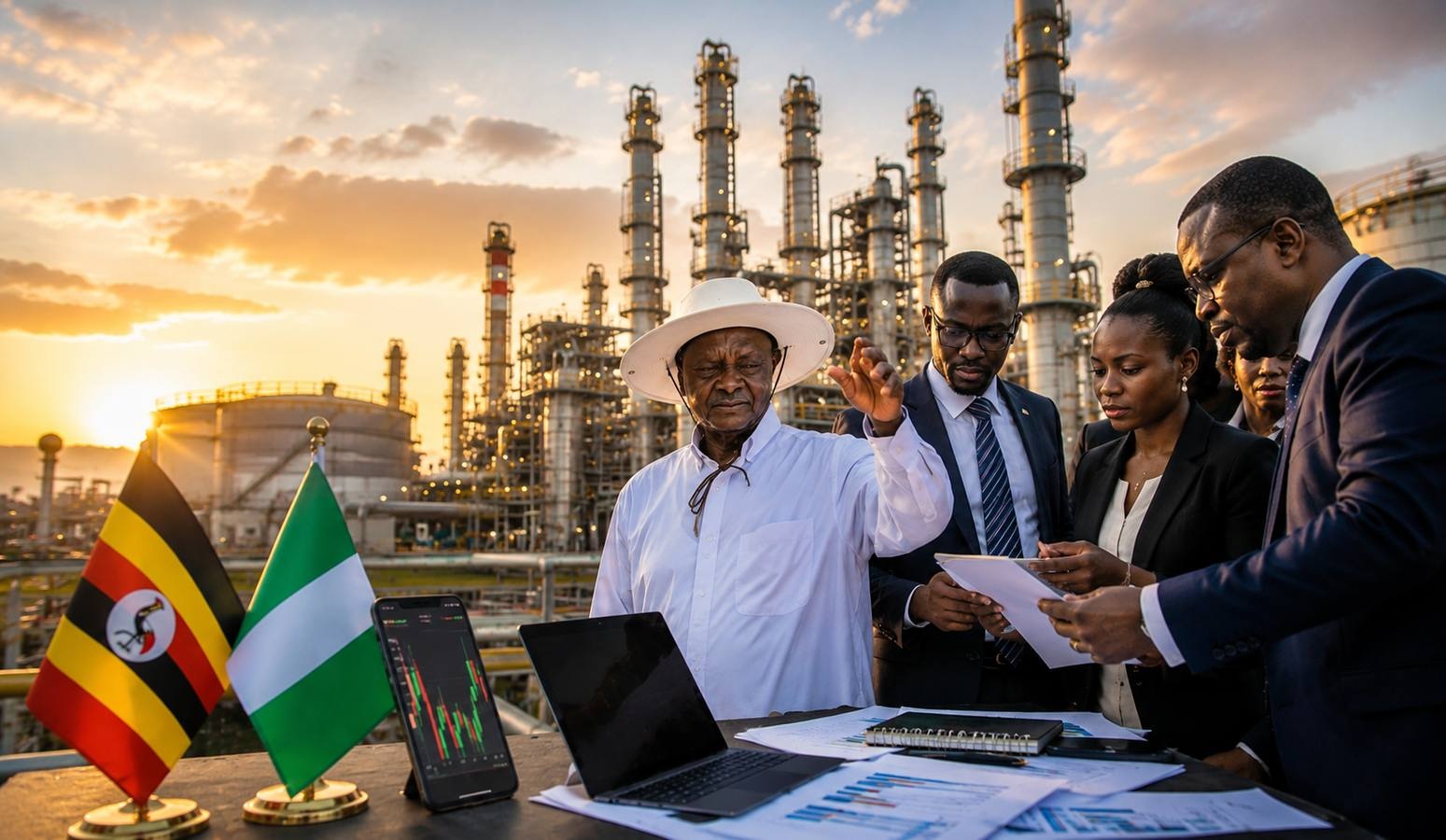
Uganda has approved participation in the initial public offering of Nigeria’s Dangote Petroleum Refinery, giving investors in the East African country access to one of the biggest corporate transactions ever attempted on the continent.
But there is a catch.
The opportunity is not open to everyone.
Uganda’s Capital Markets Authority has restricted the marketing and distribution of the Dangote refinery shares to high-net-worth individuals and professional investors, while banning mass advertising and solicitation aimed at the general public. The regulator said SBG Securities Uganda Limited is currently authorized to market the offer locally.
The decision puts Uganda at the centre of a much bigger African investment story.
For years, the continent’s most valuable companies, mines, banks, infrastructure projects and energy assets have attracted capital from international institutions and a small group of wealthy African investors.
Now, as Dangote prepares to turn its flagship refinery into a publicly traded company, the question is becoming harder to ignore:
Who will actually own Africa’s biggest businesses?
Uganda gets access, but not for everyone
The Ugandan approval came on October 6, just days before the Dangote IPO’s October 13 subscription deadline.
The Capital Markets Authority said the offer had been approved for marketing and distribution within Uganda following an application submitted on behalf of Dangote Petroleum Refinery and Petrochemicals FZE by Stanbic IBTC Capital.
However, Uganda imposed strict conditions.
The offer cannot be marketed indiscriminately to the public. Participation is restricted to high-net-worth individuals and professional investors, meaning ordinary Ugandans do not have the same direct access to the transaction.
The regulator has also stressed that its approval should not be interpreted as an endorsement of the investment or a guarantee of its financial performance.
That distinction matters.
A regulator allowing a foreign security to be marketed in Uganda is not the same as telling investors that the security is a good investment.
Investors still have to assess the refinery’s valuation, earnings, debt, currency exposure, future expansion plans and the risks of buying an asset listed in Nigeria.
The $1.6 billion bet on Dangote’s refinery
The Dangote Petroleum Refinery IPO is already being described as Africa’s largest share offering.
The company is offering 4.1 billion shares at 525 Nigerian naira each, seeking to raise about 2.15 trillion naira, or roughly $1.6 billion.
The refinery is being valued at about $47.6 billion, according to the IPO prospectus cited by Reuters. The offering opened on September 14 and is scheduled to close on October 13, with trading expected later in the year.
The numbers are extraordinary by African standards.
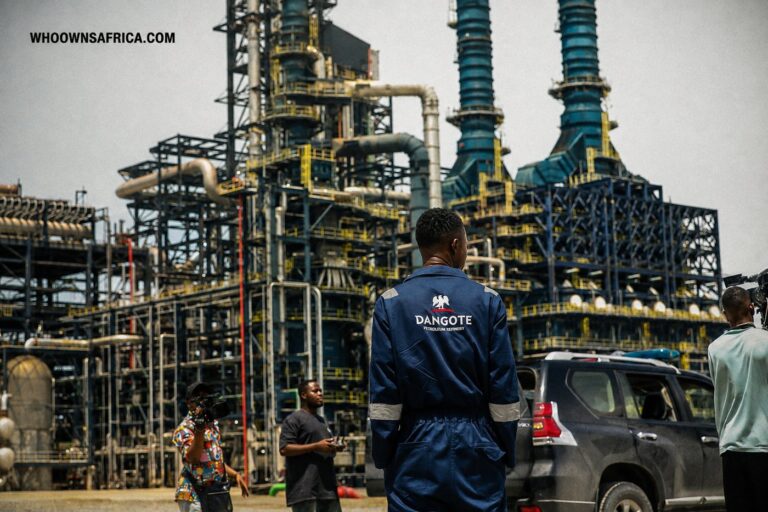
Dangote spent roughly $20 billion building the refinery over about a decade. The facility, located outside Lagos, has a processing capacity of about 700,000 barrels of crude oil per day. It began commercial operations in 2024 and has become a major force in Nigeria’s petroleum market.
The IPO is intended to raise capital for an even bigger ambition.
Dangote plans to expand the refinery’s capacity to 1.4 million barrels per day, effectively doubling its current capacity. Reuters has reported that the expansion is expected to require billions of dollars in additional investment.
For investors, that creates the central proposition behind the IPO: buy into Dangote’s refinery today and potentially participate in the growth of one of Africa’s largest energy businesses.
But the size of the opportunity is matched by the size of the risks.
Why Dangote wants millions of African shareholders
Dangote is not presenting the IPO simply as another corporate fundraising exercise.
The company has aggressively marketed the transaction as a potential “people’s IPO”, with Chief Executive David Bird saying the refinery is targeting as many as 10 million retail investors.
That target would be more than twice the roughly 4.5 million retail investors who participated in Saudi Aramco’s landmark 2019 IPO, according to Reuters.
The ambition is significant.
If Dangote succeeds, millions of Africans could become shareholders in one of the continent’s largest industrial companies.
But Uganda’s decision highlights the uneven reality of that ambition.
In Nigeria, Dangote is seeking broad retail participation. In Uganda, access has been restricted to professional and wealthy investors.
The result is a paradox at the heart of Africa’s emerging capital markets.
The continent’s biggest businesses increasingly want African investors.
But many African investors do not yet have equal access to them.
This is bigger than one IPO
The Dangote IPO matters because it comes at a time when African countries are trying to deepen their own capital markets and reduce reliance on foreign financing.
Africa has enormous pools of savings, pension assets, institutional money and private wealth.
Yet much of the continent’s major infrastructure and industrial development has historically depended on governments, development finance institutions, foreign investors and international banks.
Dangote’s IPO offers a different model.
Instead of raising all the money from a handful of banks or international institutions, the company is attempting to create a much broader shareholder base.
If successful, the model could become a blueprint for other African companies.
Imagine African pension funds owning more African infrastructure.
Imagine ordinary investors owning shares in African banks, telecommunications companies, energy producers and logistics businesses.
That would change not only who finances African development, but potentially who benefits from it.
The East African connection
Uganda’s involvement is particularly interesting because Dangote is simultaneously expanding its ambitions in East Africa.
The company is planning a separate $16 billion refinery project in Kenya’s Lamu County, designed to process about 700,000 barrels of crude oil per day.
That project is not part of the Ugandan-approved IPO.
Kenya’s Capital Markets Authority this week separately approved a mechanism allowing eligible Kenyan investors to participate in the Nigerian Dangote refinery IPO through global depository receipts.
Kenya’s regulator has made clear that the IPO concerns the Nigerian refinery and does not constitute an offer of shares in the proposed Dangote East African Petroleum Refinery project in Lamu.
That distinction is critical.
An investor buying the Nigerian Dangote refinery shares is not automatically buying into the proposed Kenyan refinery.
The two projects are separate assets.
Yet together they demonstrate how Dangote’s industrial footprint is stretching across Africa.
From Lagos to East Africa
The Nigerian refinery is already changing the economics of the country’s fuel market.
With capacity of about 700,000 barrels per day, the facility is large enough to compete with some of the world’s biggest refineries.
Dangote has also been increasing crude purchases as it ramps up operations. Reuters reported that the refinery had secured at least 16 million barrels of Nigerian crude for October deliveries, equivalent to roughly 520,000 barrels per day.
The company is therefore becoming more than a Nigerian industrial project.
It is emerging as a major African energy player.
Its expansion plans in Kenya would take that regional influence further.
The proposed Lamu refinery is intended to serve the East African market and is expected to be connected to wider regional infrastructure and petroleum supply networks.
That raises another ownership question.
As African infrastructure becomes increasingly interconnected, will African citizens own the companies building it, or will ownership remain concentrated among a small number of wealthy individuals and institutions?
The price of getting in
For Ugandan investors who qualify, the biggest question is not simply whether they can buy Dangote shares.
It is whether they should.
The IPO price is 525 naira per share, while the company is being valued at around $47.6 billion.
That valuation reflects enormous expectations about the refinery’s future earnings and expansion.
Dangote’s financial performance has improved sharply.
The refinery reported profit after tax of about 2.5 trillion naira in the first half of 2026, compared with losses in the previous two years, according to the Ugandan business press’ review of the prospectus.
But the company also carries substantial borrowings.
That means investors are not simply buying into a profitable refinery. They are buying into an ambitious expansion programme requiring additional capital.
The company’s plan to double capacity will require billions of dollars.
Whether that expansion produces returns high enough to justify the valuation is a question the market will ultimately answer.
Currency risk cannot be ignored
For Ugandan investors, there is another layer of risk.
The investment is tied to Nigeria’s capital market and therefore exposes investors to currency movements involving the Nigerian naira, Ugandan shilling and potentially the U.S. dollar.
A share can rise in local-market terms while an investor’s return in another currency is weakened by exchange-rate movements.
Cross-border investments can also involve additional custody, tax, settlement and transaction costs.
Uganda’s regulator has warned investors to consider those issues before participating.
That makes professional advice particularly important for investors who qualify.
The wealthy get the first seat
The Ugandan restriction also exposes a broader structural problem in African investing.
The continent wants to build companies that are globally competitive.
It wants African pension funds to invest locally.
It wants domestic savings converted into productive capital.
And it wants citizens to benefit from economic growth.
But access to sophisticated financial products remains uneven.
High-net-worth investors can generally access opportunities that are unavailable to ordinary households.
This does not necessarily mean the regulatory restriction is wrong. Cross-border securities can involve complex risks, and regulators have a responsibility to protect investors.
But it does highlight a difficult question for African capital markets:
How can Africa create investment opportunities for ordinary citizens without exposing inexperienced investors to risks they do not understand?
The Dangote IPO may become an important case study.
Who owns Africa?
That is the question sitting underneath the Dangote share sale.
Aliko Dangote is already Africa’s richest man and controls a vast industrial empire spanning cement, sugar, food, manufacturing and energy.
The refinery represents the culmination of that industrial strategy.
Now, through the IPO, ownership of part of that refinery is being offered to the market.
The potential transformation is enormous.
A company built through concentrated private ownership could become partially owned by thousands or millions of investors.
But ownership will not necessarily become equal.
Large institutional investors and wealthy individuals are likely to have greater financial capacity to accumulate substantial positions.
In Uganda, the restriction makes that reality particularly clear.
The opportunity exists, but it is initially aimed at those already near the top of the investment ladder.
Africa’s next ownership battle
The Dangote IPO could therefore mark more than a major Nigerian stock-market event.
It could be an early signal of a new contest for ownership of African capital.
As companies raise billions through African stock exchanges, the question will increasingly be whether African savings can finance African companies.
That could have profound consequences.
If more African pension funds, institutions and individuals become shareholders in major businesses, returns from economic growth could circulate more extensively within African economies.
If ownership remains concentrated, the wealth generated by Africa’s next industrial boom may continue to accrue to a relatively small group of investors.
Uganda’s approval puts that debate into sharp focus.
The country has opened a door to one of Africa’s biggest corporate opportunities.
But for now, only some Ugandans are being invited through it.
What happens next?
The Dangote refinery IPO closes on October 13.
The shares are expected to begin trading on the Nigerian Exchange later in the year, according to the prospectus.
For Ugandan investors, the immediate issue is eligibility and access through an authorized intermediary.
The Capital Markets Authority has made clear that its approval is not an endorsement of the investment.
For the wider African market, however, the bigger test will come after the listing.
Will investors embrace Dangote’s valuation?
Will the company successfully double refinery capacity?
Will African investors become significant shareholders?
And can a company built by one of Africa’s most powerful entrepreneurs evolve into an asset owned broadly across the continent?
Those answers will help determine whether the Dangote IPO is simply another enormous corporate fundraising exercise, or the beginning of something bigger.
Because the future of African business is not only about who builds the continent’s biggest companies. It is about who owns them.

More from Oil & Gas
Who will own Dangote refinery after the IPO?
Nigeria's SEC-approved offer sets the stage for Africa's largest share listing, reshaping ownership at the world's biggest single-train oil refinery.
How Samuel Dossou-Aworet built a $1.43 billion stake in Nigeria’s oil industry
A Benin-born engineer who once ran Gabon's national oil sector has quietly assembled one of Nigeria's largest energy fortunes today.
Libya’s $40 billion oil plan: Who will control its next energy boom?
Libya wants billions in new investment to unlock oil wealth, but security, politics and ownership could determine who benefits.