

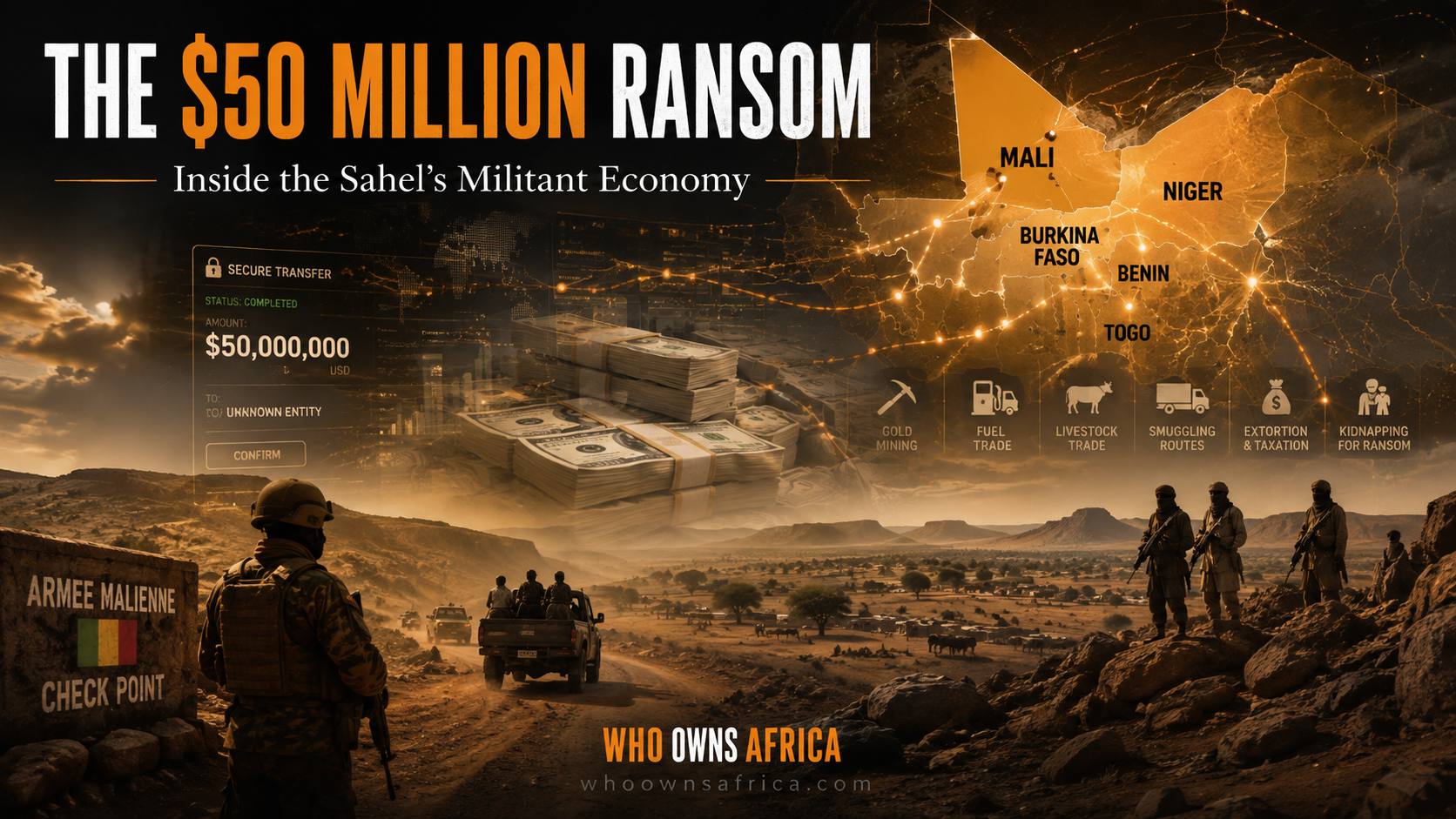
A reported $50 million ransom paid in 2025 to secure the release of a hostage held by al Qaeda-linked militants in Mali has exposed the growing financial power behind one of Africa’s most dangerous insurgencies.
United Nations experts say much of the money was channelled to fighters operating across the Sahel, helping finance an offensive by Jama’at Nusrat al-Islam wal-Muslimin, better known as JNIM.
The size of the payment is striking. But its wider significance lies in what it says about the changing economics of conflict in West Africa.
JNIM is no longer relying on a single source of income. The group has developed a broad financial network that draws money from kidnapping, extortion, taxation, illicit mining, livestock, smuggling and control of trade routes.
The reported ransom has added another powerful source of cash to that system.
For governments in Mali, Burkina Faso and Niger, as well as countries such as Benin and Togo facing growing militant pressure, the development presents a difficult challenge. Military operations may weaken fighters in the field, but disrupting the money that keeps those fighters armed, fed and mobile is a much harder task.
A ransom with regional consequences
A United Nations report on terrorism financing said kidnapping for ransom had become an increasingly important source of revenue for militant groups in the Sahel.
The report said approximately $50 million was received in 2025 for the release of a hostage held by al Qaeda-linked militants in Mali. It did not publicly identify the hostage or the country that made the payment.
Reuters, citing three regional sources, reported that the country involved was the United Arab Emirates. The sources said an Emirati citizen and two other foreign nationals were released after money changed hands.
The UAE did not directly address the reported payment. In response to questions, a UAE official said the country remained committed to combating terrorism and extremist financing.
The circumstances surrounding the hostage release remain unclear. Public information does not establish precisely how the money was transferred or how much was ultimately distributed to different militant groups.
The United Nations assessment, however, points to a significant consequence.
Much of the money went to fighters operating in the Sahel, while a portion was passed through al Qaeda’s wider network, including affiliates outside West Africa.
That means the impact of the ransom may extend far beyond Mali.
JNIM’s growing war chest
JNIM has become one of the most powerful al Qaeda-linked militant organisations in Africa.
The group operates mainly across Mali, Burkina Faso and Niger, while expanding its presence towards Benin and Togo. Its ability to move across borders has made it particularly difficult for individual governments to contain.
Its financial model is equally flexible.
In areas where militants exercise influence, they can impose taxes on communities, traders and transporters. They can demand payments from businesses and profit from livestock and natural resources.
Gold is particularly important.
The Sahel has some of Africa’s most valuable gold deposits, much of which is mined informally. Armed groups have sought to tax or control mining activity, creating a steady source of income in areas where government authority is limited.
Kidnapping provides another source of revenue.
Unlike taxation or mining, which can generate smaller amounts over time, a successful hostage negotiation can deliver millions of dollars at once.
That is what makes the reported $50 million payment so important.
A single transaction can provide an armed group with resources equivalent to a substantial portion of its normal income.
Why the money matters
Militant organisations need money for almost every aspect of an insurgency.
Cash can help pay fighters, buy food, maintain vehicles and communications equipment, support logistics and facilitate recruitment. It can also help militants build relationships with local intermediaries and maintain operations across large areas.
A large financial injection does not automatically translate into more weapons or fighters. But it gives commanders greater flexibility.
That flexibility can be decisive in a conflict where armed groups operate across vast areas and governments struggle to maintain permanent security coverage.
The UN has said the reported ransom funds played a key role in financing JNIM’s offensive in Mali.
The payment therefore matters not only because of its value, but because of its timing.
JNIM has been expanding while Mali and neighbouring countries continue to face serious security challenges. The group has demonstrated an ability to conduct attacks, collect revenue and maintain operations even when military pressure increases.
The ransom could give it additional room to manoeuvre.
Kidnapping is more than a business
For JNIM, kidnapping is not simply about collecting money.
It is also a way to demonstrate power.
When militants successfully abduct foreigners or other high-value targets, they send a message that governments cannot guarantee security across their own territory.
That can damage confidence in the state.
Businesses may reconsider investments. Foreign workers may avoid insecure regions. Aid organisations may reduce operations. Local communities may become increasingly dependent on armed groups for security, dispute resolution or access to economic activity.
The result is a cycle.
Insecurity makes economic activity more difficult. Reduced state presence creates space for militants. Militants then use that space to collect money and strengthen their operations.
Successful kidnappings can reinforce the cycle by showing that hostages can be converted into significant financial rewards.
The reported $50 million payment could therefore have consequences beyond the money itself.
It may demonstrate to militant commanders that foreign nationals remain valuable targets and that ransom negotiations can produce extraordinary returns.
The geography of the threat
The Sahel’s geography makes the problem even harder to contain.
Mali, Burkina Faso and Niger share long borders and extensive areas where government control is limited. Trade routes, livestock corridors and informal markets frequently cross those borders.
Militant groups can exploit the same networks.
A fighter can operate in one country, move supplies through another and draw revenue from communities far beyond the area where an attack takes place.
JNIM has increasingly threatened countries south of the central Sahel, particularly Benin and Togo.
This raises concern that the insecurity that has devastated parts of Mali, Burkina Faso and Niger could spread further towards West Africa’s coastal economies.
For countries such as Benin, Togo, Ghana and Côte d’Ivoire, the issue is no longer simply about protecting remote border communities.
It is about preventing militant networks from establishing the financial and logistical infrastructure needed for a sustained presence.
The changing security landscape
The financial expansion of JNIM is taking place against a major shift in the region’s political and security landscape.
Mali, Burkina Faso and Niger have moved away from many of their traditional Western security partnerships and strengthened ties with Russia.
At the same time, France and other Western governments have reduced their military presence in parts of the Sahel.
The result is a fragmented security environment.
Regional governments are attempting to build stronger national forces while dealing with insurgencies that operate across borders.
Military pressure can disrupt militant camps and kill or capture fighters. But financial networks are harder to target.
A group can lose a battlefield position and continue raising money through taxation, mining, kidnapping and smuggling.
That resilience has become one of the defining features of the Sahel conflict.
The UAE connection
The reported involvement of the United Arab Emirates adds a further layer to the story.
The UAE has developed growing economic ties with Mali and has become an important destination for gold from the country.
That relationship exists within a wider contest for influence in the Sahel, where Gulf states, Russia, China, Turkey and Western governments are pursuing different economic and strategic interests.
The reported ransom payment does not mean the UAE intended to finance JNIM.
Hostage negotiations create an extremely difficult dilemma for governments. Authorities may face pressure to secure the immediate release of their citizens, even when doing so carries longer-term security risks.
That is the fundamental problem with ransom payments to terrorist organisations.
A government may save a life today while unintentionally providing an armed group with the money it needs to conduct more kidnappings tomorrow.
The wider militant economy
The reported ransom should therefore be viewed as part of a much larger economic system.
JNIM’s strength comes from combining local sources of income with regional and international connections.
In remote areas, the group can collect taxes and fees. Around mining sites, it can benefit from gold and other natural resources. Along roads, it can impose payments on traders and transporters. Through kidnapping, it can seek much larger sums from foreign governments or families.
Each source reinforces the others.
The money allows the group to maintain fighters and logistics. Its military strength allows it to control territory. Territorial influence then creates more opportunities to collect money.
This creates a cycle in which economic power and military power continually strengthen one another.
Breaking the cycle
For governments and international partners, the lesson is increasingly clear.
Defeating Sahelian militant groups will require more than battlefield operations.
Authorities will also need to track and disrupt the financial networks that allow groups such as JNIM to operate.
That means improving intelligence sharing between neighbouring countries, strengthening monitoring of high-risk financial transactions and targeting illicit gold and smuggling networks.
It also means improving security around vulnerable economic corridors.
The challenge is that much of the Sahel’s economy operates informally. Gold, livestock, agriculture and cross-border trade support millions of legitimate livelihoods.
Efforts to disrupt militant financing therefore have to distinguish between ordinary economic activity and businesses or networks being exploited by armed groups.
That will require stronger institutions, better intelligence and closer regional cooperation.
A warning for West Africa
The reported $50 million ransom is more than a story about one hostage.
It offers a glimpse into the financial machinery helping to sustain the Sahel’s insurgencies.
For JNIM, money is not simply a resource. It is a weapon.
It can pay fighters, maintain supply lines, support recruitment and expand influence. It can also help an organisation survive military pressure and continue operating across national borders.
For Mali, Burkina Faso and Niger, the immediate challenge is to prevent militant groups from converting economic influence into permanent territorial power.
For Benin and Togo, the priority is to stop that influence from moving further south.
For international governments, the case demonstrates the difficult consequences of hostage negotiations in regions where armed groups have become sophisticated financial actors.
The biggest question now is whether the reported $50 million payment will remain an extraordinary one-off event or become a model for future militant financing.
If kidnapping continues to deliver exceptionally large returns, the incentives for further hostage-taking could grow.
The Sahel’s war is therefore no longer only a battle for territory. It is a battle for money, trade routes, natural resources and economic influence. And as JNIM expands its financial reach, controlling the flow of cash may become just as important as controlling the battlefield.
Who Owns Africa
The story of the $50 million ransom reveals a deeper reality about power in Africa’s Sahel.
Armed groups are increasingly becoming economic actors, governments are struggling to reclaim territory and international powers are competing for influence over the region’s resources and strategic corridors.
Understanding who controls those resources, who benefits from them and who finances the forces fighting for them is essential to understanding the future of West Africa.

More from Politics
Libya: Who really owns the state?
Libya’s oil wealth is expanding, but political fragmentation exposes the deeper struggle over institutions, military power and national sovereignty.
Abiy Ahmed begins new term as Ethiopia faces security and regional challenges
Ethiopia’s new political chapter begins with a stronger mandate, but unresolved conflicts and regional rivalries could define Abiy Ahmed’s second term.

Wicknell Chivayo: What his rise reveals about Zimbabwe’s business and political elite
The rise of Wicknell Chivayo reveals how wealth, state contracts, philanthropy and political access are reshaping Zimbabwe’s modern power structure.