

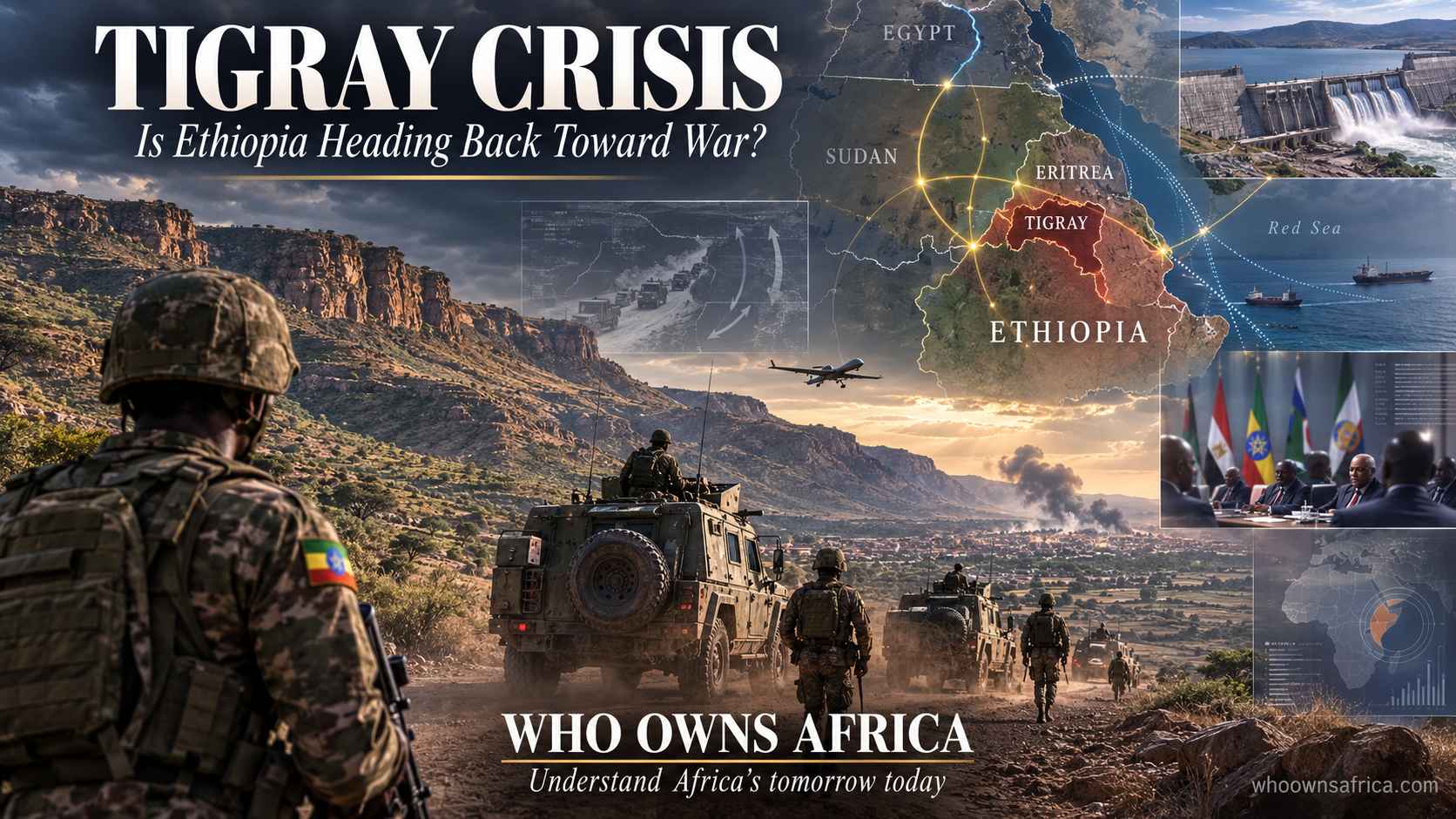
Ethiopia’s fragile peace in Tigray is facing its most serious test since the 2022 ceasefire, after renewed fighting, military mobilisation and a series of reported drone strikes raised fears that the country could slide back into a wider war.
The immediate confrontation remains centred on the Ethiopian federal government and the Tigray People’s Liberation Front (TPLF), but the stakes extend far beyond the northern region. Eritrea, Sudan and Egypt all have interests tied to Ethiopia’s security and regional ambitions, meaning another Tigray war could quickly become a broader Horn of Africa crisis.
A fragile peace under pressure
The latest escalation follows years of political disputes that have steadily weakened the Pretoria peace agreement, signed in November 2022 to end the devastating two-year Tigray war. That conflict killed hundreds of thousands of people, displaced around one million and left Tigray with a shattered economy and deeply damaged public services. The agreement stopped the large-scale fighting, but many of the political questions that fuelled the war remained unresolved.
The most immediate warning came on Aug. 1, when fighting broke out around Shererina in western Tigray near the Sudanese border. Reports described clashes involving federal forces and Tigrayan fighters, with artillery and drones used during the confrontation. Both sides blamed the other for starting the fighting. Ethiopian officials accused TPLF forces of initiating the confrontation, while Tigrayan authorities said federal forces launched an offensive. Independent verification of competing casualty claims has been difficult.
The fighting was followed by reports of additional military deployments and growing tension along several fronts. While there was a lull after the Aug. 1 clashes, analysts warned that the absence of sustained fighting did not necessarily mean the underlying crisis had been resolved. Forces on both sides remained positioned for confrontation, creating the possibility that a local incident could trigger a much larger military response.
Drone strikes raise the stakes
The situation became more dangerous in August as reports of drone strikes added a new dimension to the confrontation.
On Aug. 18, Tigrayan authorities accused the federal government of carrying out a drone strike near Mekelle. The reported attack occurred in Dandera, about 15 kilometres from the regional capital. Tigrayan authorities said there were no injuries, while a local source cited by AFP said at least one person was killed. Ethiopia’s federal army did not immediately comment on the allegation.
Two days later, another reported drone strike hit a residential area in Mekelle. A hospital official told AFP that at least 13 people were injured, including five children and seven women. Three of the injured were reported to have suffered serious injuries. Tigrayan authorities blamed the federal government, while the federal army had not immediately responded to requests for comment. A second strike was also reported near Mekelle University.
The significance is not simply the number of casualties. Drone warfare changes the calculation for both sides. It allows a government or armed group to strike targets without immediately committing large numbers of ground troops, but it can also increase the risk of escalation by making military action easier to launch. The reported strikes have therefore added to fears that Ethiopia’s northern crisis is moving from political confrontation towards sustained military pressure.
Why the Pretoria deal is weakening
At the centre of the crisis is a dispute over who governs Tigray and under what constitutional arrangement.
The Pretoria agreement established an interim administration for Tigray while political and security arrangements were worked out. The system was designed to prevent the immediate return of the pre-war political order and create space for disarmament, reconciliation and eventual elections.
That framework has increasingly come under pressure.
In 2025, the federal government revoked the TPLF’s legal status as a political party, deepening the confrontation. In 2026, the TPLF hardline faction consolidated its control in Tigray and rejected the extension of the federally backed interim administration. The group subsequently reinstated the regional legislative council and selected TPLF chairman Debretsion Gebremichael as president of Tigray.
For Addis Ababa, that amounted to a challenge to federal authority. For Tigrayan leaders, it reflected frustration over what they regard as failures to implement the peace agreement, particularly regarding contested territories and political representation.
The result is a dangerous political vacuum. The institutions created by the peace deal are losing authority, while neither side has developed a trusted mechanism for resolving disputes.
The unresolved western Tigray question
One of the most explosive issues is western Tigray, an area claimed by both Tigrayan and Amhara actors.
The territory became a major battlefield during the 2020-2022 war and remains central to the post-war dispute. The presence of Amhara forces in parts of western Tigray has been a longstanding source of tension, while Tigrayan leaders have demanded the return of displaced populations and resolution of territorial questions.
The Aug. 1 fighting occurred in precisely the wider border zone where these disputes intersect with Ethiopia’s frontier with Sudan. That geography makes the conflict particularly dangerous.
A renewed battle for western Tigray would not only reopen old ethnic and territorial grievances. It could also increase refugee flows into Sudan and place additional pressure on a country already struggling with its own devastating civil war.
Sudan becomes part of the equation
The Sudan dimension is critical.
Tigray shares a border with Sudan, and reports have indicated that Tigrayan fighters have operated from Sudanese territory. After the Aug. 1 fighting, refugees and wounded fighters reportedly crossed into Sudan. There were also reports that projectiles from the fighting landed on Sudanese territory.
Relations between Addis Ababa and Khartoum have deteriorated sharply. Sudan’s army-led government has accused Ethiopia of supporting or facilitating forces fighting in Sudan, while Ethiopia has accused Sudan of supporting the TPLF.
The danger is that the Tigray conflict could become entangled with Sudan’s war between the Sudanese Armed Forces and the Rapid Support Forces. Each side in Ethiopia could seek external partners, turning an internal Ethiopian confrontation into another layer of the Horn’s increasingly complex proxy conflicts.
Eritrea’s strategic role
Eritrea may be the most consequential external actor.
Ethiopia and Eritrea were once close allies against the TPLF during the 2020-2022 war. That relationship has since deteriorated dramatically. The two countries now have competing strategic interests, particularly around Ethiopia’s ambition to secure reliable access to the Red Sea.
Eritrea’s port of Assab is particularly important in that calculation. Ethiopia is landlocked and has repeatedly emphasised the strategic importance of sea access. Eritrea, meanwhile, has strongly resisted any arrangement that could threaten its sovereignty or territorial control.
Analysts say Eritrea has maintained contact with Tigrayan hardliners and could potentially support the TPLF if a larger conflict erupts. Several reports have pointed to closer ties between Eritrean and Tigrayan actors as relations between Asmara and Addis Ababa deteriorated.
A renewed Ethiopia-Tigray war could therefore reopen the possibility of direct or indirect Eritrean involvement, dramatically increasing the military stakes.
Where does Egypt fit?
Egypt’s interest is less direct but strategically significant.
Cairo has long been locked in a dispute with Addis Ababa over the Grand Ethiopian Renaissance Dam on the Blue Nile. Egypt depends heavily on the Nile for water, while Ethiopia views the dam as a central part of its development strategy and energy ambitions.
Egypt has also developed closer relations with countries that have strategic interests in limiting Ethiopian influence in the Horn of Africa and the Red Sea.
The Tigray crisis does not automatically mean Egypt would become a military participant. But any prolonged weakening of the Ethiopian government could alter the regional balance around the Nile, Sudan and the Red Sea. That makes Ethiopia’s internal stability a matter of strategic importance to Cairo.
The broader pattern is clear: Ethiopia’s domestic conflicts increasingly overlap with the geopolitical competition surrounding the Horn of Africa.
Who benefits if Ethiopia weakens?
For Who Owns Africa, this is perhaps the central question.
A prolonged Tigray conflict would have no simple winner. Ethiopia’s federal government would face enormous military, economic and political costs. Tigray would again bear the humanitarian burden of fighting. Sudan could receive another wave of refugees and face greater insecurity along its eastern border.
But strategic competitors could gain room to manoeuvre.
Eritrea could use a weakened Ethiopian government to strengthen its position on the Red Sea. Sudanese actors could exploit Ethiopia’s distraction. Armed groups elsewhere in Ethiopia could expand their operations if federal forces are redeployed north. External powers could also deepen their relationships with Ethiopian factions and neighbouring states.
The danger for Prime Minister Abiy Ahmed’s government is therefore not simply another Tigray war. Ethiopia is already dealing with security challenges involving Amhara and Oromo armed groups. A major northern war would stretch the state’s military and financial resources while increasing political pressure on the government.
What happens next?
The immediate question is whether the Aug. 1 clashes and subsequent drone strikes remain isolated incidents or become the opening phase of another war.
There are still reasons for restraint. Ethiopia faces serious economic and security pressures, while the TPLF is internally divided and does not possess the same political position it held before the 2020 war. Both sides also understand the enormous human and economic cost of returning to full-scale conflict.
But restraint cannot be assumed.
The breakdown of trust is itself dangerous. Military mobilisation, political exclusion, disputed territorial control and competing narratives over who started the fighting can create a cycle in which every defensive move is interpreted as preparation for an attack.
The international community therefore faces a narrow window to act. Diplomacy will need to address more than the latest clashes. It must tackle the political status of Tigray, disputed territories, the future of the interim administration, the position of armed forces and the unresolved relationship between Addis Ababa and Mekelle.
The bigger Horn of Africa picture
Ethiopia’s Tigray crisis is no longer simply an Ethiopian problem.
The region sits at the intersection of Sudan’s war, Eritrea’s security calculations, Egypt’s Nile interests and the wider competition for influence across the Red Sea and Horn of Africa. Any renewed Ethiopian civil war would reverberate across those borders.
The Pretoria agreement has not necessarily disappeared as a diplomatic reference point, but its political foundations have been badly weakened. The Aug. 1 fighting and August drone strikes demonstrate how quickly the gap between political confrontation and armed conflict can narrow.
For Ethiopia, the central challenge is to prevent another war before military mobilisation becomes irreversible. For Tigray, the challenge is to secure political representation and unresolved post-war demands without returning to armed confrontation.
And for the wider Horn of Africa, the question is bigger still: can Ethiopia contain its internal struggle before its neighbours become unwilling participants in another regional conflict?
For now, the answer remains uncertain. What is clear is that the peace achieved in Pretoria in 2022 is under its most serious pressure yet.
Who Owns Africa will continue to track the political, military and economic interests shaping Ethiopia and the wider Horn of Africa.

More from Politics
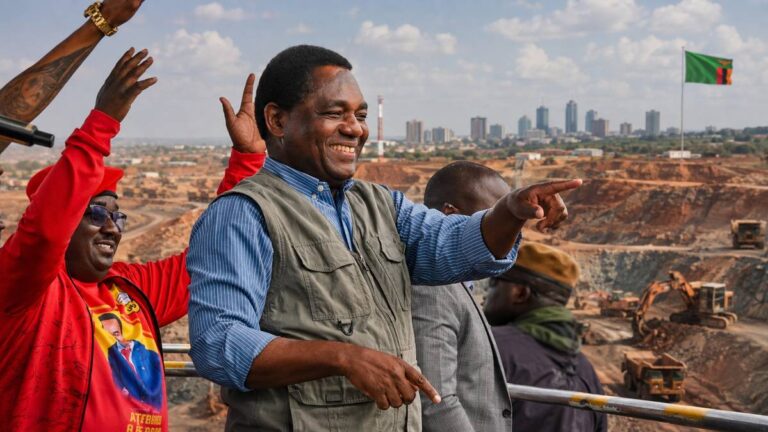
Zambia’s Hichilema wins a second term: What it means for Africa’s copper economy
Zambia’s copper boom is entering a critical phase as President Hakainde Hichilema begins a second term focused on investment, production and local value.
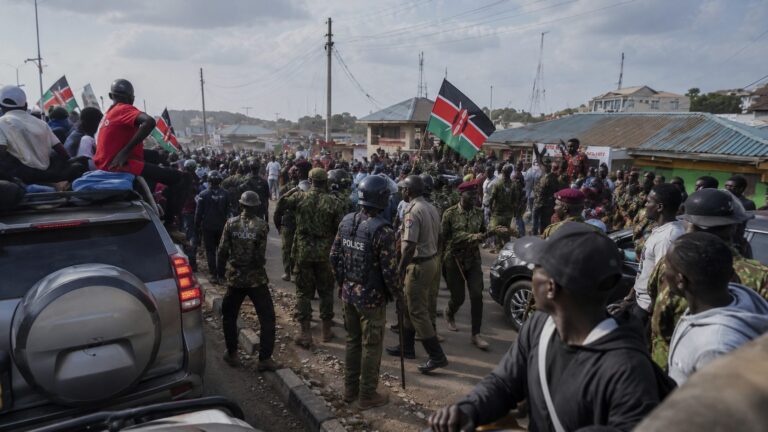
Homa Bay violence exposes Kenya’s deepening political fault lines ahead of 2027
The Homa Bay violence surrounding the Linda Mwananchi campaign has intensified concerns over political intolerance as Kenya’s 2027 election approaches.