

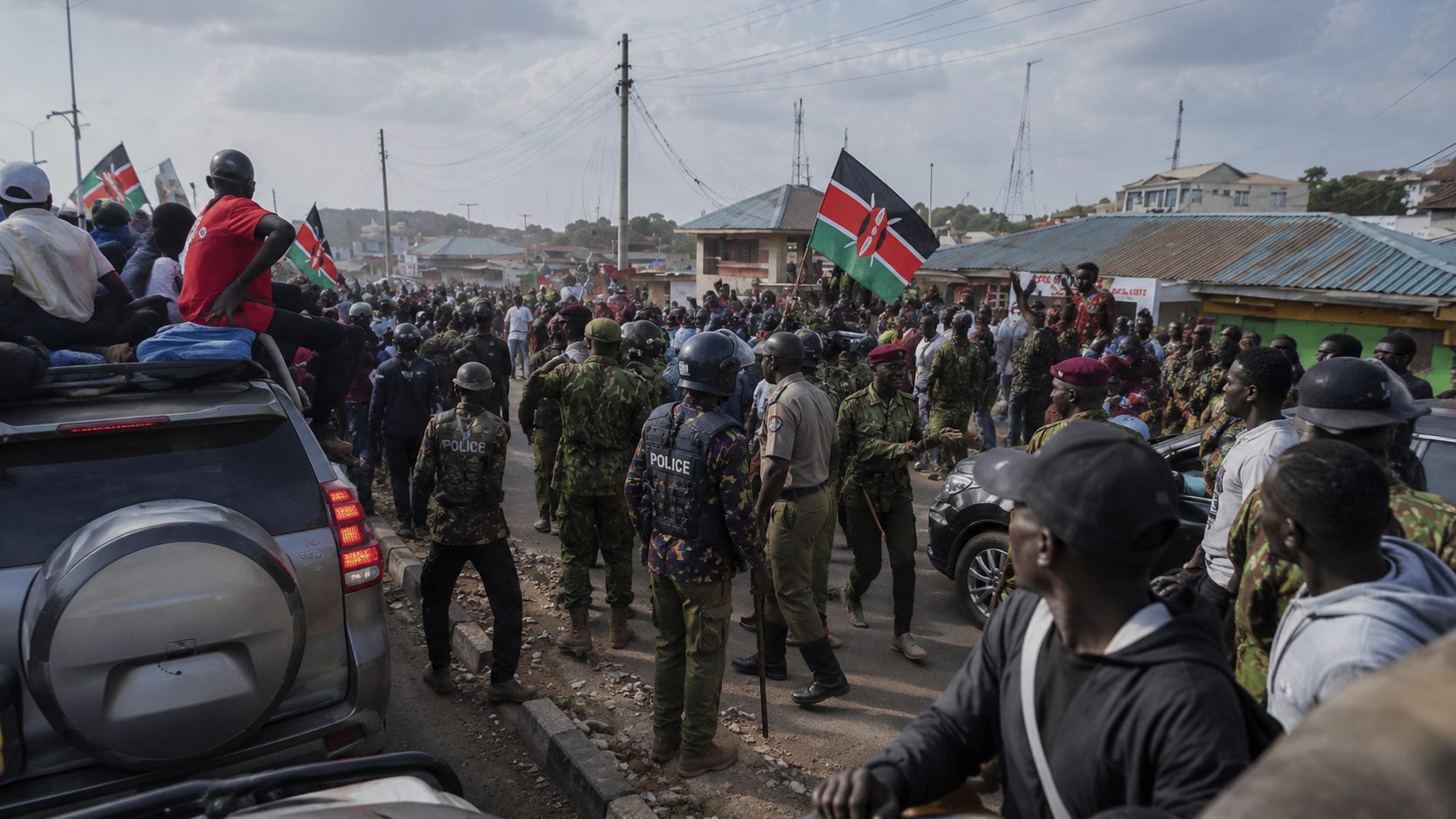
The Homa Bay violence that disrupted the Linda Mwananchi campaign has exposed growing political tensions in one of Kenya’s most closely watched regions, raising fresh questions about political tolerance, security and the increasingly competitive race ahead of the 2027 general election.
The confrontation has quickly moved beyond a local political dispute.
Reports of clashes, injuries, attacks on journalists and disruption of political activities have placed Homa Bay at the centre of a wider debate about Kenya’s political direction. Leaders have traded accusations over responsibility, while calls for investigations have intensified.
For a country with a long history of election-related political violence, the events carry significance far beyond Homa Bay County.
The timing is also important. Kenya is still more than a year away from the 2027 general election, but political alliances are already shifting, established parties are defending their strongholds and new movements are attempting to build support.
The Homa Bay violence therefore offers an early glimpse of the political tensions that could shape the next election.
Why Homa Bay matters
Homa Bay has long been an important political centre in Nyanza and is closely associated with the opposition politics built around the late Raila Odinga.
That history makes the county more than another electoral battleground.
Political control in Homa Bay carries symbolic weight. It is also part of the larger contest for influence across Nyanza, a region whose voters have traditionally played a significant role in national elections.
The Linda Mwananchi campaign has entered that political environment at a sensitive moment.
Its efforts to mobilise supporters and establish a political presence have collided with existing political interests, creating a contest over who can organise, speak to voters and command political loyalty.
The resulting confrontation has turned Homa Bay into an important case study in Kenya’s emerging 2027 politics.
Linda Mwananchi campaign
The Linda Mwananchi campaign has attracted attention as political actors position themselves for the next general election.
Its activities in Homa Bay were expected to provide an opportunity for political mobilisation and engagement with voters. Instead, the confrontation surrounding the campaign has highlighted the difficulties facing emerging political movements in areas dominated by established political networks.
The central issue is not simply which political group can attract the biggest crowd.
It is whether different political organisations can operate peacefully in the same electoral space.
In a democracy, voters should be able to listen to competing political messages and make their own decisions. Political parties and movements should also be able to organise within the law without facing intimidation or violence.
When political competition becomes a physical confrontation, the democratic process suffers.
Violence shifts the political debate
The Homa Bay political violence has also raised concerns about the safety of journalists covering political events.
Reports that journalists were attacked and equipment damaged are particularly troubling because independent media play a crucial role during election periods.
Political campaigns generate competing versions of events. Journalists are expected to document those events, question political claims and provide voters with information.
If reporters cannot safely cover political gatherings, the public loses an important source of independent information.
The same principle applies to ordinary voters and political supporters.
Citizens should not have to fear violence because they attend a political meeting, support a particular candidate or belong to a particular political movement.
The response to the Homa Bay violence will therefore be closely watched.
Calls for investigations
Political leaders and other stakeholders have called for investigations into the confrontation.
That response is important, but the credibility of any investigation will depend on whether it is independent, evidence-based and applied without political favour.
Kenya’s security agencies face a difficult responsibility.
They must protect political gatherings while avoiding the perception that security is being used to favour one political camp over another. At the same time, individuals accused of criminal conduct should be held accountable where evidence supports prosecution.
The investigation should establish what happened, identify those responsible for acts of violence and determine whether there were failures in security arrangements.
Political leaders also have a responsibility to avoid inflaming tensions through unverified accusations.
Kenya’s 2027 succession battle
The Homa Bay violence cannot be separated from the broader contest already taking shape around the 2027 presidential election.
President William Ruto is expected to seek a second term, while opposition figures and emerging political movements are positioning themselves to challenge his administration.
The political landscape is considerably more fluid than in previous election cycles.
Longstanding alliances are changing. Some opposition politicians have moved closer to the government, while others are seeking to maintain a stronger opposition position. New political formations are also looking for space among voters who may not feel represented by traditional parties.
That fluidity is particularly visible in regions that have historically voted as political blocs.
Nyanza is therefore likely to remain a major focus of the 2027 succession battle.
The battle for Nyanza
Who controls political influence in Nyanza could become an important question in the next election.
For decades, Raila Odinga was the region’s dominant political figure. His influence extended well beyond Homa Bay and helped establish Nyanza as a reliable opposition base.
His absence from the 2027 contest creates a significant political vacuum.
Several leaders and movements are likely to compete for that space.
The contest will not necessarily produce a single political heir. Instead, voters may see competing claims from established politicians, government-aligned leaders and new movements.
That makes counties such as Homa Bay strategically important.
Political actors who can build credible grassroots structures in the region could gain influence beyond Nyanza and potentially affect the wider national electoral equation.
Lessons from Kenya’s past
Kenya’s political history makes any report of election-related violence significant.
The country experienced severe post-election violence after the disputed 2007 presidential election. More than 1,000 people were killed and hundreds of thousands displaced.
The violence exposed the dangers of political competition when ethnic mobilisation, institutional weaknesses and contested electoral outcomes combine.
Since then, Kenya has invested heavily in electoral reforms and institutions intended to prevent a repeat.
But institutions alone cannot guarantee peaceful elections.
Political leaders must also respect democratic rules, security agencies must act impartially and citizens must be able to participate without fear.
That is why the Homa Bay violence deserves attention well before the 2027 election campaign reaches its peak.
Political tolerance under pressure
At the heart of the Homa Bay dispute is a basic question about political tolerance.
Can competing political groups campaign in areas controlled by rival parties?
The answer should be yes.
Kenya’s Constitution provides citizens with political rights, including the freedom to participate in political activities. Those rights become particularly important during election periods.
A political stronghold should not become a political no-go zone.
Likewise, an opposition campaign should not be treated as an automatic threat simply because it challenges established political interests.
The responsibility for protecting that space rests with political leaders and state institutions.
What Homa Bay means for 2027
The significance of the Homa Bay violence extends beyond the immediate confrontation.
It provides an early warning about the political environment that could develop as the 2027 election approaches.
If political competition becomes increasingly defined by confrontation, intimidation and accusations of violence, similar incidents could emerge elsewhere.
If, however, authorities respond firmly and transparently, Homa Bay could become an example of institutions addressing political violence before it spreads.
That distinction matters.
Kenya’s political class has more than a year to lower the temperature of the 2027 campaign. Political leaders can choose to compete through policies, ideas and voter engagement rather than confrontation.
Voters also have an important role.
The strength of Kenya’s democracy ultimately depends on citizens being free to make political choices without intimidation.
The road to 2027
The Homa Bay violence has brought an uncomfortable reality into sharper focus: Kenya’s 2027 election is already influencing political behaviour.
The succession battle is no longer a distant conversation among national politicians. It is increasingly being felt at county level, where political networks are competing for influence and new movements are attempting to establish themselves.
Homa Bay is particularly important because of its political history and its position within the wider Nyanza power structure.
The immediate challenge is to establish the facts surrounding the violence and ensure accountability where wrongdoing is proven.
The longer-term challenge is bigger.
Kenya must ensure that political competition remains peaceful, open and democratic as the country moves toward 2027.
The ballot box, rather than the street, should determine political power.
For Homa Bay, the events surrounding the Linda Mwananchi campaign are therefore more than another political confrontation. They are an early test of whether Kenya can manage an increasingly competitive succession battle without allowing political differences to become violence.
And with the 2027 election approaching, that test has only just begun.

More from Politics
Africa takes on the world map: UN backs a new picture of the continent
A Togo-led campaign to correct distorted world maps gives Africa a symbolic victory over geography, perception and colonial-era narratives.
Niger’s attempted mutiny raises questions over who profits from Sahel instability
Failed uprising highlights the intersection of military rule, foreign influence, strategic minerals and regional security in one of Africa's most volatile regions.
Ethiopia’s Tigray crisis is back: Who is fighting for control of the Horn of Africa?
Renewed clashes, drone strikes and collapsing trust threaten Ethiopia’s fragile peace while drawing Eritrea, Sudan and Egypt deeper into regional rivalry.