

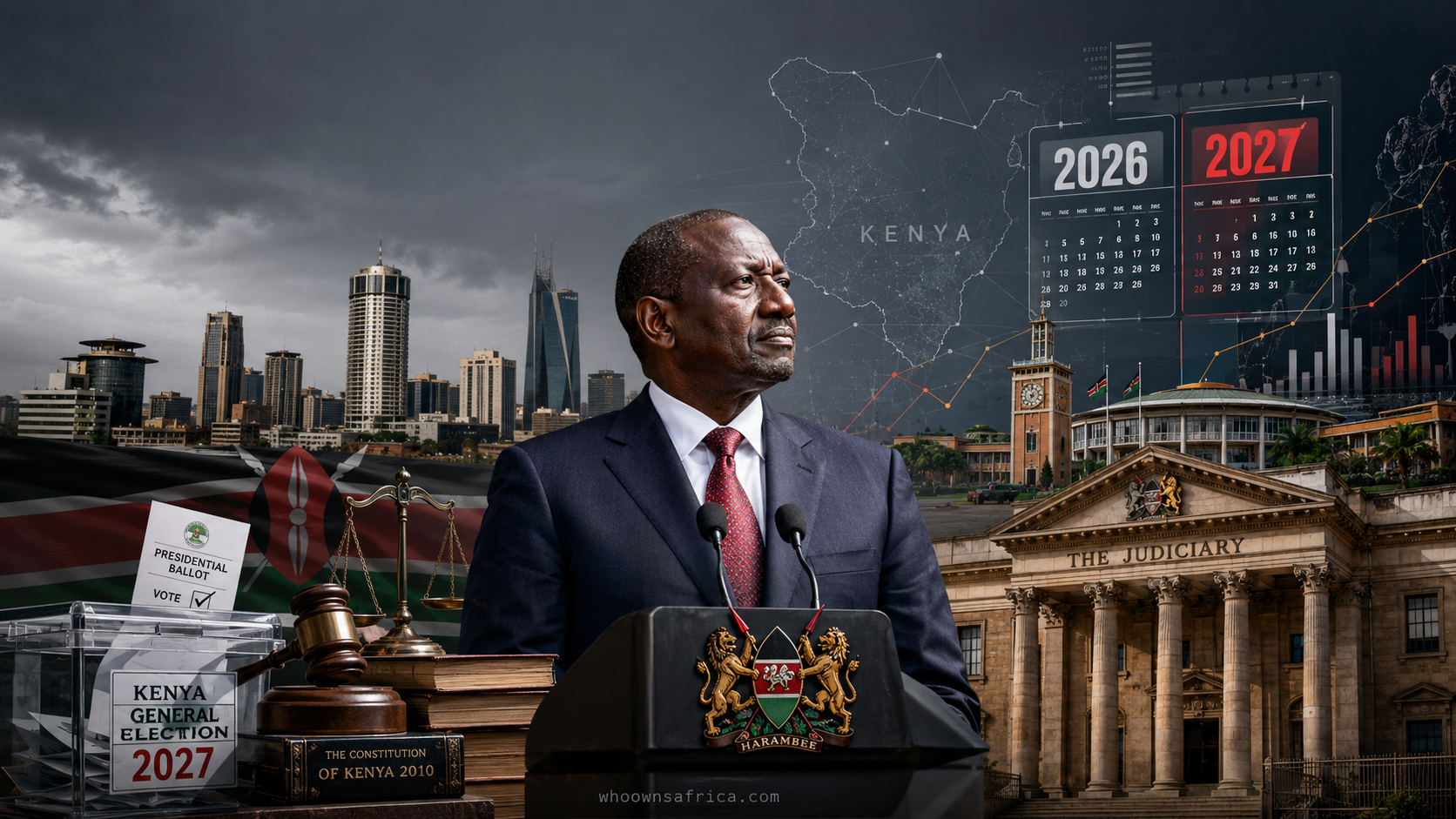
Kenya’s 2027 election plans face fresh uncertainty after the High Court ruled that the next presidential election could be constitutionally due in 2026 rather than 2027.
The ruling has triggered debate over presidential term limits, the election timetable and the interpretation of Kenya’s Constitution.
It also puts President William Ruto and the Independent Electoral and Boundaries Commission, or IEBC, under renewed scrutiny.
The IEBC has been preparing for the next general election in August 2027. Its current election operations plan sets Tuesday, Aug. 10, 2027 as the date for the poll.
The court ruling has now introduced a competing interpretation of when Kenyans should next elect their president.
What the court ruling means
The dispute centres on Article 136 of Kenya’s Constitution.
The article provides for a presidential election on the second Tuesday in August every fifth year following the previous election.
Kenya last held its general election on Aug. 9, 2022. Ruto won the presidential contest after defeating opposition leader Raila Odinga.
The latest ruling has raised a key constitutional question.
Does the five year period mean Kenya should hold its next presidential election in 2026, or does the established electoral timetable allow the country to vote in 2027?
The court has not ordered Kenyans to vote immediately.
It suspended the effect of its declaration, allowing the legal process to continue and giving the affected parties an opportunity to appeal.
Ruto therefore remains president while the dispute is considered by the courts.
Why the ruling matters to Ruto
The controversy comes at a critical time for Ruto.
His administration has been preparing for the 2027 political contest while working to strengthen its national political coalition.
A 2027 election would give the government more time to implement its policies, defend its economic record and build support for a second term.
An election in 2026 would change that calculation.
Ruto and his allies would have less time to prepare for the campaign. Political parties would also have to accelerate candidate selection, coalition building and voter mobilisation.
The dispute could therefore affect the strategy of both the government and opposition.
Kenya’s 2027 election preparations
The IEBC has already invested significant effort in preparing for the Kenya 2027 election.
Its election operations plan covers voter registration, political party activities, candidate nominations and polling preparations.
It identifies Aug. 10, 2027 as the scheduled date for the general election.
Changing that date would create a major logistical challenge.
Kenya’s general election includes the presidential race as well as elections for Parliament, governors and county assemblies.
The IEBC would need to review voter registration, ballot preparation, election technology, polling stations, staffing and security arrangements.
An earlier election could also leave less time for testing electoral systems and resolving technical problems.
That makes the court dispute important not only for politicians but also for the credibility of the electoral process.
A bigger constitutional battle
The case is about more than an election date.
It raises questions about how Kenya interprets its Constitution and calculates presidential terms.
Since the adoption of the 2010 Constitution, Kenya’s courts have played an increasingly important role in resolving disputes involving elections and government institutions.
The Supreme Court demonstrated that role in 2017 when it annulled the presidential election and ordered a fresh poll.
The latest case could become another important test of judicial authority.
If the ruling is appealed, higher courts could eventually provide a final interpretation of the constitutional provisions governing the election timetable.
That decision could settle the question of whether the next presidential election should be held in 2026 or 2027.
What happens next
The immediate focus is likely to shift to the appeal process.
The High Court ruling can be challenged before the Court of Appeal. Constitutional questions of national importance could eventually reach the Supreme Court.
Until the legal process is completed, Kenya faces an unusual situation.
The IEBC is preparing for a 2027 election while a court ruling has raised the possibility of an earlier presidential vote.
Political parties will therefore have to watch the courts while continuing their preparations.
Potential presidential candidates may also have to consider both scenarios.
Impact on political alliances
Kenya’s presidential elections are heavily influenced by political alliances.
Since taking office, Ruto has worked to expand his political support beyond his traditional base.
The opposition, meanwhile, has been attempting to build a stronger coalition ahead of the next election.
The uncertainty over the election date could accelerate those efforts.
An earlier election would leave parties with less time to negotiate alliances and select candidates.
It could also force politicians to begin campaigning earlier than expected.
For the opposition, the court ruling provides another opportunity to challenge the government.
For Ruto’s administration, the priority will be to maintain political stability while defending its position on the election timetable.
Why investors are watching
The election dispute also has economic implications.
Kenya is East Africa’s largest economy and an important regional centre for finance, trade and transport.
Investors closely follow political developments because elections can affect government policy, public spending and business confidence.
An unexpected change to the election timetable could increase uncertainty for businesses preparing for the next political cycle.
The government is already dealing with fiscal pressures and difficult economic reforms.
A shortened political timetable could add further pressure to government spending and economic policy.
However, the economic impact will depend largely on the outcome of the legal process.
For now, the ruling has created uncertainty rather than an immediate change to the election calendar.
What it means for Kenya 2027
The central question is whether Kenya will vote in 2026 or proceed with the planned 2027 election.
The answer will ultimately depend on the courts.
The ruling has nevertheless changed the political conversation.
The Kenya 2027 election can no longer be viewed simply as a fixed date on the political calendar. Its constitutional basis is now being challenged.
For Ruto, that creates uncertainty around his second term strategy.
For opposition parties, it creates another avenue for political pressure.
For the IEBC, it presents a difficult planning challenge.
For voters, it raises important questions about presidential terms and the constitutional rules governing elections.
Kenya’s election clock
The High Court ruling has not automatically cancelled the 2027 election timetable.
The IEBC continues to identify Aug. 10, 2027 as the date for the next general election in its published plan.
But the legal challenge means that date is now part of a much wider constitutional debate.
The final outcome could determine how Kenya interprets presidential tenure and its five year electoral cycle.
It could also shape the political environment surrounding Ruto’s second term ambitions.
For Kenya, the stakes are bigger than the date on the ballot paper.
The case tests the relationship between the judiciary, the presidency and the electoral commission.
It also tests the strength of Kenya’s constitutional system at a time when political alliances are already shifting.
The road to the Kenya 2027 election may therefore be decided not only on the campaign trail, but also in the courtroom.

More from Politics
Abiy Ahmed begins new term as Ethiopia faces security and regional challenges
Ethiopia’s new political chapter begins with a stronger mandate, but unresolved conflicts and regional rivalries could define Abiy Ahmed’s second term.

Wicknell Chivayo: What his rise reveals about Zimbabwe’s business and political elite
The rise of Wicknell Chivayo reveals how wealth, state contracts, philanthropy and political access are reshaping Zimbabwe’s modern power structure.
Ethiopia is sliding back into war: Who is really behind the new Tigray conflict?
Ethiopia's renewed Tigray war is exposing a dangerous struggle over power, borders, sea access and influence across the Horn of Africa.