

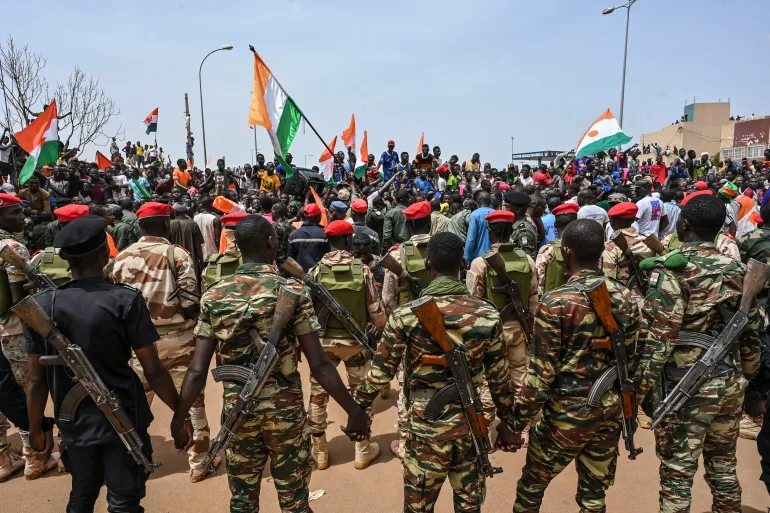
Niger’s failed mutiny has once again placed the spotlight on the Sahel, where security crises increasingly overlap with competition for strategic influence, natural resources and military partnerships. While authorities said loyal forces regained control after disaffected soldiers attacked key military installations in Niamey, the incident has renewed debate over who ultimately benefits from prolonged instability in a region that has become a geopolitical battleground.
The attempted mutiny was the most serious internal challenge faced by Niger’s military government since it seized power in a 2023 coup. Fighting erupted around strategic locations including a military airbase near Diori Hamani International Airport and areas surrounding the presidential palace. Government forces eventually regained control after hours of clashes, restoring calm in the capital, but the violence exposed deep fractures within an army already struggling to contain a growing jihadist insurgency.
The unrest comes at a difficult moment for Niger and the wider Sahel. Military governments in Niger, Mali and Burkina Faso all came to power promising stronger security and an end to extremist violence. Instead, attacks linked to Islamic State affiliates and al Qaeda aligned groups have intensified across large parts of the region, raising questions about whether military rule has delivered the stability many citizens expected.
A military under pressure
Analysts say the mutiny reflected frustration among soldiers deployed in frontline regions where casualties have mounted in recent years. Many of the troops involved reportedly came from areas hardest hit by militant attacks, where overstretched security forces face increasingly sophisticated insurgent operations.
Although Niger’s authorities described the uprising as an isolated act by disgruntled officers, the episode highlighted broader concerns about morale inside the armed forces. Soldiers operating in insecure regions often face shortages of equipment, difficult terrain and sustained attacks from well-organized militant groups.
The mutiny also diverted military attention from counterterrorism operations at a time when extremist organizations continue to exploit weak state control across vast stretches of the Sahel. Security experts warn that every period of internal political instability creates opportunities for insurgent groups to regroup, recruit fighters and expand their influence.
Rising defense spending
Security has become the dominant priority across the Sahel, prompting governments to devote growing portions of national budgets to defense.
Niger has expanded military recruitment, increased spending on equipment and strengthened security operations since the 2023 coup. Similar trends are visible in neighboring Mali and Burkina Faso, where military governments argue stronger armed forces are essential to restoring stability.
However, rising defense budgets also carry economic consequences. Every additional dollar directed toward military operations reduces resources available for education, healthcare, infrastructure and economic development. In countries where poverty and unemployment remain widespread, those trade-offs can deepen public frustration and create conditions that extremist groups exploit for recruitment.
The failed mutiny demonstrated that increased military spending alone cannot resolve institutional challenges within armed forces. Without improvements in leadership, logistics, troop welfare and accountability, financial investment may have only limited impact on long-term security.
New foreign military partnerships
Since taking power, Niger’s military government has dramatically reshaped its international security relationships.
The junta ended military cooperation with several Western partners while strengthening ties with Russia. During the latest mutiny, Russia’s Africa Corps reportedly assisted loyal government forces after Niger requested support, underscoring Moscow’s expanding security role in the country. Algeria also expressed support and provided military assistance during the crisis, reflecting wider regional concern over instability spreading across borders.
These developments illustrate the broader geopolitical shift underway in the Sahel. Western governments have reduced their military footprint in several countries following deteriorating relations with military juntas. Russia has filled part of that vacuum through defense cooperation agreements, military advisers and security assistance.
For Niger’s leadership, diversifying foreign partnerships is presented as a way to strengthen national sovereignty and reduce dependence on traditional allies. Critics argue, however, that changing international partners does little to address the structural causes of insecurity, including weak governance, poor economic opportunities and fragile institutions.
Mining wealth attracts global attention
Niger’s strategic importance extends well beyond security.
The country possesses some of Africa’s largest uranium reserves while also producing gold and oil. Uranium has long been central to Niger’s export economy, supplying international energy markets and making the country strategically significant for governments seeking reliable access to critical minerals.
Since taking power, the military government has sought greater control over the mining sector, including actions affecting French uranium interests. Officials argue that Niger should receive a greater share of the benefits generated by its natural resources, while investors have expressed concerns about policy certainty and investment security.
Political instability inevitably complicates mining operations. Security costs increase, insurance premiums rise and companies often postpone exploration or expansion projects until conditions improve. Long-term investment decisions depend heavily on political stability, transparent regulation and reliable infrastructure.
Mining therefore sits at the intersection of economics and national security. Protecting extraction sites, transport routes and energy infrastructure has become a strategic priority for governments, while armed groups understand the economic significance of disrupting those assets.
Geopolitical competition in the Sahel
The Sahel has evolved into one of the world’s most contested geopolitical regions.
European governments continue to view the region through the lens of counterterrorism, migration and regional stability. Russia sees opportunities to expand political influence through security partnerships. Regional governments seek military assistance while attempting to preserve their sovereignty and reduce dependence on external powers.
Meanwhile, global demand for critical minerals is increasing competition for access to strategic resources, making countries such as Niger increasingly important beyond Africa.
This convergence of military, economic and diplomatic interests means domestic political crises rarely remain domestic for long. Events in Niamey quickly attract attention from governments, investors and international organizations because their implications extend beyond Niger’s borders.
Who profits from instability?
The question of who benefits from instability has no straightforward answer.
Militant organizations gain opportunities to expand territorial control whenever state institutions weaken. Criminal networks involved in arms trafficking, fuel smuggling, illegal mining and human trafficking also thrive where government authority is limited.
Defense industries and private security companies may benefit from increased military spending as governments seek equipment, surveillance technology and logistical support. Foreign governments can also strengthen diplomatic influence by offering military cooperation, intelligence sharing or security assistance.
Yet these gains are overshadowed by the costs borne by local populations.
Communities living in conflict zones experience repeated displacement, declining agricultural production and shrinking economic opportunities. Schools and health facilities struggle to operate in insecure regions, while businesses delay investment because of uncertainty.
For governments, prolonged insecurity creates a vicious cycle. Higher defense spending limits investment in development, while underdevelopment contributes to unemployment and social grievances that armed groups exploit.
Regional implications
The attempted mutiny has implications well beyond Niger.
Neighboring Mali and Burkina Faso, both governed by military authorities, face similar security pressures and institutional challenges. Any instability in one member of the Alliance of Sahel States risks affecting military cooperation, intelligence sharing and joint counterterrorism operations.
Regional organizations also face new challenges as political alliances evolve and relations with traditional Western partners continue to shift.
Analysts caution that while foreign involvement receives considerable attention, the region’s long-term stability ultimately depends on domestic governance, accountable institutions and sustainable economic development rather than external military support alone.
Outlook
Niger’s failed mutiny has exposed the fragile balance between political authority, military cohesion and regional security in one of Africa’s most strategically important countries. Although the government restored control over key installations, the underlying pressures that contributed to the uprising remain unresolved.
As competition over strategic minerals intensifies and geopolitical rivalries deepen, Niger is likely to remain central to international security calculations. Defense spending will probably continue to rise, foreign military partnerships are expected to evolve and investment decisions will remain closely tied to political stability.
Ultimately, the greatest challenge facing Niger and the wider Sahel is ensuring that security policies support long-term development rather than simply managing recurring crises. Until governments can improve governance, strengthen institutions and expand economic opportunities alongside military operations, instability will continue to create opportunities for armed groups, foreign competitors and criminal networks while imposing the heaviest burden on the region’s citizens.

More from Politics
Libya: Who really owns the state?
Libya’s oil wealth is expanding, but political fragmentation exposes the deeper struggle over institutions, military power and national sovereignty.
Abiy Ahmed begins new term as Ethiopia faces security and regional challenges
Ethiopia’s new political chapter begins with a stronger mandate, but unresolved conflicts and regional rivalries could define Abiy Ahmed’s second term.

Wicknell Chivayo: What his rise reveals about Zimbabwe’s business and political elite
The rise of Wicknell Chivayo reveals how wealth, state contracts, philanthropy and political access are reshaping Zimbabwe’s modern power structure.