

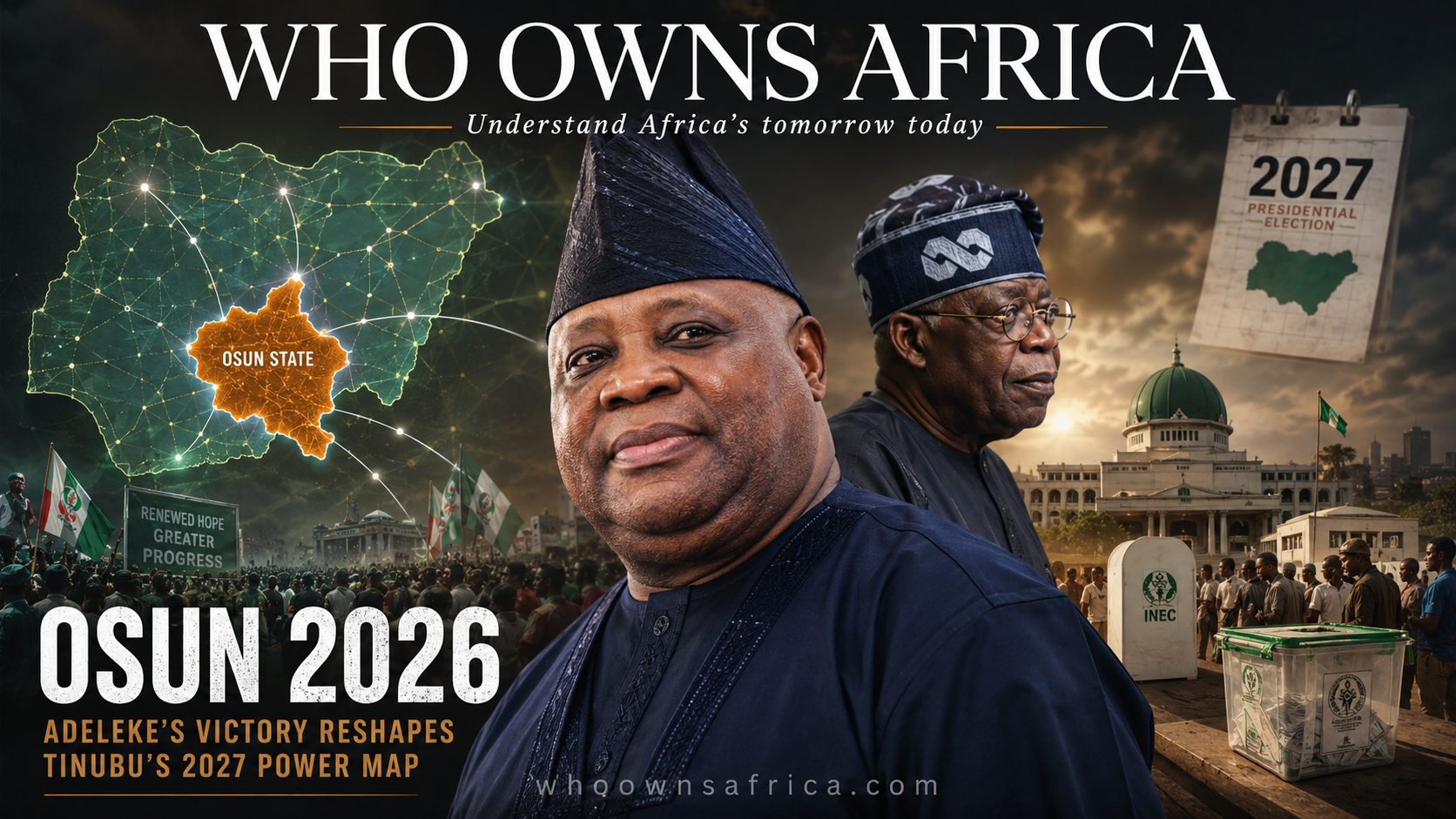
The Osun election 2026 has produced a result that could influence Nigeria’s political calculations well beyond the state. Governor Ademola Adeleke has secured a second term after defeating the candidate of President Bola Tinubu’s All Progressives Congress, but the bigger story is what followed. Adeleke has reaffirmed his support for Tinubu’s re-election in 2027, creating an unusual political alignment in which a governor who defeated the president’s party at state level is backing the president at national level.
The Independent National Electoral Commission declared Adeleke the winner after he secured 511,067 votes against 444,815 for APC candidate Bola Oyebamiji. Adeleke won by 66,252 votes and carried 19 of Osun’s 30 local government areas.
The result gives Adeleke a stronger mandate and reinforces his position as one of the most influential political figures in Osun. For the APC, it is an early warning that federal power does not automatically translate into victory at state level.
For Tinubu, the outcome is more complicated. His party lost the governorship, but he retains the backing of the governor who defeated his candidate. That could become politically valuable as parties begin building alliances for the 2027 presidential election.
Why Osun matters
Osun is only one of Nigeria’s 36 states, so its governorship election cannot be treated as a direct prediction of the 2027 presidential result.
State elections are shaped by local issues, candidate popularity, development records and grassroots networks. Those factors can differ significantly from the issues that dominate a national presidential campaign.
But Osun matters because it sits in the South-West, a region central to Tinubu’s political base.
The result shows that the APC cannot assume automatic support across the region. Adeleke’s victory also demonstrates the strength of a political organisation built around a popular incumbent.
For the opposition, that is an encouraging signal.
For the APC, it is a warning.
Adeleke emerges stronger
Adeleke entered the election as an incumbent seeking a second term. He leaves it with a renewed mandate and greater political leverage.
His first victory in 2022 established him as a major force in Osun politics. His latest win suggests that his support is not simply a product of one election cycle.
He has built a political identity that extends beyond traditional party structures.
That was particularly evident in his decision to contest under the Accord Party rather than rely entirely on the established machinery of the Peoples Democratic Party.
The result shows that Adeleke can mobilise voters around his own political brand.
That could make him increasingly important in the 2027 calculations.
Presidential candidates will need influential regional figures who can help mobilise voters, build alliances and communicate with local political structures.
Adeleke now has a fresh mandate from Osun and a strong platform from which to play that role.
The Adeleke-Tinubu paradox
The most intriguing part of the election came after the result.
Adeleke reaffirmed his support for Tinubu’s re-election in 2027 and described the president as a son of Osun State.
The political symbolism is difficult to ignore.
Adeleke defeated an APC candidate in Osun, yet he is supporting the national leader of the APC.
In a traditional two-party system, that might appear contradictory. Nigerian politics is more fluid.
Politicians can compete at one level while cooperating at another. Governors can oppose a president’s party in state elections while supporting the president in a national contest.
Regional interests and personal relationships can also cut across party lines.
Adeleke’s position offers an early indication of how complicated the 2027 alliances could become.
Why Tinubu could benefit
Tinubu could gain politically from Adeleke’s endorsement even though the APC lost Osun.
Adeleke has demonstrated that he can mobilise a substantial voter base. His supporters cannot simply be transferred to Tinubu, but his political network could help the president reach voters and local leaders outside the APC structure.
The endorsement also allows Tinubu to demonstrate that his political relationships extend beyond the ruling party.
That could be particularly useful in the South-West, where political competition remains strong despite the president’s influence.
Tinubu congratulated Adeleke after the election and urged him to unite Osun and focus on development, stability and economic progress.
The response helped lower the temperature after a closely watched contest.
It also created room for cooperation between the federal government and the re-elected governor.
A warning for the APC
The APC’s defeat should not be treated as a national rejection of the party.
But it should not be ignored either.
The party had hoped to regain control of Osun. Instead, Adeleke secured another term.
The APC must now examine its campaign strategy, candidate selection and grassroots organisation.
Those questions matter because presidential elections are won through local mobilisation.
National popularity can generate momentum, but parties ultimately need strong structures at ward, local-government and polling-station level.
Osun has shown that a popular local candidate can withstand the pressure of a powerful national party.
The APC still has time to respond.
But the lesson is clear.
The South-West battle
The South-West is likely to be one of the most important regions in the 2027 presidential election.
Tinubu’s political career is deeply rooted in the region. His influence in Lagos and across the South-West was central to his rise to the presidency.
But the region is not politically uniform.
Osun has repeatedly produced competitive elections, and Adeleke’s latest victory reinforces that trend.
The APC therefore cannot assume that Tinubu’s regional influence will automatically deliver every South-West state.
At the same time, Adeleke’s endorsement of Tinubu demonstrates the other side of the equation.
Opposition to the APC at state level does not necessarily mean opposition to Tinubu at presidential level.
That distinction could become crucial in 2027.
The opposition’s Adeleke problem
For Nigeria’s opposition, the Osun result is both encouraging and uncomfortable.
The encouraging part is obvious.
The APC can be defeated.
Adeleke’s victory demonstrates that a strong local candidate can overcome the advantages of the ruling party.
But there is a complication.
Adeleke is supporting Tinubu for president.
That means his victory cannot simply be presented as evidence of a national anti-Tinubu movement.
His political priorities are different.
His endorsement also shows that some politicians may separate their state-level alliances from their presidential preferences.
Former Vice President Atiku Abubakar and Peter Obi were among the prominent politicians who congratulated Adeleke after the election.
Their reactions highlight the national interest in the result.
But the opposition still faces a much bigger task.
It must build a coalition capable of competing across Nigeria’s regions.
Atiku, Obi and the coalition challenge
The opposition’s biggest challenge ahead of 2027 remains fragmentation.
Atiku has a substantial national political profile and a long history of presidential contests.
Obi has built a strong political movement, particularly among younger and urban voters.
But bringing different political bases together will be difficult.
A successful coalition would need agreement on leadership, regional representation, policy priorities and the distribution of political power.
The Osun result illustrates why that process will not be straightforward.
A politician can defeat the APC locally while supporting Tinubu nationally.
That means dissatisfaction with the ruling party cannot automatically be converted into support for a single opposition candidate.
Voters remain the key
Political alliances can influence elections, but voters make the final decision.
The issues that shape the 2027 presidential race will be broader than those that dominated the Osun election.
The economy will be central.
So will the cost of living, inflation, jobs, security, fuel prices, taxation and infrastructure.
Tinubu’s administration will need to convince voters that its reforms are improving their daily lives.
An endorsement from Adeleke can strengthen the president’s political network.
It cannot replace voter confidence.
The same applies to the opposition.
Criticism of the government will not be enough. Opposition candidates will need a credible alternative that addresses the concerns of ordinary Nigerians.
Adeleke’s second-term advantage
Adeleke’s re-election gives him time to strengthen his record in Osun.
His performance over the next four years could determine how much influence he commands nationally.
If his government delivers visible improvements in infrastructure, public services and economic opportunities, his political standing could grow.
If expectations are not met, his influence could weaken.
His relationship with Tinubu will also require careful management.
Adeleke needs federal cooperation to deliver development projects.
Tinubu benefits from maintaining relationships with influential governors outside the APC.
There is therefore a practical reason for both sides to keep their relationship intact.
But Adeleke must also preserve the political independence that helped him win.
Nigeria’s politics are becoming more fluid
The Adeleke-Tinubu relationship illustrates a broader feature of Nigerian politics.
Party membership remains important, but it does not always determine political alliances.
Governors have their own constituencies.
Political families have established networks.
Regional leaders have their own priorities.
Business and community interests can also influence political decisions.
As 2027 approaches, these networks are likely to become increasingly important.
The presidential election may therefore be shaped by alliances that do not neatly fit into party boundaries.
That could make the contest harder to predict.
What Osun tells us about 2027
The Osun election offers several early lessons.
First, the APC remains vulnerable in competitive parts of the South-West.
Second, strong local political organisations can overcome the advantages of national parties.
Third, Adeleke has strengthened his position as an independent political force.
Fourth, political alliances can cross party lines.
Finally, opposition politicians cannot assume that state-level victories will automatically translate into presidential support.
None of these factors determines the outcome of the 2027 election.
But they provide an important glimpse into the political terrain.
The battle is only beginning
Nigeria’s 2027 presidential election is still months away.
Much can change before voters return to the polls.
Candidates could change.
Political parties could merge or split.
New alliances could emerge.
Existing relationships could collapse.
Economic conditions could also reshape the national debate.
The Osun election has nevertheless provided an important early signal.
Adeleke has shown that he can defeat the ruling party.
Tinubu has shown that he can maintain relationships beyond the APC.
The opposition has been reminded that an APC defeat does not automatically translate into a Tinubu defeat.
And Nigerian voters have once again demonstrated that political outcomes cannot be reduced to simple party arithmetic.
Who Owns Africa’s power question
For Who Owns Africa, the deeper significance of the Osun election lies in how political power is built in Nigeria.
Power does not sit only with the president or national party leaders.
Governors control state institutions and local political networks. Political families maintain long-standing relationships. Regional leaders influence voter behaviour. Grassroots organisations determine turnout.
Individual politicians can sometimes command support that extends beyond the formal strength of their parties.
Adeleke’s victory shows the power of a strong local political machine.
His endorsement of Tinubu shows how that power can operate across party boundaries.
Tinubu’s response shows why national leaders need relationships with governors outside their political camp.
These dynamics could shape the 2027 presidential election as much as formal party campaigns.
Nigeria’s 2027 power map remains unfinished
Osun has not decided Nigeria’s next presidential election.
But it has complicated the calculations.
Adeleke has emerged from the election with a stronger mandate and greater political leverage. The APC has suffered a setback in an important South-West state. Tinubu has retained the support of an influential governor despite his party’s defeat.
For the opposition, the result is another reminder that building a national coalition will require more than defeating the APC in individual states.
For Tinubu, Adeleke’s endorsement is an opportunity, but not a guarantee of votes.
For Adeleke, his second term gives him a stronger platform from which to influence Nigeria’s wider political conversation.
And for voters, the most important decisions are still ahead.
The alliances visible today may look very different by the time Nigerians vote in 2027.
Adeleke has secured Osun. Tinubu still has his endorsement. The APC has been given a warning, while Nigeria’s opposition has another coalition problem to solve. The battle for the country’s 2027 power map is only beginning.

More from Politics
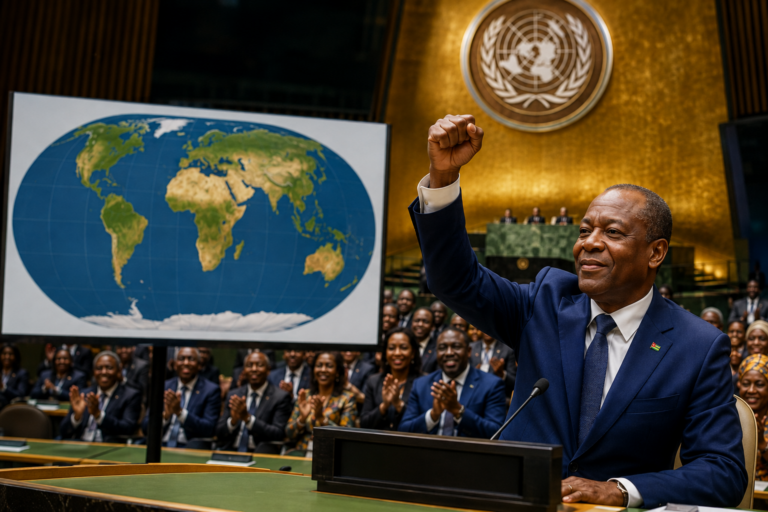
Africa takes on the world map: UN backs a new picture of the continent
A Togo-led campaign to correct distorted world maps gives Africa a symbolic victory over geography, perception and colonial-era narratives.
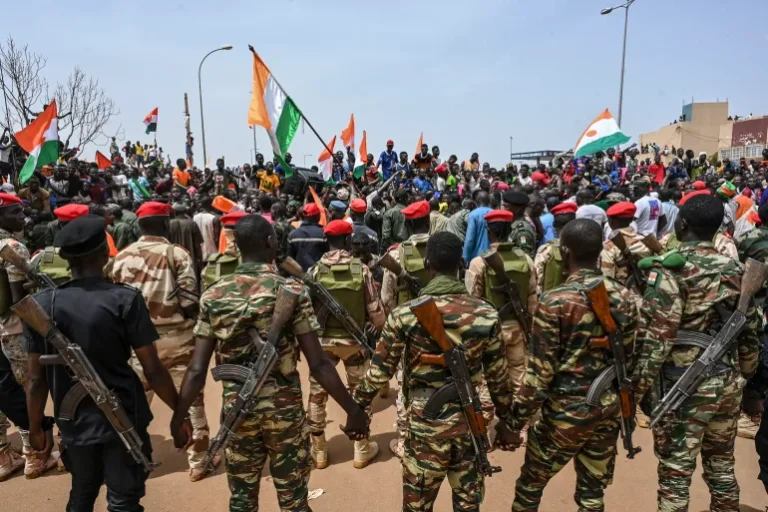
Niger’s attempted mutiny raises questions over who profits from Sahel instability
Failed uprising highlights the intersection of military rule, foreign influence, strategic minerals and regional security in one of Africa's most volatile regions.

Ethiopia’s Tigray crisis is back: Who is fighting for control of the Horn of Africa?
Renewed clashes, drone strikes and collapsing trust threaten Ethiopia’s fragile peace while drawing Eritrea, Sudan and Egypt deeper into regional rivalry.