

Space technology — satellites, ground stations, and the applications they enable — plays an increasingly important and diverse role across African development challenges. From earth observation satellites providing crop monitoring and forest cover assessment, to communications satellites extending internet connectivity to underserved areas, to navigation systems underpinning precision agriculture and logistics, satellite-derived data and services are increasingly woven into the infrastructure of African economic and social life. A growing number of African countries have also moved from being purely users of space technology developed elsewhere to active participants in the space economy, launching domestic satellite programs, establishing space agencies, and developing local technical expertise in space science and engineering.
Earth Observation and Development Applications
Earth observation satellites — spacecraft carrying sensors that image and measure the earth’s surface and atmosphere from orbit — provide data that supports a remarkable range of development applications in African contexts. Agricultural monitoring using multispectral satellite imagery allows assessment of crop health, growing conditions, and predicted yield over large areas at regular intervals, supporting both smallholder advisory services and government food security planning. Forest cover change monitoring provides near-real-time data on deforestation and degradation across tropical and subtropical African forests, supporting both conservation efforts and monitoring of commitments made under carbon market and climate policy frameworks. Flood mapping using synthetic aperture radar imagery that can penetrate cloud cover provides rapid assessment of flood extent after events, supporting emergency response and damage assessment. Coastline change monitoring, urban expansion tracking, and infrastructure inventory assessment are among many other earth observation applications with significant development relevance that are actively used across the continent.
Communications Satellites and Connectivity
Communications satellites have long played a role in extending telecommunications connectivity to African locations where terrestrial infrastructure is absent or insufficient. Geostationary satellites providing broadband internet access have enabled connectivity for remote schools, health facilities, government offices, and businesses in areas without terrestrial broadband options, though high latency inherent in geostationary satellite communications has limited the usefulness of this connectivity for certain applications. The emergence of low-earth orbit satellite broadband constellations offering much lower latency and higher bandwidth than traditional geostationary satellites is creating new connectivity possibilities for African locations currently unreachable by terrestrial networks, though terminal costs and subscription prices remain significant barriers to widespread adoption at the individual household level. Direct-to-cell satellite technology, allowing smartphones to connect directly to satellites for basic communications without any terrestrial network coverage, represents a further connectivity innovation with significant potential relevance for the many African locations still outside mobile network coverage.
African Satellite Programs
A growing number of African countries have developed domestic satellite programs, reflecting both the strategic value of having national space assets for sovereign applications and the ambition to build domestic space science and engineering expertise. Several African countries have launched small earth observation satellites — many built in collaboration with international partners or under technology transfer arrangements — providing domestic remote sensing capabilities for applications including agriculture, natural resource management, and disaster monitoring. These programs vary in technical sophistication from very small cubesat-class satellites to more capable medium-class earth observation spacecraft, and in their primary purpose from primarily educational and capacity-building objectives to operational earth observation requirements. The ability to independently access space is increasingly seen by African governments as a dimension of technological sovereignty and as a foundation for building domestic space industry capability over time.
Space Agencies and Institutional Development
Several African countries have established dedicated space agencies or national space programs, providing institutional homes for domestic space activities, coordinating national satellite programs, engaging with international space organisations, and promoting the application of space data and technology across government and development programs. The African Union has established the African Space Agency as a continental-level institution aimed at coordinating African space activities, promoting data sharing between national programs, and representing African interests in international space governance. These institutions face the challenge of building sustainable capability with limited budgets relative to the scope of their mandates, and international partnerships — including data sharing arrangements with established space agencies, joint mission development, and capacity-building programs — are important supplements to purely domestic investment in building African space sector capability.
Navigation and Positioning
Global navigation satellite systems — including the United States GPS and European Galileo systems — provide the positioning and timing services that underpin a growing range of African economic applications, from precision agriculture technologies that use GPS guidance for planting and spraying to logistics tracking systems monitoring vehicle locations to financial transaction timestamping. The reliance on external navigation satellite infrastructure for these applications creates a dependency on systems operated by foreign entities, which African space policy discussions have addressed partly through support for regional satellite navigation augmentation systems that improve positioning accuracy and reliability for African users and partly through participation in the development of African space infrastructure that could eventually provide navigation services from African-operated systems.
Remote Sensing Data Access and Capacity
The value of earth observation data depends not only on the satellites providing the data but on the ground infrastructure, data processing capabilities, and analytical expertise needed to convert raw satellite imagery into useful information for decision-makers. Significant investment has been made across the continent in earth observation data receiving stations, processing infrastructure, and training programs building the human capacity to analyse and apply satellite data for specific applications. Several regional and continental earth observation data sharing platforms have been developed to improve African researchers’ and government agencies’ access to both commercial and freely available earth observation data archives, and to provide analytical tools that reduce the technical barriers to using this data for practical applications.
Looking Ahead
Africa’s engagement with the space economy is deepening across multiple dimensions simultaneously: as a user of space-derived data and services addressing development challenges; as an operator of an increasing number of national satellite programs; as a partner in international space science and exploration; and gradually, as a contributor to the commercial space industry through ground station services, satellite component manufacturing, and space application service businesses. The trajectory points toward growing African agency in shaping how space technology serves African development needs, and increasing African technical capacity to participate in and contribute to the global space economy rather than simply receiving its outputs.

More from Tech

How Nigeria is building Africa’s next AI talent powerhouse
Nigeria is combining public investment, university programmes and private-sector infrastructure to turn its large technology workforce into an AI-driven economic advantage.
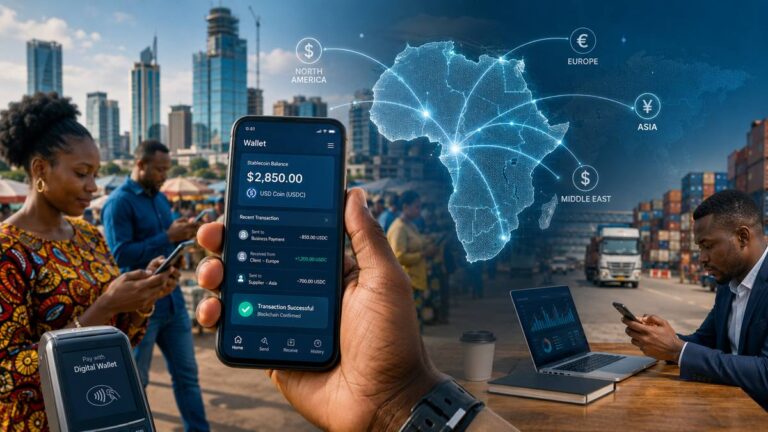
Why Stablecoins could transform Africa’s $1 trillion payments market
Africa’s growing digital economy is creating demand for faster, cheaper cross-border payments, putting stablecoins at the centre of a new financial infrastructure race.
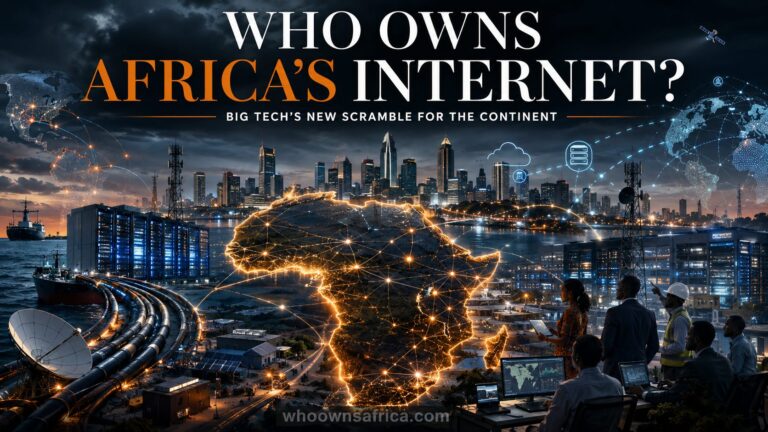
Who owns Africa’s internet? Big tech’s new scramble for the continent
Global tech giants are pouring money into cables, cloud infrastructure and satellites, reshaping who controls Africa's digital future.