
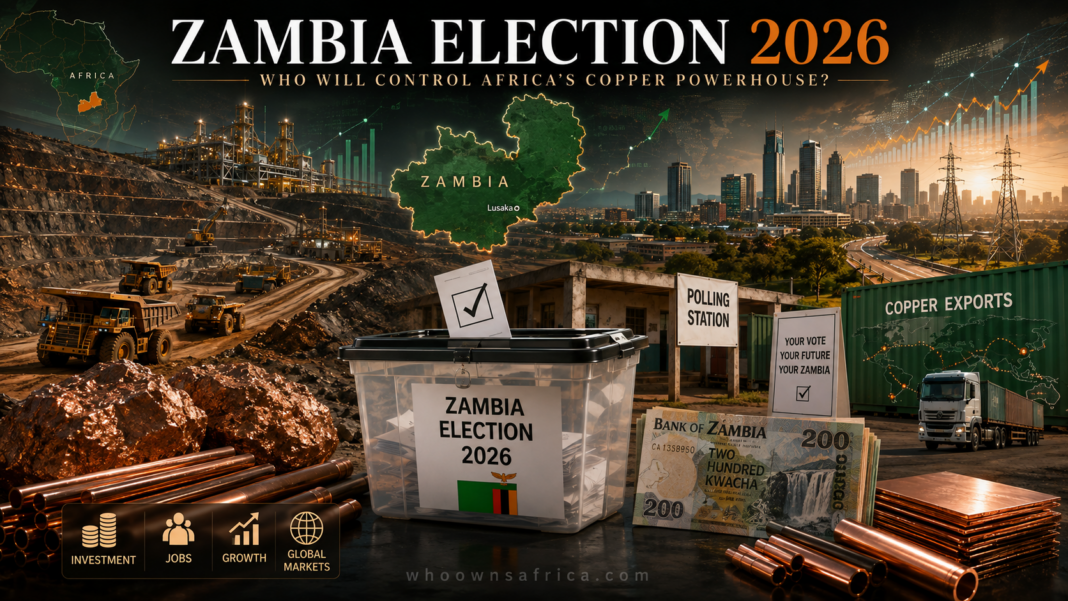

Zambia heads to the polls on August 13 in an election that will test President Hakainde Hichilema’s economic record and determine whether his government can turn a copper revival into broader growth, jobs and investment.
Hichilema is seeking a second term after taking office in 2021, when Zambia was emerging from a sovereign debt crisis and had defaulted on its external obligations. Five years later, the economy is in a stronger position, but the recovery remains unfinished.
For investors, the election is about more than who occupies State House. It is about whether Zambia can maintain fiscal discipline, complete its debt restructuring, secure a new programme with the International Monetary Fund and attract enough investment to expand copper production.
Copper is at the centre of that equation. The metal accounts for about 70% of Zambia’s export earnings and more than 10% of gross domestic product, according to Reuters. The government wants to more than triple annual copper production to 3 million metric tons by 2031.
That ambition has made Zambia one of Africa’s most closely watched mining economies at a time when global demand for copper is rising because of electric vehicles, power networks, renewable energy and other technologies.
Hichilema seeks a second mandate
Hichilema, leader of the United Party for National Development, won the 2021 election after defeating then President Edgar Lungu.
The election transformed Zambia’s political landscape and was widely seen as another example of the country’s history of peaceful transfers of power.
The 2026 contest is expected to be dominated by Hichilema and opposition candidate Brian Mundubile of the Tonse Alliance, although several candidates are contesting the presidency. Reuters has described Hichilema as the favourite for a second term, while noting that the election is effectively a referendum on his economic record.
The government can point to important economic gains since 2021.
Zambia has made progress on restructuring its external debt, while mining investment has increased and copper output has strengthened. The IMF estimated that the economy grew by 5.2% in 2025 and projected growth of 5.8% in 2026 in its January assessment.
But the economic recovery has not eliminated pressure on households.
The opposition has focused on the cost of living and economic hardship, issues that could influence voters even as international investors focus on macroeconomic stability.
That creates a central political challenge for Hichilema. His administration needs to convince voters that economic reforms are improving everyday lives while convincing investors that the reforms will continue.
Copper is the election’s biggest economic issue
Few commodities matter to Zambia as much as copper.
The country is Africa’s second largest copper producer after the Democratic Republic of Congo and has become increasingly important in global efforts to secure supplies of critical minerals.
Copper prices have risen sharply over the past year, creating an opportunity for Zambia to attract capital and expand production. Reuters reported in August that copper prices had risen more than 40% over the previous year to around $14,000 per ton.
Mining companies are therefore watching the election closely.
The industry wants clearer exploration rules, stronger infrastructure, reliable electricity, incentives for investment and greater opportunities for local processing. Mining companies have invested more than $10 billion since the 2021 election, according to Reuters.
The government has set an ambitious target of producing 3 million metric tons of copper annually by 2031.
Achieving that target would significantly change Zambia’s economic position. It could increase export earnings, strengthen the kwacha, generate tax revenues and create new opportunities in manufacturing and mineral processing.
But higher production will require major investment.
Zambia needs additional electricity generation, improved roads and railways, more efficient border systems and expanded processing capacity. Reuters reported that the mining sector estimates Zambia needs about 2,000 megawatts of additional power capacity to support its copper ambitions.
The election will therefore be watched closely by mining companies seeking to determine whether the next government will maintain current policies or introduce new taxes, regulations and local content requirements.
The kwacha is another election barometer
The Zambian kwacha has become an important indicator of investor confidence.
Currency movements can affect the cost of imported fuel, machinery, food and other goods, making the exchange rate an issue for both businesses and households.
Investors are watching whether election uncertainty creates renewed pressure on the kwacha or whether a clear result allows financial markets to focus on Zambia’s improving copper revenues and fiscal position.
Reuters reported in late July that Zambia’s currency was expected to remain under pressure around the election period, highlighting the sensitivity of the foreign exchange market to political uncertainty.
The longer term outlook is closely linked to copper.
Higher copper export revenues can increase the supply of foreign currency and support the kwacha. But that benefit depends on production actually increasing and the government maintaining credible economic policies.
A stronger currency would also help reduce imported inflation, although it could create challenges for some exporters.
For investors, the key question is therefore not simply whether the kwacha strengthens after the election. It is whether the currency can be supported by a sustained improvement in Zambia’s external accounts.
Debt remains a major test
Zambia entered the 2020s under severe debt pressure.
The country became the first African sovereign to default during the coronavirus pandemic, setting off years of negotiations with creditors.
The Hichilema administration has since worked with international creditors to restructure billions of dollars of external debt.
The IMF said in January that Zambia had made significant progress with debt restructuring and fiscal consolidation. However, it also warned that public debt remained at high risk of overall and external debt distress.
That means the next government will have limited room for policy mistakes.
Large increases in public spending could undermine investor confidence if they are not matched by revenues or productive investment.
At the same time, excessive fiscal restraint could frustrate voters who expect better public services, more jobs and higher incomes.
The balance will be particularly important after the election.
Zambia needs investment in electricity, roads, health, education and other infrastructure, but it must avoid returning to the borrowing patterns that contributed to the previous debt crisis.
A new IMF programme is in focus
Another major issue for investors is Zambia’s relationship with the IMF.
The country completed its $1.7 billion IMF programme in January, a facility that played an important role in supporting economic reforms and the debt restructuring process.
Finance Minister Situmbeko Musokotwane said in July that Zambia hoped to agree a new IMF programme by the end of 2026. Discussions were expected to continue after the August 13 election.
A new programme would send an important signal to investors.
It could provide a framework for fiscal policy while reinforcing confidence that Zambia will continue implementing reforms.
But the next programme is likely to be different from the emergency support provided during the debt crisis.
Investors want to see policies that support growth, private investment and job creation rather than simply stabilising public finances.
The government will therefore face pressure to demonstrate that Zambia can move from crisis management towards sustainable economic expansion.
Electricity could determine the copper boom
Zambia’s copper ambitions face one major structural obstacle: power.
The country relies heavily on hydropower, making electricity generation vulnerable to drought.
Recent energy shortages exposed the risks of relying too heavily on hydropower. Power disruptions can force mines to reduce production, raise operating costs and discourage new investment.
For a government promising to triple copper production, expanding reliable electricity supply is therefore essential.
Mining companies are calling for more generation capacity as well as improvements to the transmission network. Reuters reported that the sector estimates around 2,000 megawatts of additional capacity will be needed to support the planned expansion.
That could create opportunities beyond mining.
Solar power, transmission infrastructure, battery storage and regional electricity trading could become important areas of investment.
If Zambia can solve its power constraints, copper could become the anchor for a much wider industrial strategy.
Investors want more than copper
Although copper dominates the investment story, Zambia needs to diversify its economy.
Agriculture remains important to employment and household incomes. Manufacturing could benefit from cheaper and more reliable electricity. Tourism has potential because of Zambia’s wildlife and natural attractions, while logistics could expand because the country sits at the centre of several regional trade routes.
The challenge is turning mineral wealth into broader economic development.
A copper boom that creates export revenues but few jobs outside mining would leave Zambia vulnerable to another commodity downturn.
That is why investors are also watching government policies on local suppliers, processing and industrial development.
Reuters reported that investors are interested in whether foreign mining commitments translate into higher production and whether local content requirements can be implemented without discouraging investment.
The next government will have to manage that balance carefully.
Zambia wants more value from its minerals, but it also needs international capital and technical expertise to expand the industry.
Politics and investor confidence
The election also matters because Zambia has built a reputation for democratic stability in a region where political transitions have sometimes been contested.
Recent analysis has nevertheless raised concerns about the use of state institutions, constitutional changes and the treatment of political opponents. Chatham House has urged Hichilema to preserve Zambia’s democratic reputation and resist using state power to gain an unfair electoral advantage.
For investors, political stability is not simply a question of election day.
It affects the credibility of contracts, mining licences, tax policy and institutions.
A peaceful and credible election would help reinforce Zambia’s reputation as a destination for long term investment.
A disputed result or prolonged political uncertainty could have the opposite effect.
The outcome of the parliamentary elections will also matter. A government with strong legislative support could have greater room to implement economic reforms, while a more fragmented parliament could force broader political negotiations.
What happens after August 13
The most important question for Zambia after the election will be whether the country can convert its copper opportunity into sustainable growth.
Hichilema enters the vote with a stronger economic story than the one he inherited in 2021. Debt restructuring has advanced, mining investment has increased and copper prices are providing favourable conditions.
But the risks remain substantial.
The IMF has warned that Zambia’s debt remains at high risk of distress. Electricity shortages threaten mining expansion. The fiscal position requires discipline. Investors remain sensitive to currency movements and political uncertainty.
For ordinary Zambians, the test will be more immediate.
Economic growth needs to translate into jobs, lower living costs and improved public services.
For investors, the test is whether Zambia can maintain predictable policies and turn its mineral wealth into a stronger and more diversified economy.
For Africa, the stakes are even wider.
Zambia is competing for capital in a global race for copper and other critical minerals. The United States, China, Europe and other major economies are seeking secure supplies for energy, transport and advanced manufacturing.
The country therefore has an opportunity that extends beyond its borders.
If Zambia can expand copper production while strengthening institutions, managing debt and investing in electricity and infrastructure, it could emerge as one of Africa’s most important critical mineral economies.
If it fails to address those constraints, the copper boom could remain another missed opportunity.
The August 13 election will decide who leads Zambia into that next phase. But the harder task begins after the votes are counted.
The winner will inherit a country with valuable mineral resources, rising international interest and a chance to reshape its economic future.
The question is whether Zambia can turn copper power into lasting national wealth.

