
Cameroon, August 2026: Cameroon is betting that its largely untapped mineral wealth can become a bigger source of government revenue than oil, as new iron ore, bauxite, marble and gold projects begin reshaping an economy long dependent on crude exports.
The government says the mining sector, including a revamped gold industry, could eventually generate more than 1 trillion CFA francs ($1.75 billion) a year, potentially overtaking oil revenue.
The claim marks an important moment for Cameroon. For decades, oil has been one of the country’s most important sources of export earnings, foreign exchange and public revenue. But declining crude production, volatile prices and the need to diversify have pushed Yaounde towards minerals buried beneath its forests, savannahs and mountain ranges.
The opportunity is enormous. The challenge is turning geological potential into sustained economic value without repeating some of the problems that have accompanied extractive industries elsewhere in Africa.
A mining sector coming of age
Cameroon is not starting from zero.
Small-scale gold mining has existed for years, particularly in the eastern part of the country. Artisanal miners have extracted gold from riverbeds and shallow deposits, often operating outside formal industrial structures.
What is changing is the scale.
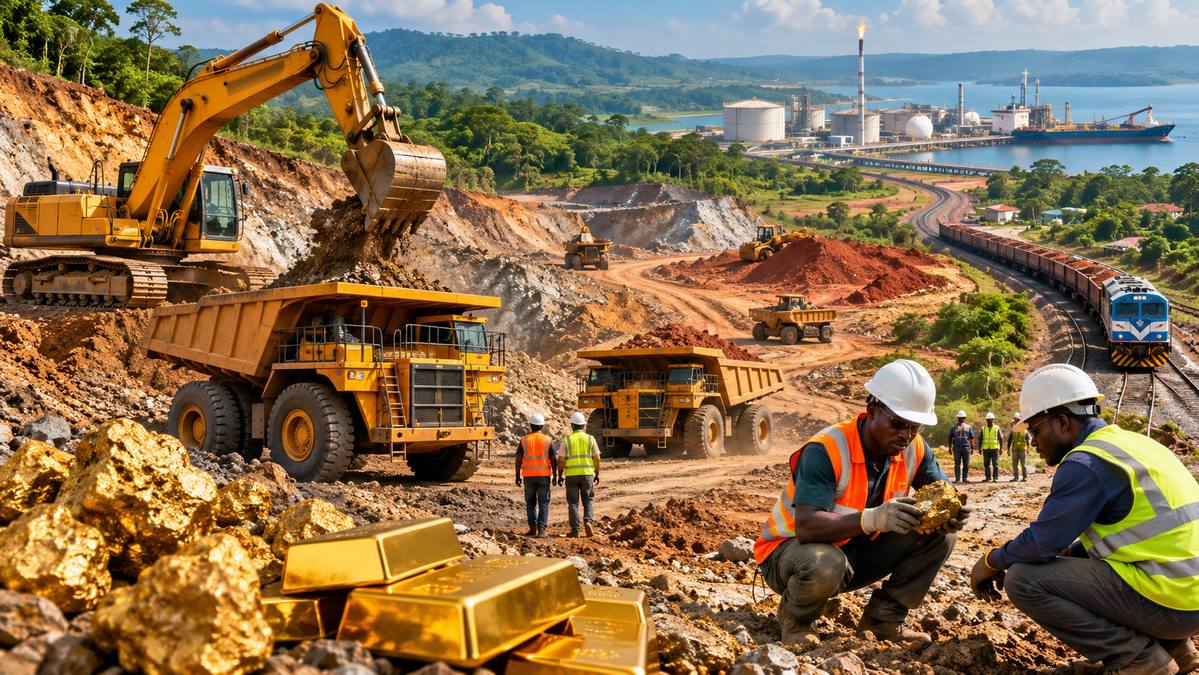
The government says 2025 represented a turning point, with Cameroon effectively entering the ranks of mining-producing countries after the commissioning or launch of five major projects. They include the Bipindi-Grand Zambi and Kribi-Lobé iron ore projects, the Minim-Martap industrial bauxite project, the Bidzar industrial marble project and the Colomine gold project.
That combination is significant because it gives Cameroon something it has lacked: a broader industrial mining base rather than dependence on a single mineral.
Iron ore could provide volume. Bauxite could feed the aluminium industry. Gold offers a high-value export. Marble adds another industrial mineral stream.
And behind those projects lies a much larger pipeline of deposits that officials hope can attract investors.
The gold question
Gold occupies a special place in Cameroon’s mining strategy.
The country has known gold deposits, but the sector has historically been fragmented, with artisanal and small-scale operations accounting for much of the activity.
The government’s reform programme seeks to change that.
Cameroon has introduced implementing regulations under its 2024 Mining Code covering mining rights, precious substances, mining operations and other aspects of the industry. The government says the reforms are designed to improve transparency, strengthen state oversight, increase national participation and combat fraud and environmental damage.
The Colomine gold project is part of this transition.
For the government, formalising gold production is about more than extracting metal. It is also about capturing economic activity that can otherwise disappear into informal markets.
Gold can move easily across borders and can be difficult for governments to trace when production takes place outside formal systems. Better registration, processing, taxation and traceability could therefore make a substantial difference to public revenues.
But the same reforms could also test Cameroon’s ability to balance state control with investor confidence.
Beyond gold
The bigger story is not actually gold.
Cameroon’s mining ambitions extend across a wide range of minerals.
The Minim-Martap bauxite project is particularly important because bauxite is the primary ore used to produce aluminium. Cameroon has some of the world’s significant bauxite resources, but the country has historically extracted only a small share of its potential.
Iron ore is another major opportunity.
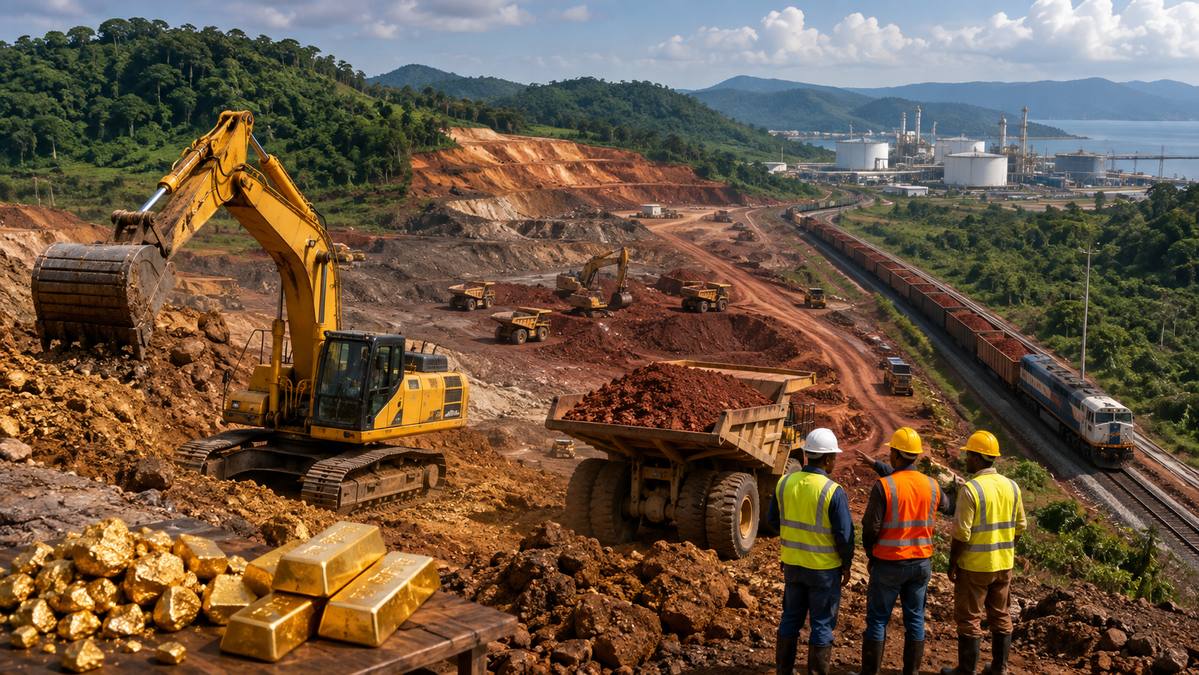
The Bipindi-Grand Zambi and Kribi-Lobé projects could help establish Cameroon as an important regional supplier of iron ore while creating demand for railways, ports, power and other infrastructure.
That matters because mining can have an economic impact far beyond the mine itself.
A large mine requires roads. It needs electricity, water, logistics, engineering services, security, housing and skilled workers. Ports need to handle exports. Financial institutions provide financing and payment services. Local businesses can supply food, equipment and transport.
If those links are developed domestically, mining can become an industrialisation strategy rather than simply an export business.
Can it really beat oil?
The headline figure is striking.
Cameroon’s mines minister said in July that annual revenue from newly launched mining projects and the restructured gold sector could exceed 1 trillion CFA francs in the short term. The government expects that to overtake the traditionally dominant oil sector.
But the comparison needs context.
Oil remains important to Cameroon’s public finances, even though its contribution has declined. IMF data show oil-sector revenue fell from 2.1% of GDP in 2024 to an estimated 1.6% in 2025.
Official economic data also show the value of Cameroon’s crude oil exports fell sharply in 2025, with crude export receipts declining from about 1,002.7 billion CFA francs in 2024 to 705.6 billion CFA francs. The government attributed the decline to lower prices and reduced export volumes.
That makes the mining target more plausible than it might first appear.
The comparison is not necessarily between a booming oil sector and an established mining industry. It is between a mature oil industry facing constraints and a mining industry entering a new investment phase.
Still, 1 trillion CFA francs should be viewed as an ambition rather than a guaranteed outcome.
Mining projects take years to reach full production. They face financing requirements, infrastructure constraints, commodity-price cycles, technical risks and regulatory uncertainty.
The ultimate test will be whether the projects can produce consistently at commercial scale.
The infrastructure race
Cameroon’s geography makes infrastructure one of the biggest tests.
Mining deposits are often located far from ports and major commercial centres. Moving heavy commodities such as iron ore over long distances can make otherwise attractive deposits uneconomic.
That means the success of the mining strategy is closely tied to transport infrastructure.
The Kribi deep-water port offers Cameroon a major logistical advantage. Railways, roads and power infrastructure will also become increasingly important as production expands.
This creates a potentially powerful feedback loop.
Mining investment can justify infrastructure. Better infrastructure can make more mineral deposits commercially viable. New mines can then generate additional demand for infrastructure.
But there is also a risk.
If infrastructure is built primarily to transport unprocessed minerals from mine to port, Cameroon could capture only a fraction of the potential value.
The bigger prize is processing.
The race for local value
Africa’s resource economies have spent decades exporting raw materials while importing finished products made from those same resources.
Cameroon has an opportunity to avoid repeating that pattern.
Bauxite could support aluminium-related industries. Iron ore could create opportunities in steel production if energy and infrastructure conditions allow. Gold could be processed and refined domestically. Industrial minerals could support construction and manufacturing.
The government’s mining reforms include measures intended to increase national participation and strengthen fiscal obligations.
The question is whether those policies will translate into local companies gaining genuine access to contracts, finance, technology and ownership.
That is where the phrase “Who Owns Africa” becomes particularly relevant.
A mine can generate billions of dollars in economic activity while leaving limited wealth behind for communities if ownership, taxation, procurement and processing are concentrated elsewhere.
Cameroon therefore faces a choice between being primarily a mineral exporter and building a broader mining economy.
The ownership question
The government says its new approach will encourage greater Cameroonian ownership of the mining sector, including majority national participation in some areas. It also says stronger environmental requirements, production obligations and traceability measures will form part of the new framework.
Those policies could reshape who benefits from the mining boom.
The state itself has an important role through the Société Nationale des Mines, or SONAMINES. The state mining company has been involved in efforts to recover and advance mineral projects, including the Nkamouna-Lomié cobalt-nickel-manganese project and other sites that had previously been abandoned or withdrawn.
Critical minerals could become increasingly important.
Cobalt, nickel, manganese and other minerals are central to global discussions about batteries, electric vehicles and energy technology.
If Cameroon can develop these resources responsibly, the country could benefit from a structural shift in global demand rather than simply from today’s commodity prices.
But that opportunity also brings competition.
Governments across Africa are seeking a larger share of the value generated by their natural resources. Investors, meanwhile, want predictable rules, secure property rights and commercially viable projects.
Cameroon will need both.
The environmental test
Mining’s economic promise comes with environmental costs that cannot be ignored.
Gold mining can contaminate waterways if poorly regulated. Large-scale iron ore and bauxite operations can disturb land and forests. Roads and other infrastructure can fragment ecosystems.
Cameroon is home to some of Africa’s most important forests and biodiversity.
The government says its mining reforms include stricter environmental safeguards and cleaner technologies.
Implementation will matter more than legislation.
Communities living near mining sites will judge the sector by what happens on the ground: whether water remains safe, whether farmland is protected, whether jobs are created and whether companies restore land after extraction.
A mining boom that damages local livelihoods could ultimately weaken the political support required for further investment.
Africa’s bigger mining shift
Cameroon’s strategy reflects a broader African trend.
Across the continent, governments are trying to capture more value from minerals while attracting investment into deposits that were previously considered too difficult or expensive to develop.
The shift is being accelerated by demand for critical minerals and by renewed interest in Africa’s gold, copper, lithium, iron ore and other resources.
But recent experience elsewhere offers a warning.
In Mali, for example, reforms designed to increase state revenue have been accompanied by tensions with mining companies, while industrial gold production fell sharply between 2023 and 2025.
The lesson for Cameroon is straightforward: a government can demand a larger share of mining wealth, but investors also need confidence that rules will remain predictable.
The strongest mining economies are likely to be those that can negotiate a credible balance between public ownership, private investment and community interests.
A new economic identity
For Cameroon, the mining push represents more than another source of government revenue.
It could change the country’s economic identity.
Oil made Cameroon part of Africa’s petroleum economy. Mining could make it part of the continent’s next resource cycle.
The potential is substantial, but potential is not the same as production.
The government’s 1 trillion CFA franc target will depend on whether mines reach commercial scale, whether infrastructure keeps pace, whether new investors arrive and whether reforms improve transparency without discouraging capital.
It will also depend on what happens to the money once it is generated.
If mining revenues finance roads, electricity, education, healthcare and industrial development, the sector could become a foundation for long-term growth.
If the proceeds largely leave the country, or become concentrated among a small group of investors and politically connected interests, the boom could look very different.
The real prize
The question facing Cameroon is therefore not simply whether mining can beat oil.
It is whether mining can do something oil never fully achieved: build a diversified industrial economy around the resources beneath the country’s soil.
That will be measured not only in tonnes of iron ore, kilograms of gold or billions of CFA francs in revenue.
It will be measured in jobs, local businesses, infrastructure, technology and the ability of Cameroonians to own a meaningful share of the wealth created.
Cameroon has opened the door to a new mining era. The next question is who will walk through it, and who will ultimately own the value that comes out.

More from Economy
Somalia’s $2 billion blue economy: Where will the investment go?
Somalia courts foreign capital for its untapped ports, fisheries and coastline, though security and governance risks still worry global investors.
Botswana’s diamond crisis deepens as country searches for new sources of economic growth
Botswana's diamond-reliant economy is projected to rebound in 2026, yet mounting public debt and weak global demand threaten lasting recovery.
Who really owns Kenya’s housing levy billions?
Billions flow from payslips into Kenya's housing fund each month, yet delivery lags, enforcement is thin, and new debt looms.