

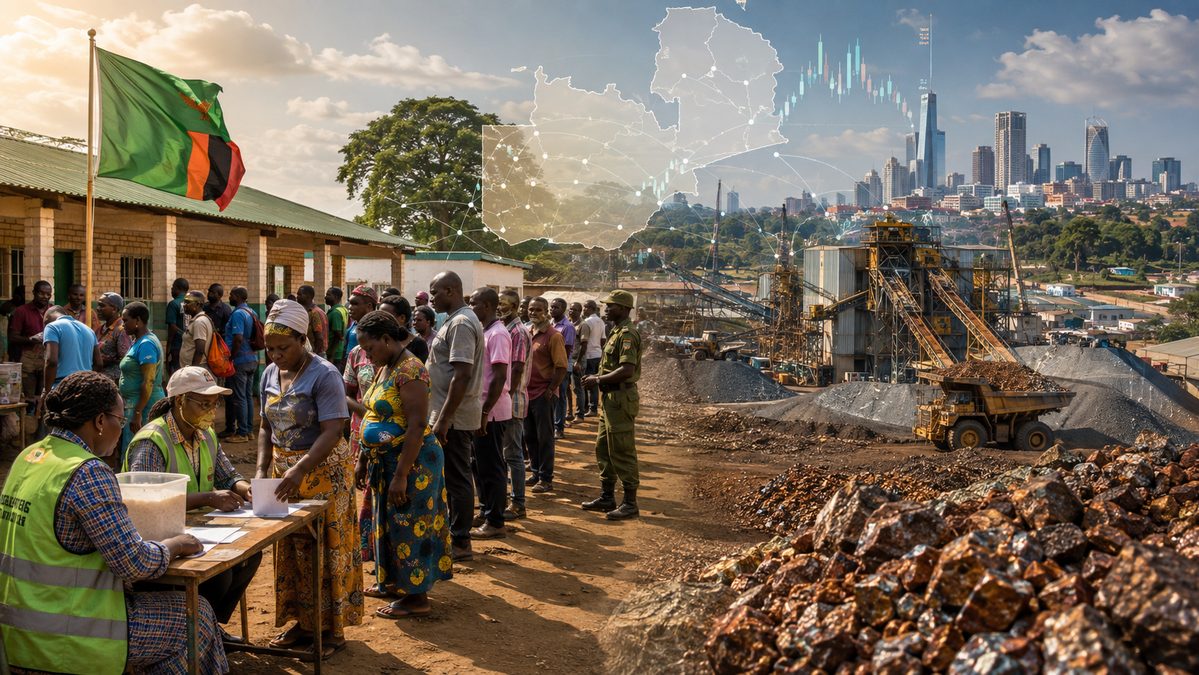
Zambia’s 2026 election has become more than a contest for State House. It is now a test of whether the country can preserve the economic stability built since its 2020 debt default while managing a political environment that has grown increasingly tense.
The vote on Aug. 13 was largely peaceful at first, but violence against election officials and the theft of marked ballot papers forced the Electoral Commission of Zambia to temporarily suspend counting before restarting the process under heightened security. As of Aug. 16, the country was still awaiting the final official result.
For investors, the uncertainty comes at a sensitive moment.
Zambia has spent much of President Hakainde Hichilema’s first term rebuilding its economic credibility, restructuring more than $12 billion of debt and attracting fresh interest into its copper industry. The country is Africa’s second-largest copper producer and sits at the centre of an increasingly important global competition for critical minerals.
The election therefore carries consequences far beyond Lusaka.
Whether Hichilema secures a second term or the opposition gains power, investors will be watching one issue above all: whether Zambia can maintain predictable economic policies while responding to growing public frustration over the cost of living, unemployment and the distribution of mineral wealth.
The election enters uncertain territory
Hichilema, who won the presidency in 2021 after defeating the late Edgar Lungu, entered this year’s election as the perceived frontrunner. His main challenger was opposition leader Brian Mundubile, a first-time presidential candidate who became the leading figure of a fragmented opposition.
The campaign, however, was more politically charged than the previous election.
Opposition parties and civil society groups accused the government of restricting political space and targeting opponents. The government denied allegations of repression. After voting ended, the situation became more complicated when attacks on election officials and the theft of ballot papers prompted the electoral commission to halt counting temporarily.
The commission later said the security threat had been contained and resumed the process. It warned candidates against declaring themselves winners before official results were announced. Mundubile nevertheless claimed his own parallel tally showed that he had won, while Hichilema urged supporters to remain calm and wait for the official outcome.
International observers have since raised concerns about reported intimidation, abductions and violence surrounding the electoral process.
For financial markets, this matters because elections are ultimately about expectations.
Investors do not necessarily need a particular political party to win. They need confidence that contracts will be honoured, capital can move, mines can operate, taxes will remain predictable and institutions will function independently.
Copper remains the big prize
Few commodities are as important to Zambia as copper.
The metal accounts for about 70% of the country’s export earnings and is central to government revenues, foreign exchange and investment. Reuters reported before the election that investors were watching whether Zambia could turn a pipeline of mining investments into meaningful increases in production.
That pipeline includes major international mining companies and projects linked to the expansion of existing operations and the revival of assets previously affected by disputes.
The government has also set an ambitious long-term target of dramatically increasing copper production.
That ambition has attracted interest from both Western and Chinese investors as demand rises for minerals needed for electric vehicles, renewable energy infrastructure, power grids and other technologies.
But copper also presents Zambia with a political dilemma.
A stronger copper sector can bring foreign currency, jobs and tax revenues. Yet higher copper prices and greater mining investment do not automatically translate into higher household incomes.
That disconnect was visible during the election campaign.
Many Zambians continue to face high food and energy costs despite improvements in headline economic indicators. More than 70% of the population lives on less than $3 a day, according to World Bank data cited during the election campaign.
The political question is therefore becoming increasingly important for investors: how much of Zambia’s mineral wealth will remain with mining companies and the government, and how much will reach local communities?
Investors want policy continuity
Hichilema’s economic record has been one of the strongest arguments for continuity.
When he took office in 2021, Zambia was dealing with the consequences of its sovereign debt default. His administration subsequently negotiated a major debt restructuring and worked with international creditors to restore fiscal credibility.
The previous $1.7 billion IMF programme ended in January 2026, leaving investors watching closely for the shape and timing of any new arrangement. Reuters identified a new IMF programme as one of the clearest tests of economic policy continuity after the debt restructuring.
A new programme would matter for more than government financing.
It would signal to international investors that Zambia remains committed to fiscal discipline, debt sustainability and economic reform.
But there is also a difficult balancing act.
The government needs to control spending while investing in infrastructure, electricity, agriculture, education and job creation. It also faces pressure to ensure that economic growth produces visible improvements for ordinary citizens.
The political crisis has made that balance harder.
The cost of living is the weak point
Zambia’s macroeconomic recovery has not eliminated economic hardship.
Inflation has fallen sharply. Reuters reported that annual inflation reached 6.5% in June, its lowest level in more than eight years. Economic growth is also expected to remain positive.
Yet macroeconomic statistics can tell a different story from the household economy.
Food prices, electricity costs and unemployment remain politically sensitive. For younger Zambians in particular, the central question is whether economic growth can produce jobs.
This is also an investor issue.
An economy that grows without creating enough employment can generate political pressure for higher taxes, greater state intervention or tougher requirements on foreign companies.
The government has already signalled that mining companies should increase local procurement. Reuters reported that Zambia’s proposed local-content rules would require miners to raise domestic procurement from about 20% towards 40% over three to four years.
For investors, such measures can create opportunities for Zambian suppliers while also increasing operating costs.
The distinction will be important.
If local-content rules create competitive domestic businesses, they could strengthen Zambia’s industrial base. If implemented unpredictably, they could instead discourage investment.
The China-US factor
Zambia’s copper resources have also given the election a geopolitical dimension.
China has long been a major investor in Zambia’s mining sector, while the United States has increasingly identified African critical minerals as strategically important as Western governments seek to diversify supply chains away from excessive dependence on China.
That competition creates opportunities for Zambia.
Lusaka can potentially use demand from multiple international partners to negotiate better investment terms, develop infrastructure and expand mineral processing.
But it also creates risks.
Investors will want clarity about whether Zambia intends to maintain a balanced foreign investment policy or move closer to one geopolitical bloc.
The most attractive position for Zambia may be one that welcomes capital from both China and Western economies while insisting on transparent contracts and commercially viable projects.
What happens if the opposition wins?
A change in government would not necessarily mean an economic rupture.
Mundubile’s campaign focused heavily on the cost of living, poverty, democratic freedoms and the distribution of economic benefits. The opposition has also criticised Hichilema’s record on political rights and the government’s handling of dissent.
For investors, the immediate question would be whether a new administration would preserve the core elements of the debt restructuring and investment framework.
Any major reversal could unsettle markets.
Mining companies, bondholders and development institutions would want reassurance that existing contracts remain valid and that Zambia will continue meeting its international obligations.
A new administration could also seek to renegotiate aspects of mining policy.
That could be popular domestically, particularly if citizens believe the country is not receiving enough from its mineral resources. But abrupt changes to taxation, royalties or ownership rules could raise the country’s perceived risk premium.
The safest outcome for investors would therefore be political change accompanied by institutional continuity.
What if Hichilema wins?
A second Hichilema term would probably provide greater policy continuity.
Investors would likely welcome continued implementation of debt reforms, mining expansion and efforts to secure a new IMF relationship.
But a second term would also bring greater expectations.
The president would need to demonstrate that economic reforms can move beyond stabilising government finances and start producing more jobs, higher household incomes and broader participation in the copper economy.
The political environment would also require careful management.
The election-related allegations and the temporary suspension of vote counting have already raised concerns about institutional credibility. International investors typically place a premium on countries where electoral disputes can be resolved through trusted institutions rather than political confrontation.
Electricity remains a major risk
Zambia’s copper ambitions depend on something less glamorous than the price of the metal: electricity.
The country relies heavily on hydropower, leaving the electricity system vulnerable to drought. Reuters identified power reliability as one of the structural issues investors are watching alongside copper, fiscal policy and the election.
For mining companies, unreliable power can translate directly into lower production and higher operating costs.
For the wider economy, power shortages can discourage manufacturing and weaken small businesses.
Zambia’s long-term investment story will therefore depend partly on whether it can diversify its energy mix.
Solar, transmission infrastructure and other forms of generation could become increasingly important as mining production expands.
The bigger investor question
The 2026 election has exposed a contradiction at the heart of Zambia’s economic story.
The country has made meaningful progress in restoring macroeconomic stability, yet many citizens do not feel that recovery in their daily lives.
That gap creates political risk.
Investors should therefore look beyond the presidential result.
The more important indicators will be what happens after the election: whether the political temperature falls, whether the opposition accepts the result, whether institutions are trusted, whether parliament provides effective checks and whether the government can maintain reform momentum.
Markets can tolerate political competition.
They struggle more with prolonged uncertainty.
A test of Zambia’s next chapter
Zambia remains one of Africa’s most strategically important mineral economies. Its copper reserves, investment potential and location give it considerable economic leverage at a time when critical minerals are becoming increasingly valuable.
But the country cannot rely on copper alone.
Its next phase of growth will depend on whether mining investment can stimulate local businesses, whether government revenue can be converted into better public services, whether electricity supply can support industrial expansion and whether economic gains can reach a broader share of the population.
The political crisis surrounding the 2026 election has made those questions harder to ignore.
For investors, the immediate priority is therefore not simply identifying the winner.
It is assessing whether Zambia emerges from the election with stronger institutions, credible economic policies and enough political stability to turn its mineral wealth into sustained growth.
If it does, the country could enter a powerful new investment cycle.
If political divisions deepen, the same copper wealth that has attracted global attention could become a source of greater domestic conflict.
For Zambia, the election is about who governs. For investors, the larger question is whether the country’s economic transformation can survive the politics surrounding it.

More from Politics
Libya: Who really owns the state?
Libya’s oil wealth is expanding, but political fragmentation exposes the deeper struggle over institutions, military power and national sovereignty.
Abiy Ahmed begins new term as Ethiopia faces security and regional challenges
Ethiopia’s new political chapter begins with a stronger mandate, but unresolved conflicts and regional rivalries could define Abiy Ahmed’s second term.

Wicknell Chivayo: What his rise reveals about Zimbabwe’s business and political elite
The rise of Wicknell Chivayo reveals how wealth, state contracts, philanthropy and political access are reshaping Zimbabwe’s modern power structure.